Are Ukraine’s deep strikes against Russia helping Kyiv win the war or strengthening the hand of Kremlin hardliners? Since early summer, an escalating barrage by Ukrainian long-range drones and cruise missiles have devastated oil refineries, sunk or damaged more than 220 ships in the Black Sea and burned at least a dozen large warehouses of Russia’s Wildberries online retail chain. The result has been a nationwide fuel crisis and deepening economic pain. For millions of ordinary Russians, the conflict has finally moved off the television screen and into their daily lives.
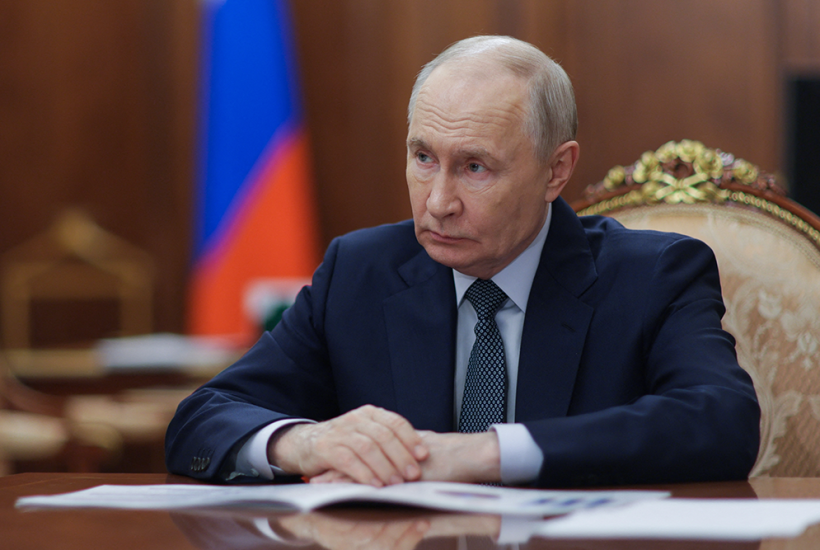
In public, Vladimir Putin has repeatedly stated that he’s not for turning. The purpose of Ukrainian deep strikes is to ‘undermine our confidence in ourselves and our capabilities’, he told state TV last month. Rejecting proposals to suspend long-range strikes, Putin insisted that Russia remained focused on the ‘complete liberation’ of Donbas and the territories of ‘Novorossiya’ – which include Zaporizhzhia and Kherson.
If Kyiv’s military planners hoped that their campaign of strikes would spark protests and boost anti-war feeling inside Russia, it hasn’t happened. Polls indeed show that the number of Russians reporting ‘anxiety’ has risen to a near-four-year high of 57 per cent, according to FOM, the Kremlin’s own polling agency, while the independent Levada Center reports that support for peace negotiations hit a record 67 per cent in February. But when asked what to do if peace cannot be reached, 59 per cent told Levada they favoured a ‘greater use of force’. And overall support for the war remains at over 72 per cent – down only a little from January.
Even if Ukraine has not succeeded in undermining support for the war, it has undercut the credibility of the Kremlin’s ability to protect its people. Self-described patriotic military bloggers have blasted the government for inadequate anti-missile defence and incompetent military leadership. The popular Telegram blogger Alexander Kots warned that Kyiv’s strategy was to make ‘the ordinary person… start looking for someone to blame inside the country’. The million-subscriber Rybar has written that the ‘offensive has stalled, that the command hides losses’, and that officials ‘steal and vacation at resorts while fighters die’.
Yet the real pain point for the Kremlin – and the true strategic target of Ukraine’s deep strikes – is damage to Russia’s economy. ‘These attacks were never about getting Russians to oppose the war,’ argues Sam Greene, professor in Russian politics at King’s College London. ‘They were about getting Russians to oppose an increasingly difficult economy, a problem the Kremlin can’t solve without addressing the war.’
In May Andrei Klepach, chief economist at the Russian state-owned Vnesheconombank, told an audience of elite bankers at Moscow’s Nikitsky Club: ‘We’re losing not only to China and the US but in some ways, we’re losing to Ukraine.’ He further warned: ‘We’re falling behind, losing both the technological and economic competition globally.’ Russia’s Ministry of Finance had to cancel a series of government bond issues over the past month for lack of demand, and Wildberries, which has suffered the destruction of a fifth of its warehouses, is teetering on the edge of bankruptcy.
Russia’s economic pain is real, but so far by no means catastrophic. The Russian National Welfare Fund is much depleted but still holds about $35 billion – with a similar sum in the form of bank shares that can be tapped. In short, says Ben Aris of BNE, a Berlin-based consultancy: ‘Russia can get through to the end of this year one way or the other.’ Ukraine, by contrast, faces a $20 billion hole in its budget even after it accepts a $46 billion EU reparations loan.
The bottom line is that despite Ukraine’s stepped-up attacks, Putin still has sufficient financial and political space to continue and even escalate his war. In the run-up to the parliamentary elections next month there is no sign of a major electoral backlash that the Kremlin’s political technologists can’t handle (the inconveniently liberal party Yabloko has been banned, along with politicians who have called for peace).
Putin’s biggest challenge is not (yet) running out of cash but rather finding men to feed the ongoing meat-grinder in Donbas. Ukraine has claimed a record 41,000 killed and wounded Russians in the past month. Despite offers of a year’s wages as a signing bonus and generous payouts in case of death, plus authorising the mobilisation of convicted rapists and murderers to the army’s ranks, the Russian military still faces a serious manpower shortage. Rumours on Russian social media warn of a post-election mobilisation of military reservists next month.
More civilian deaths could help the Kremlin build a vengeance narrative in the run-up to a mobilisation
Yet mobilisation is a risky step that could tip the balance of popular opinion against the war. The last time the Kremlin tried it, in September 2022, there were localised protests, attacks on military recruitment offices and a wave of emigration.
Paradoxically, Kyiv’s attacks all over Russia could actually help the Kremlin’s narrative that the war is becoming an existential threat to the Motherland. For much of the conflict, Russian state media have downplayed the significance of the war – and indeed all the main state TV news bulletins have almost completely ignored the Wildberries and refinery attacks. Rather, the stories that have been widely reported are strikes on Russian civilians, including a recent drone attack on a bus in the Belgorod region which killed five, and the deaths of seven holidaymakers – including three children – when a Ukrainian drone crashed on a beach in Gelendzhik, a Black Sea resort town. Putin described those attacks as ‘acts of terrorism’. More such civilian deaths could help the Kremlin build a vengeance narrative in the run-up to a possible mobilisation.
The challenge facing Putin is to convince Russians why they need to fight and die to secure more war-ravaged slivers of Ukraine. The idea that Russia is under attack from the ‘collective West’ has been a staple of the Kremlin’s propaganda narrative from the start of the war. In part, it’s worked – a Levada poll showed that 32 per cent of Russians blame the EU for the failure to reach peace, 20 per cent blame Ukraine, 19 per cent the US and only 10 per cent Russia itself. But so far there is no sense in Russia of a society or even an economy fully mobilised for war. However, when more and more ordinary Russians die under Ukrainian bombs, bringing the war home to ordinary people may have the opposite effect to that Kyiv intends. Instead of breaking Russians’ spirit, attacking them in their homes may strengthen the Kremlin’s hand.
Got something to add? Join the discussion and comment below.
You might disagree with half of it, but you’ll enjoy reading all of it. Try your first month for free, then just $2 a week for the remainder of your first year.