If you’re interested in how words work with music, the collected lyrics of Stephen Sondheim are an investment you’ll never regret. But Sondheim isn’t infallible, and when he writes about his mentor Oscar Hammerstein II he’s often plain wrong. Sondheim mocks one particular lyric from The Sound of Music: ‘Like a lark that is learning to pray.’ ‘Wait a minute – a lark praying?’ he snarks. But the character who sings those words is a devout young Austrian woman with a head full of Schubert and folksongs. Hammerstein is writing as Maria, not himself. It’s an art that Sondheim never quite mastered, which is why his characters – whether Swedish aristocrats or East End cannibals – all sound like New Yorkers in therapy.
The audience was one of the most enthusiastic (as well as one of the youngest) that I’ve seen in Leeds
Opera North’s new production of The Sound of Music takes the piece seriously. Clearly, they’re hoping to capitalise on the popularity of the 1965 film: they’d be insane not to, and there’s glitter on the souvenir programme. But the director Nikolai Foster pulls off a neat trick – keeping the movie fans happy while doing something faithful and fresh with the stage musical that’s been buried beneath all that Technicolor. This is Rodgers and Hammerstein’s swansong, after all; a homage to operetta, with a story rooted in bereavement and religious doubt. Its heroine sings of her ‘Favorite Things’ in a bittersweet minor key, and it ends with the death of a civilisation.
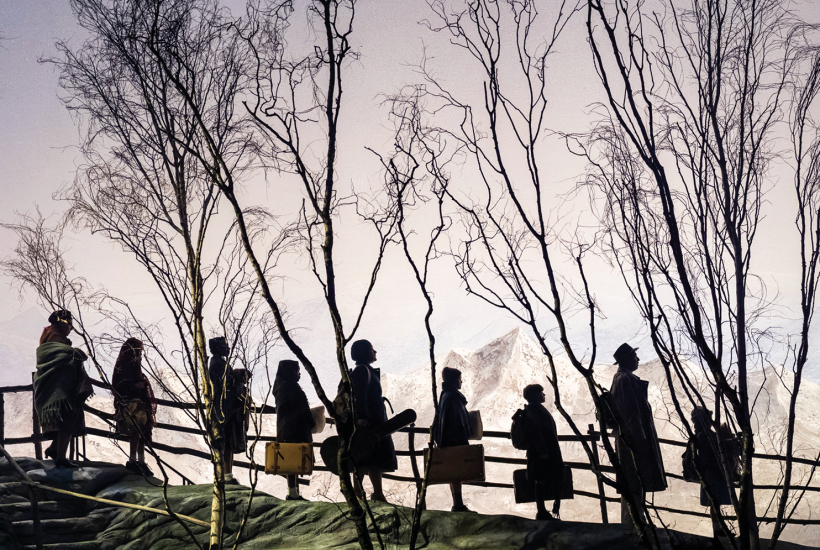
So Foster’s staging (first seen in Leicester last Christmas) takes place beneath a wintry-looking mountain, with bare trees etched against a sunset sky. It’s pure Caspar David Friedrich, especially when gothic arches descend to represent the Abbey. Out goes ‘I Have Confidence’ (which was written for the film, not the original show), though Foster is shrewd enough to keep ‘Something Good’, which shares the same provenance. Back comes a sassy, cynical duet for Max (Nicholas Butterfield) and the Baroness (Amy Freston), roles which have more room to breathe (and accordingly make a great deal more sense) than in the movie. And in comes the Opera North orchestra under Oliver Rundell, revelling in the tunes, but leaning into horn countermelodies and sighing string accompaniments.
Meanwhile the rococo staircase that signifies the von Trapps’ home whirls on and off stage and the children, who have been superbly drilled, manage to make it all look disarmingly spontaneous. They’re forces of nature; Maria (Katie Bird) clearly has her work cut out and one of the most enjoyable aspects of Bird’s performance is that while her singing is as clear as a mountain brook, she can project doubt and even anger. It’s a nice touch to have a Mother Abbess (Katherine Broderick) who doesn’t seem much older than Maria, though I was less certain about Edward Bennett as Captain von Trapp. It’s possible to play this role too stiff, and too straight.
But stripped of sentiment, Bennett’s artless, understated ‘Edelweiss’ regains its catch-in-the-throat potential, and does much to offset the Producers-like vibe of the later scenes (always a risk with choreographed Nazis). Overall this is a Sound of Music with brains as well as heart, and the audience on the first night was one of the most enthusiastic (as well as one of the youngest) that I’ve seen in Leeds. Opera companies across Europe have long since incorporated the great postwar musicals into their repertoire, and it’s good that we’re catching up. Opera North deserves a big success with this show.
Of course, Italian opera has to deal with its own share of preconceptions. La traviata has such a reputation as a weepie – and as a vehicle for the grander kind of soprano – that it comes as a jolt to realise that Marie Duplessis, the woman who inspired Dumas’s La Dame aux Camélias (and through it, Verdi’s opera), was barely 23 when she died. If you’re ever near Montmartre cemetery you should visit her grave. People still leave flowers and there’s a faded portrait of Marie, looking piteously young and frail.
Adrian Kelly’s lyrical conducting felt like a benediction on the whole tragic tale
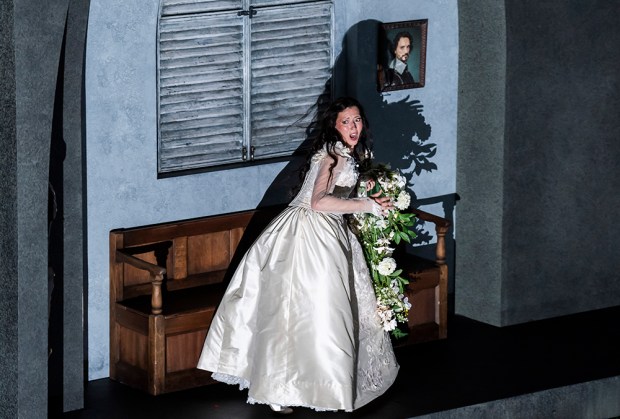
The best compliment I can pay to Alexandra Nowakowski – the Violetta in Buxton International Festival’s new production of La traviata – is that her performance rang true. She looked girlish and she sounded more innocent than experienced. In the best way, that is; her sweet, focused voice was capable of great brilliance but also blended elegantly with her rather bullish Alfredo, Tigran Melkonyan.
Another Traviata stereotype is Germont père as bullying patriarch. But that, too, can play out very differently and André Heyboer sounded so mellow, and sang with such dignity, that you could practically feel the audience aligning behind him. With ingenious period sets by Elliott Squire, and unfussy direction by James Hurley, the result was an atmospheric, intimate-feeling drama. Practically a chamber piece, in fact, and Adrian Kelly’s lyrical conducting felt like a benediction on the whole tragic tale.
Got something to add? Join the discussion and comment below.
You might disagree with half of it, but you’ll enjoy reading all of it. Try your first month for free, then just $2 a week for the remainder of your first year.