With his 2012 book, The A303: Highway to the Sun, the author and psychogeographer Tom Fort pulled on his driving gloves, got behind the wheel and took us on a journey down the royal road to the West Country and to la Grande Bretagne profonde.
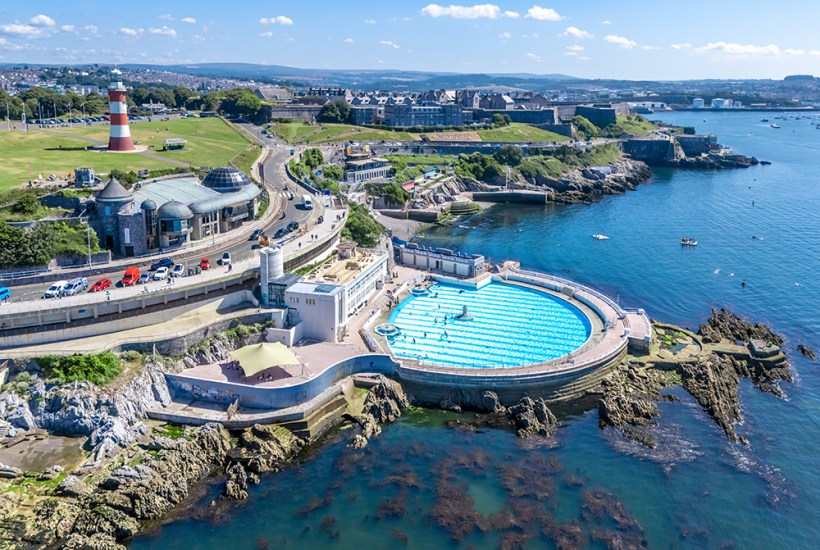
Now, in this highly entertaining, informative new study – observant and lightly nostalgic in a similar way – he guides us round our lidos, the outdoor swimming pools which sprang up all over Britain in the 1920s and 1930s, designed and bankrolled by confident, imaginative local councils in the hardy fresh-air-and-fun enthusiasm of the time.
The lido is not sexy exactly, but it’s sensuous and even thrilling in its unique way
Lidos are far more interesting than boring old indoor pools, which are places for wimps and fainthearts who bottle out at the thought of swimming in the open air on a cloudy British midweek day. At the lido, you make a shivery, pigeon-toed walk from rudimentary changing facilities with your rolled towel under your arm, feeling the gritty municipal concrete under your bare feet and specks of rain on your goosepimply shoulders. You approach the shimmering, arctic-blue vastness of its depths, a colossal rectangle of water which in some cases extends almost to the horizon, with a single brown leaf floating there, or perhaps a line of ducklings (which I have encountered at north London’s Parliament Hill Lido). Then… well either you dive in and risk full-scale cardiac arrest or you timidly descend the wobbly metal ladder and feel the freezing water creep up your calves and thighs. It’s bracingly different from the luxurious blue of a David Hockney swimming pool. The lido is not sexy exactly, but it’s sensuous and even thrilling in its unique, secret way.
Fort takes us on a grand tour from Aberdeen in the frozen north to Brighton in the frozen south – a bit like Burt Lancaster in the film The Swimmer, who, after a drowsy, hungover pool party, capriciously decides to ‘swim’ back home via all the backyard pools in his upscale neighbourhood, and finds himself going back in time.
With wit and scholarship, Fort shows us how lidos, though inspired by quaint notions of what ‘continental’ swimming must be like, have an intensely British design. Art deco flair and single-storey brick structures enclose the pool and its changing areas, with grandstand-type sunbathing areas, the stern rectilinear form varied by cafés, flowing shapes and blue-and-white designs – like an ocean liner or the balcony of a grand hotel. It’s vaguely like the Côte d’Azur (without the exoticism) and also Germany’s Freikörperkultur (without the nudity).
‘Lido’ was a word which appears to have been seized on by the press at the time and instantly accepted, inspired by the Venice Lido, though our outdoor pools couldn’t be further from the languorous, golden beach on which Gustav von Aschenbach yearned for a beautiful Polish boy. And here I rather bridled at what Fort writes about the word’s pronunciation. He says that the prissy Italianate ‘lee-dough’ is for people who aren’t proper lido swimmers. Those who are use the robust, stolid, John-Bull pronunciation ‘lie-dough’. Personally, I still say ‘lee-dough’ and I can take cold water shock as much as anyone, thank you very much.
With lidos all over Britain, it was the same story: a glorious prewar opening, rapturously reported in the local newspapers (and Fort’s book shows us how local newspapers are as valuable as local outdoor pools, and as vulnerable to closure). But then there were falling visitor numbers in the postwar years as people disloyally cottoned on to sunny holidays in Benidorm. The concrete deteriorated and was costly to maintain and councils closed the pools or subcontracted their management to leisure companies, who siphoned off the profits of one to shore up another. Some were paved over; others are eerie empty rectangular pits awaiting reopening. Fort visits these sad ghosts of joyful swims past.
But a few paid their way or were saved by community campaigns, lottery cash or a renewed interest in cold water bathing or 20th-century architecture and are now wonderful temples of swimming. I laughed at Fort’s tongue-in-cheek suggestion that, thanks to climate change, lidos are not even quite as forbidding these days – and the continent is just too unbearably hot. He regrets the health-and-safety panic that banished diving boards and so removed the boisterous, knockabout splashiness of the lido culture – which I remember from childhood visits to Finchley Lido.
There’s another factor behind the lido resurgence which Fort doesn’t mention: social media. Every lido swimmer knows that after you’ve got out of the pool you have a terrible need to show off about your superhuman achievement. So you post a selfie with a humblebrag comment about how you didn’t stay in as long as other people. I’ve done it myself.
My local is what used to be called the Hornsey Lido, in Crouch End (now the Park Road Lido) and I like Fort’s quotation from the News Chronicle reporting at the time of its opening about the blue of the Hornsey sky contrasting with the water ‘as green as the eyes of Aphrodite’. Well, the sky is actually a porridgey grey and the water is blue because that is how every swimming pool in the world is painted. But the spirit of Aphrodite lives on.
Got something to add? Join the discussion and comment below.
You might disagree with half of it, but you’ll enjoy reading all of it. Try your first month for free, then just $2 a week for the remainder of your first year.