Sydney
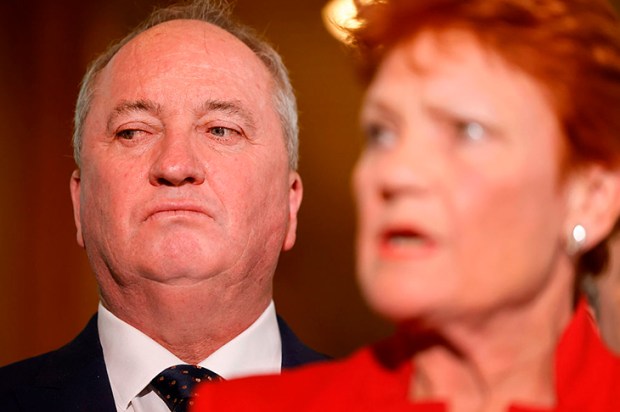
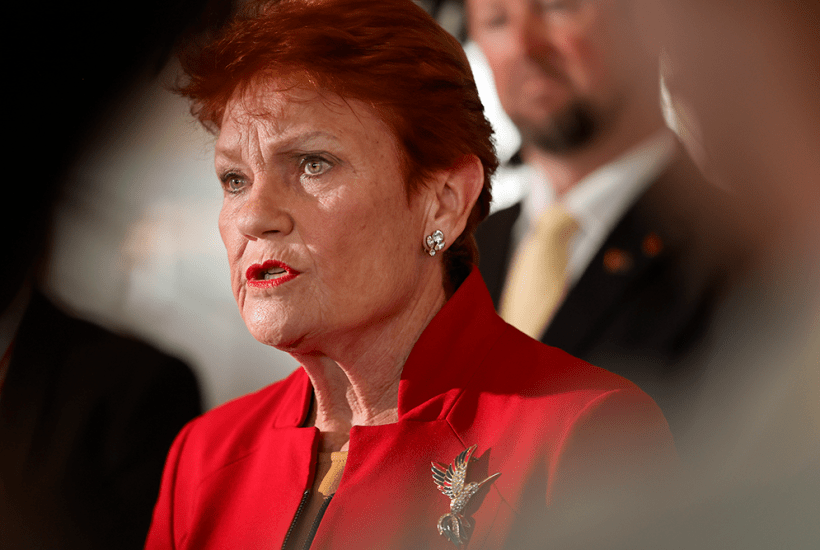
For three decades, Australia’s political Establishment has been predicting Pauline Hanson’s demise. But whenever critics tried to administer the kiss of death to the flame-haired firebrand, it somehow functioned as mouth-to-mouth resuscitation.
Today her One Nation party is polling at levels once thought unimaginable. In recent polls, it even surpasses support for Australia’s centre-left Labor government and centre-right Liberal-National party opposition. Last month, One Nation won its first lower-house seat. Whatever happens next, Hanson has become one of the most consequential figures in modern Australian politics.
To British readers, Hanson is often described as Australia’s answer to Nigel Farage. The reverse is closer to the truth. Hanson emerged in 1996, two decades before Brexit, long before Donald Trump’s rise, before Reform UK and before the resurgence of nationalist and populist parties across Europe. Australia encountered populism before populism became fashionable.
The Establishment mocked her as a former fish-and-chip shop owner who wandered into parliament by mistake
Hanson’s maiden parliamentary speech that year, in which she said that Australia was in danger of being ‘swamped by Asians’, triggered outrage among metropolitan sophisticates and offended an entire region. The Australian left responded with its customary restraint and moderation by comparing her to Hitler. She even served time in prison on electoral fraud charges that were ultimately overturned on appeal.
To much of educated Australia, Hanson appeared less like a politician than an embarrassing historical artefact. The assumption was Hanson would eventually vanish. I should confess that I was among those who believed she had reached her peak years ago. So were many others. Hanson has spent much of her career proving us wrong.
Why? The answer is not that Australians suddenly became racists or extremists. Nor is it that Hanson was always right. Rather, many of the issues she raised never disappeared. Concerns about mass immigration, housing affordability, national identity, energy security and affordability, and the widening gap between political elites and the general public remained potent long after commentators declared them settled.
For years, much of Australia’s media and political class treated these questions as beyond respectable debate. It was not so much their opinion and her opinion; it was their opinion – and she’s stark raving mad. Hanson wanted to reopen questions that the Establishment considered closed. That helps explain her extraordinary longevity.
The Establishment has often mocked Hanson as a simpleton, a former fish-and-chip shop owner who had somehow wandered into parliament by mistake. Yet her supporters see a profoundly patriotic politician who speaks plainly, appears authentic, and seems less interested in impressing elites than representing voters who feel ignored by them.
In an age of growing distrust toward institutions, authenticity has become a formidable political asset. Hanson and One Nation have benefited from a simple perception shared by many supporters: whatever her faults, Hanson says what she thinks. This also helps explain why repeated attempts to destroy her politically often backfired. Critics attacked Hanson herself rather than addressing the concerns which were driving voters towards her. The more she was denounced as beyond the pale, the more some Australians concluded she must be touching subjects others preferred not to discuss.
Recent events have reinforced that lesson. The landslide defeat of the Voice referendum in 2023 – the proposal that a selective group of Indigenous Australians should be granted a special place in the national parliament – revealed a substantial gap between elite opinion and public opinion. The result demonstrated that Establishment consensus is not always the same thing as popular consensus. The same institutions that expected a comfortable victory for the Voice have repeatedly underestimated the depth of support for Hanson and the causes she represents.
The same dynamic is evident in the immigration debate. Over the course of a generation, large parts of urban and outer-suburban Australia have been transformed by rapid population growth. Many residents worried about housing shortages, congested roads, overstretched hospitals and crowded schools felt their concerns were either ignored or dismissed as prejudice. But they were genuine anxieties, and many voters continue to believe that neither major party is prepared to address them.
The coalition behind One Nation therefore includes not only traditional conservatives who think the Liberal party has lost its way under a succession of wet and weak leaders, but also working-class voters who believe Labor has become preoccupied with identity politics. In that respect, Hanson supporters resemble many of those drawn to Farage, Donald Trump and Marine Le Pen. They are willing to disrupt conventional politics not because they know precisely what comes next, but because they have lost faith in what already exists.
None of this means One Nation is destined for government. Under Australia’s preferential voting system, Hanson may never become prime minister. But that may be beside the point. Farage was not even an MP when Britain left the European Union. Political influence is not measured solely by office. Some politicians govern; others make the weather. Hanson belongs firmly in the second category. The more important question is whether Australian politics continues moving onto terrain that Hanson helped define. On immigration, energy policy, cultural identity and distrust of political elites, that process already appears well under way, especially at a time of stagnant living conditions and a productivity drought.
The real surprise is not that Pauline Hanson survived, but how many of the issues she raised now dominate politics across the democratic world.
Got something to add? Join the discussion and comment below.
You might disagree with half of it, but you’ll enjoy reading all of it. Try your first month for free, then just $2 a week for the remainder of your first year.