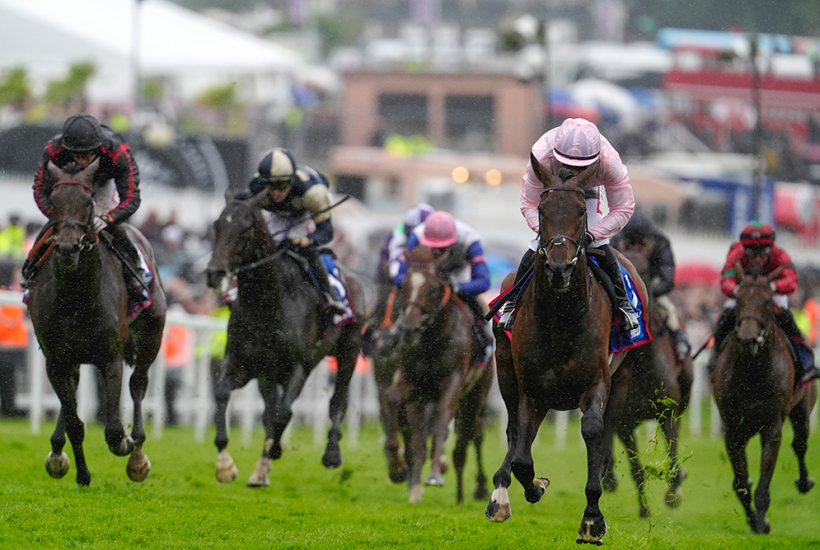
In 1949, the 18th Earl of Derby revived the tradition of the Derby Club dinner in London, three days before the race. His guests of honour were the Prince of Wales and Winston Churchill. No one can remember which of them spoke, so they can’t have been very interesting. Encouraged by this, I foolishly accepted the invitation from the 19th Earl to address the dinner last week.
I say foolishly because the Derby Club has a reputation for being a rough crowd. Its members even pelted the great Martin Bayfield with bread rolls when he cracked a few rugby jokes in 2008.
One tie-less guest, who for some reason had come in his slippers, was drinking beer from a bottle
I’m delighted to say that times have changed. Women now attend and, oh boy, what a calming influence they’ve had on that blue-blooded bear pit. I asked my mate Fritz where all the aristocratic old farts had gone to. He replied: ‘We are the old farts these days.’
Some, however, would say that standards have slipped. One tie-less guest, who for some reason had come in his slippers, was drinking beer from a bottle. And one of the most coveted tables in the centre of the Sheraton Grand ballroom was served red wine from a screw top.
Given that the guests were a knowledgeable audience, I decided to try them with some pretty heavy equine stuff.
There was an infamous Italian breeder called Federico Tesio who dreamed up the Law of Changeable Maximums. This law stipulated that only three consecutive generations of stallions could win the Derby, because even with selective breeding, the third generation represents the limit of progress. It also explains why the world’s greatest geniuses reach an intellectual level which their sons never progress beyond. (When I’d finished the speech and sat back down next to the Earl, another guest at our table pointed out that after 19 generations of selective breeding, maybe our host was at odds with Tesio’s law? Hmm.)
The madding crowd remained hushed and tethered long enough for me to mention the eminent zoologist Desmond Morris, who died recently at 98. Morris concurred with Tesio and advocated that if the modern-day thoroughbred was to progress then a few elite Arabian mares should be reintroduced into the gene pool. He pointed out that 81 per cent of the genetic make-up of all thoroughbreds is based on just 31 original horses. To begin with there was room for genetic improvement, and the first 100 years of racing showed almost annual increases in speed. But then improvement stalled. Morris concluded that ‘if the genetic explanation is correct, then it is time for the sacred stud book to be opened once more and for the Middle Eastern influence to be added into our thoroughbred bloodstock’.
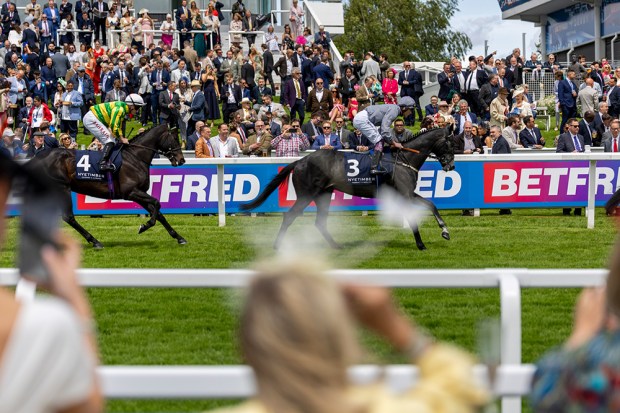
At midnight, Fritz and I scuttled off to the Cavalry and Guards Club for a nightcap. But I was fresh and full of running for Oaks Day, the curtain raiser to the Derby. A knowledgeable group of readers joined us for the inaugural Spectator Epsom picnic. We had a great spot in Lord Derby’s car park, next to the Jockey Club, whose members eyed our picnic enviously. John Gosden dropped by and talked us through the vagaries of the track before Legacy Link, the beautifully bred daughter of Frankel’s sister by Dubawi, which he trains, ran a blinder in the second fillies classic of the season. Another year and she would have won.
I love Oaks Day because it’s the lull before the storm. But I may have been too relaxed in my sartorial standards. As I walked up the hill to admire the open-topped buses on Tattenham Corner, I was approached by a ticket tout. ‘Excuse me, mate, are you a bookmaker?’
I do confess, however, that I was unable to attend the actual Derby this year. It may be the most fascinating race in the world, but nothing, literally nothing, beats spending a couple of hours with the legendary Australian trainer Gai Waterhouse and her fascinating husband Robbie.
Gai has won the Melbourne Cup, 145 Group One races and seven Sydney trainers’ championships. She is the equivalent of Coco Chanel, Lady Diana and Zendaya all rolled into one. Robbie, however, is one of the shrewdest observers of horse racing in the world. It’s no surprise that his father was both a barrister and a bookmaker. No one supersedes them when it comes to identifying talent in the UK that can take advantage of the superior prize money in Australia. Fiorente, for example, was purchased from Sir Michael Stoute and was then trained Down Under by Gai to win the Melbourne Cup.
We made an assignation to go to the Pitts River museum in Oxford to look at shrunken heads. It turned out to be a bit of a damp squib. The heads have been removed from the display cabinets in case they offend someone. The trip was saved, however, by the uncensored presence of a silvered glass bottle that is said to contain a witch. Opening it, apparently, would unleash ‘a peck o’ trouble’. We weren’t tempted.
Got something to add? Join the discussion and comment below.
You might disagree with half of it, but you’ll enjoy reading all of it. Try your first month for free, then just $2 a week for the remainder of your first year.