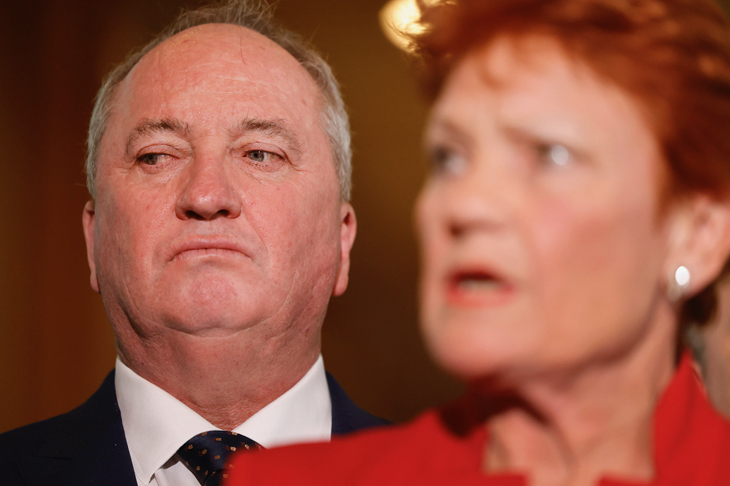
When Barnaby Joyce decided to join One Nation, one assumes that it was not because of its housing policy. How else can you explain the fact that six months after joining the party, he apparently did not know what the policy was?
Joyce told Andrew Bolt on Sky News Australia last week that if One Nation formed government, permanent residents who were not citizens would be forced to sell their homes to Australians within two years.
There are more than 1.2 million permanent residents in Australia who are not citizens. They include British migrants who settled here before 1984, when Australians and Britons were all British subjects, and who remain entitled to vote.
After wrapping up the interview, Joyce phoned a friend and then asked Bolt to re-record his answer. He explained that the policy was still ‘formative’ – others might call it making it up as you go along – and that permanent residents would not, in fact, be forced to sell their homes.
Senator Sean Bell has even fewer excuses for not knowing the policy. He worked in Senator Pauline Hanson’s office for nine years before his appointment to the Senate last year. When asked on 2GB the day after Joyce’s interview, what would happen to non-residents who failed to sell their properties within two years, he couldn’t answer, lamely repeating that One Nation would not apologise for putting Australians first. Eventually, host Mark Levy put Bell out of his misery, telling him to call back when he had some clarity.
Senator Hanson subsequently confirmed that temporary visa holders and foreign citizens residing overseas would be given two years to dispose of their Australian residential property.
The obvious question is whether any of this would make any difference to housing affordability.
The answer is no.
According to Australian Taxation Office estimates, foreigners own only about 40,000 residential properties out of Australia’s 10.9 million dwellings — approximately 0.37 per cent of the housing stock.
Moreover, foreign citizens and temporary residents are already largely prohibited from purchasing established dwellings. They are generally restricted to buying new dwellings, off-the-plan developments, vacant land for construction, or properties intended for redevelopment. One Nation would simply prohibit these purchases as well.
Yet even if every foreign-owned dwelling were sold tomorrow, it would make almost no difference to Australia’s housing shortage. The problem is not who owns homes. The problem is that there are too few of them.
More disturbing than the confusion surrounding the policy is the apparent willingness of a former deputy prime minister to contemplate retrospective interference with property rights.
Conservatives have traditionally recognised that secure property rights are a cornerstone of a free society. Once governments begin compelling people to dispose of assets they lawfully acquired under the rules of the day, ownership becomes conditional upon political approval. That should be anathema to any self-respecting conservative or a classical liberal.
Predictably, while One Nation is proposing to remove some foreigners from the housing market, the Albanese government has been giving a helpful handout to others to enter it.
The government has acted as guarantor for approximately 51,000 permanent residents who are not Australian citizens under its 5 per cent deposit home ownership scheme.
As the opposition has pointed out, this raises an obvious question: why should Australian taxpayers underwrite housing loans for non-Australian citizens? Especially when the scheme exposes taxpayers to losses if borrowers default. The government’s contingent liability runs into the billions of dollars, although actual losses would depend on future house prices and default rates.
Even more alarmingly, the Albanese government is simultaneously pursuing policies that its own federal president, Wayne Swan, boasts are already cooling the housing market. Last week, Swan welcomed the fact that Labor’s proposed changes to negative gearing and the capital gains tax discount were already depressing housing markets even before the legislation had passed the Parliament. According to Swan, ‘that’s a good thing’ because the housing market had been ‘bloated by investors’.
This creates a startling contradiction. The Commonwealth is guaranteeing highly leveraged mortgages while simultaneously pursuing policies designed to punish investors and reduce house prices. Auction clearance rates in Sydney and Melbourne have fallen sharply as have dwelling values in both cities. Purchasers who recently entered the market with only 5 per cent deposits, helped by the Albanese government, may soon find themselves with negative equity if prices continue to fall.
Yet the larger problem with these policies is that both Labor and One Nation are fighting the wrong battle. The One Nation policy implicitly blames foreigners. Labor’s policy implicitly blames ‘boomers’. Both approaches to housing stem from a mindset of scarcity. Neither targets the obvious solution: increasing supply.
Governments at every level have spent decades making housing more expensive through planning restrictions, zoning rules, infrastructure bottlenecks, development levies, land-release constraints and bureaucratic delays. Developers routinely identify these factors as among the most significant contributors to high housing costs.
Australia is one of the largest and least densely populated countries on earth. A confident nation would be asking how to build more homes. An anxious nation argues querulously about who should be excluded from buying them.
The truth is that Labor has created the housing affordability crisis by bringing in too many migrants too quickly and is now scapegoating boomers and simultaneously destroying the incentives not just to invest in housing but to invest in anything.
One Nation seems prepared to cut migration arbitrarily rather than ensure it is calibrated to the country’s economic needs.
Opposition leader Angus Taylor has been criticised for not putting a fixed cap on migration when the reality is that One Nation’s fixed cap does not begin to address the complexities of the migration program.
The irony is that Labor accuses the Coalition of aping One Nation’s policies, while One Nation accuses the Coalition of being indistinguishable from Labor, part of a so-called ‘uniparty’. In reality, while Labor and One Nation differ sharply on culture, immigration and national identity, they share a faith in government intervention.
The difference is that Labor’s interventionism is globalist and redistributive, whereas One Nation’s is nationalist and protectionist. The Coalition, under Angus Taylor, seeks to revive a more classical liberal tradition in which governments govern, regulators regulate, and markets allocate capital. Each represents a strand in our history, but only one offers a path away from the politics of scarcity and towards the politics of abundance.
Got something to add? Join the discussion and comment below.
You might disagree with half of it, but you’ll enjoy reading all of it. Try your first month for free, then just $2 a week for the remainder of your first year.