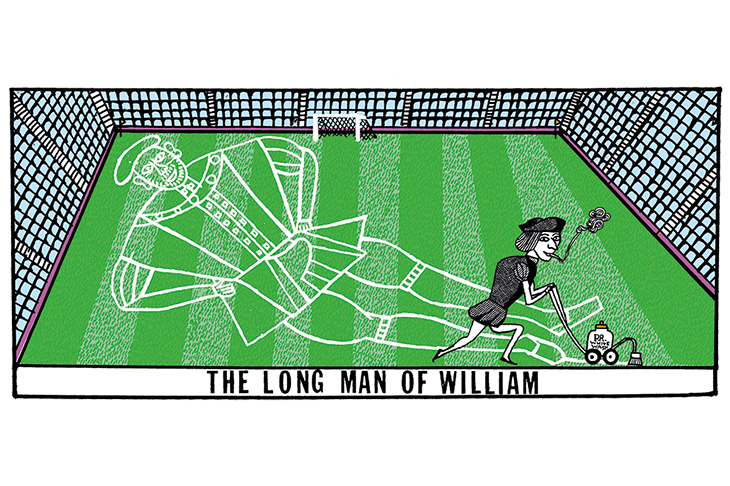
When Aston Villa won the Europa League recently, the focus was less on the football than on the Prince of Wales bawling ‘Sweet Caroline’. And while images of Wills bouncing in his box and cheering his favourite team wouldn’t seem to connect to a Tudor court painter, they probably wouldn’t exist without him.
This year marks 500 years since Hans Holbein came to London and invented royal image-making at a stroke. The German-born artist’s vision of Henry VIII – legs apart, shoulders wide and with a codpiece the size of a prizewinning marrow – was an instant hit and remains the most famous image of our most famous king. More than that, it set a trend.
Ever since, image-making has been as much a tool of the royal trade as throne, crown and sceptre. Henry’s portrait was partly necessity: his were restive times, due largely to the way he ran things. Holbein’s terrifying image, copied in vast numbers and hung in every town hall, would have certainly helped show who was in charge.
Holbein’s Henry VIII was an instant hit and remains the most famous image of our most famous king
Five hundred years later, William is also facing difficulties, due largely to his uncle Andrew. He too is using imagery to gain the upper hand. As he limbers up to succeed his father, he is keen to appear a man of the people. Someone who shares in their joys and sorrows. A husband and dad who knows about sticky hands on car seats as much as about homelessness, illness and poor refereeing decisions.
The Windsors have always been good at this. The dynasty that – trading under that name – started with George V is the only one to rival the Tudors as brilliant visual manipulators. As a direct result, they are the only British royal dynasty who comes close to Henry VIII and co in popularity, or are catnip on a similar level to broadcasters, filmmakers, historians and authors.
As an author who has written novels about both the Windsors and the Tudors, I’m interested in these dynamics. My new book, The Queen’s Painter, is about Hans Holbein and revolves around his famously over-flattering painting of Anne of Cleves. It’s one of art’s most enduring mysteries; why did he make her look prettier when it caused such trouble?
In my novel, the explanation is that it is to bring down Thomas Cromwell, who had promoted the Cleves match but also, years before, sent Holbein’s friend and patron Anne Boleyn to the scaffold. Having studied the evidence, this seemed to me a distinct possibility. And anyway, it worked. Cromwell went to the block in 1540 as a direct result of the portrait, which encouraged Henry into a marriage he hated once he’d actually clapped eyes on the bride.
Therefore, as royal images go, indeed as any images go, that of the fourth Mrs Henry Tudor is one of the most consequential ever painted. It changed the history of England, even if the painting is no longer here. Anne is in the Louvre, where she recently received a superb restoration. The other week, when I visited, she was starring in a Snapchat animation. How Holbein would have loved that.
But it’s just as it should be for the artist who, in inventing royal image-making, also invented the Tudors. Their continuing presence among us has less to do with Bosworth Field than the boy from Augsburg who brought them so vividly to life. Jane Seymour, Anne of Cleves, Thomases Cromwell and More, and a host of others, are captured in portraits whose visual power is equalled only by the drama of their subjects’ actual existences. Without these pictures, blazing with colour, glittering with jewels and so realistic you feel they might wink or order your head off, we’d care far less about our history’s bloodiest family than we do.
And now, 500 years later, in order to keep us caring about them, the Windsors are taking a leaf from Holbein’s book (perhaps the one they actually own, in the Royal Collection). And not just with Wills at the football. The right photo of Kate and the children is still worth a thousand words, especially if it can help distract from the bad words being written about Mr Mountbatten-Windsor.
Image-making is not an easy trick to pull off, even so. Gallery walls show many instances of history’s less adept practitioners. While Elizabeth I followed her father’s example and commissioned many magnificent paintings of herself – the Ditchley Portrait, the Armada Portrait and the Hardwick Portrait to name but three – not all her successors were quite as accomplished.
James I always looks weird in portraits, and as a result that’s how we think of him. His son Charles I theoretically struck lucky with Anthony van Dyck, but the magnificent, delusional images seem to predict the coming disaster. By picking the likes of Allan Ramsay, the Hanoverians played a blinder. But they then went wrong by commissioning portraits so vast you needed a ladder to view their faces. If you can’t see the whites of your king’s eyes, how can you care about him? As Holbein knew, paintings must be on a human scale.
Queen Victoria also knew this. As with most other things, she steered the business of royal image-making firmly back into line. She had Franz Xaver Winterhalter paint her in white satin, surrounded by Prince Albert, sideburns flowing, and their flock of beautiful, adoring children. This hugely successful and popular initiative, combining glamour with family unity, solved a pressing royal problem. The monarch no longer led armies into battles or was the literal earthly representative of God. The family was all that was left, so Victoria made a virtue of it.
Her descendants picked up the beat. George V might not have looked it, but he was a gifted spin doctor who steered the Windsors through some choppy waters, including being German during the first world war and having unpopular Russian relatives to boot. A quick change of name and a lot of photographs were the answer. He was helped by the rise of the mass-market press and the lucky fact that three of his sons with the thunderous-looking Queen Mary were un-expectedly film-star handsome.
In the age of social media, what is seen and what is believed is not as easily controlled as before
One daughter-in-law, the Duchess of York, watched and learned. Few moments of her photogenic daughters’ childhood went unrecorded as Marcus Adams or Studio Lisa produced winsome images of the little Princesses Elizabeth and Margaret. When things got sticky following the Abdication, Cecil Beaton saved the day again with syrupy shots of the new Queen posing with white umbrellas. Interestingly, the aforementioned Winterhalter was the inspiration; Beaton was shown the paintings by George VI and told to do something similar.
The war was another opportunity, with shots of Princess Elizabeth in the ATS, and Eleanor Roosevelt before Buckingham Palace’s empty food cupboards in a bid to get America to help (it worked). Holbein, Henry VIII and Elizabeth I would all have been wildly impressed.
Elizabeth II kept up the good work, remarking she had ‘to be seen to be believed’. What she really meant, in less deferential times, was that she had to be seen to survive. Thus no monarch was ever more seen, from the televised coronation kicking off the reign to the billions of photographs over seven decades on the throne. There were portraits by Warhol and even a Holbeiny one by Pietro Annigoni. Of all these images, it’s hard to think of a damaging one, although it was thought that Lucian Freud did her no favours.
But whither royal image-making now that the Windsors battle headwinds from all directions? In the age of social media and Meghan Markle, of varying recollections and Andrew Mountbatten-Windsor, what is seen and what is believed is not as easily controlled as before. It might take a bit more than football. Possibly even Hans Holbein would be stumped. That said, a shot of a royal marrying an NHS nurse can’t hurt.
Got something to add? Join the discussion and comment below.
You might disagree with half of it, but you’ll enjoy reading all of it. Try your first month for free, then just $2 a week for the remainder of your first year.