Visitors have a licence to offend, and some visitors offend more than others, and it was reasonable to assume that UK comedian Jimmy Carr would fall into the second category. But the least offensive part of Carr’s latest Sydney sell-out show was his Acknowledgement of Country, in which, after the usual respectful but uncomfortable silence had fallen, he identified the former owners of the land we were gathered on as ‘the Queen’. Everyone cheered, relief rolled round the Darling Harbour auditorium like a Mexican wave, and I sat back in my seat and braced my sides for splitting. But I needn’t have bothered. The rest of Mr Carr’s repertoire rarely strayed outside paedophilia, domestic violence and anal sex, and I’m not sure I laughed out loud once. Even his occasional departures from depravity – like the observation that the word ‘trampoline’ could be the name of a cleaning product for homeless people – smacked of cruelty, and after a while I stopped looking at the stage and started looking instead at the people around me. It is certainly a shame that Carr, an Oxford graduate known for his quick wit and informed opinion, dumbs down his material to this extent when he tours. But it is even more depressing that his Australian audiences can’t get enough of such sick schtick. The lazier and more disgusting the jokes, the louder people laughed, and sitting in that sea of demented kookaburras I was reminded that I am of the expat Pom generation who arrived here when Australians still laughed at the likes of John Clarke and Kath and Kim, and were still exporting comedians like Barry Humphries and Paul Hogan.
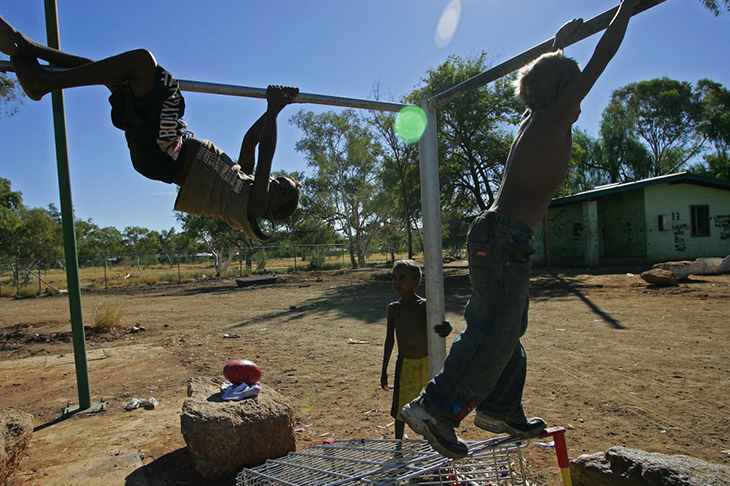
I like to think Carr might not have relied quite so heavily on paedophilic humour if he’d begun his tour a week later, after the Kumanjayi ‘Little Baby’ story had broken. Even Australian commentators who reserved judgement about the raping and butchering of hundreds of Israeli women and children three years ago were quick to condemn the sexual assault and murder of a five-year-old aboriginal girl. My own horror was compounded by a nagging fear that I might be partly responsible. A fear which only increased the following week, when Federal Court Justice Richard Schonell ruled that a little NT aboriginal boy who’d been removed from a dangerous home environment by social services last year should be sent back to it. Notwithstanding the boy’s claims to have been sexually assaulted by a man there, Judge Schonell is of the opinion that the trauma the child would suffer being taken from the white woman who has since provided him with a secure and loving home in WA, and to whom he has formed a strong attachment, ‘must be measured against what I am satisfied would be the long-term effect of his disconnection from his country, community and kin’. These words reminded me very much of a brief I was given a few years ago by the Aboriginal Child, Family and Community Care State Secretariat of NSW. The ads I subsequently created for them featured an indigenous toddler with a sad expression and a three-part headline: ‘Keeping her safe is a priority. Helping her family is a solution. Adopting her out of her community is a life sentence.’
At the time I congratulated myself on having, as I thought, framed a prickly and potentially divisive issue in an engaging, inclusive way. And when the NSW parliament voted the following year to change NSW adoption laws, making it harder to separate aboriginal children from their communities, I let myself believe that after decades of persuading Australians to buy things they didn’t need, I had finally used my creative skills to do some unalloyed good. Now I’m not so sure. Now I can’t help wondering if I hadn’t simply helped to perpetuate a status quo in which the goals of well-intentioned but ill-informed ideologues are given priority over what are, to ordinary Australians, glaringly obvious human rights.
Got something to add? Join the discussion and comment below.
You might disagree with half of it, but you’ll enjoy reading all of it. Try your first month for free, then just $2 a week for the remainder of your first year.