A friend who spent much of his life as an archaeologist in Israel once told me that there were three levels of authenticity when it came to Christian pilgrimage sites in the holy land. There were those that were almost certainly inaccurate but soaked in prayer. Those that may or may not be the real thing, of which there are many. Finally, those that according to most of the experts were the real thing. ‘No serious doubt,’ he said with a smile, ‘it happened here.’ It’s not altogether different when it comes to Christian history or the places and events that shaped the early church, including Easter. So, what do we know?
For the overall picture from those who lived during or very close to the time of Jesus, there’s the great Jewish general and commentator Josephus, the Roman historian Tacitus, and the governor Pliny. But for Easter itself, the politics, people, and events are complicated. The Gospels assume a certain regional and social familiarity from readers, but 2,000 years later that simply isn’t there. It was once fashionable to argue that the four accounts of the life of Christ were unreliable and composed late. Seldom now. They’re early, the first written perhaps less than 30 years after the original Easter, based on first-hand accounts, and would have been read by people who were present during Holy Week.
Transubstantiation, consubstantiation, real presence, sublime symbol
First, the variety of Herods. The original, Herod the Great, ruled Israel for more than 30 years but died in 4 B.C. It was his son, Herod Antipas, who governed at least part of the area – it was divided after Herod the Great’s death – during the time of Jesus’ ministry and what we now know as Easter. His nephew, Herod Agrippa, had the apostle James killed and also imprisoned Peter. None of these Jewish rulers enjoyed absolute power, however. Antipas had the Romans on his doorstep, and was also obliged to listen to the religious authorities around him. Because this is, in spite of what some hysterical yet influential online commentators claim, an essentially Jewish story. It simply makes no sense otherwise.
The Gospel of John, read frequently during Easter, speaks of ‘the Jews’ more than 60 times and for centuries provoked sometimes deadly anti-Semitism. But the author of the Gospel of John, likely John himself, was Jewish. He’s using a shorthand to describe the Jews who didn’t accept Jesus from the Jews who did.
Most of those around Jesus at Easter were Galileans, from a region where both Greeks and Jews lived, as did bandits, sometimes led by Jewish aristocrats deprived of their power by the Romans. The local accent – and to an extent the manners and dress – would have made them stand out in Judea, where the paschal story takes place. Jesus’s ministry had lasted for three years; there had been many miracles and revolutionary teaching, but the quintessence of the story is telescoped into a few days.
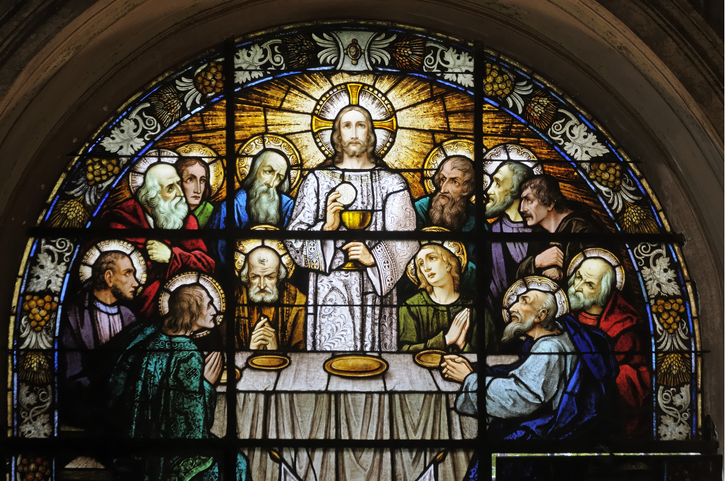
Where the Last Supper took place isn’t known for sure. Today, the official location of the Cenacle (Latin ‘coenaculum’ for ‘dining’ or ‘upper room’) is above what is known as the Tomb of David on Mount Zion. It’s not David, and the room above it is 12th-century, but the geography could be correct. Three of the Gospels present the meal as a Passover Seder but it’s not exactly what a 1st-century seder would have looked like. Bread, wine, and do this ‘in remembrance of me’. Transubstantiation, consubstantiation, real presence, sublime symbol. Christendom is divided but for me it’s the epicentre of worship.
Just a few hours later, Jesus is arrested and put on trial. Jerusalem’s Antonia Fortress, where much of the Roman garrison was housed during major Jewish festivals, may well have been the place. Local politics were delicate and Pontius Pilate was acutely aware of the volatile nature of an occupied people. Wherever they were, the Romans preferred, out of practicality and not morality, to tolerate local religious customs. Jesus is a Galilean, the Romans have no direct rule over Galilee, so Herod can take care of this one. Jesus is questioned by Herod, who wants to see miracles but receives only silence. He’s humiliated and sent back to Pilate, a man who Philo of Alexandria condemned as ‘inflexible, stubborn, and cruel’.
It’s early in the morning and Pilate really would prefer that this all went away. He may have been indifferent to internal theological arguments but rabbinical leaders worked tirelessly to achieve a balance between Jewish freedom and imperial might. They knew that rebellion would mean slaughter, and indeed just a few years later, the Jewish revolt would lead to exile, destruction and up to a million deaths. Jesus said he was the Messiah. He was a man of peace but his claim to be anointed by God would surely by misinterpreted. Better one man dies than countless perish. The punishment for treason was the Etruscan-invented crucifixion, a hideous punishment for slaves but not Roman citizens. Seneca wrote, ‘You must never mention crucifixion in polite company.’
Still reluctant to become overly involved, Pilate offers the crowd a choice. It is, after all, Passover. Will it be Jesus, or a popular rebel leader who had killed Romans and wanted to kill more? Jerusalem had so recently welcomed Jesus with palms and cheers but now roared for Barabbas. No surprise, and Pilate should have known. The followers of Barabbas were violent, numerous, and intimidating, and could easily have pushed their way to the front. Jesus’ friends were not always heroic – witness Peter’s repeated denial, probably described by the man himself.
More degradation and torture. And execution. This was a time when death was ever-present. People knew intimately what is looked like. Then the resurrection, witnessed by many who would give their lives because of what they saw. There are martyrs for countless causes, some of them pernicious, but the cause is absolute belief. These people believed because they saw. Mass hallucination, naivete, stupidity? If you like. He is risen. He is risen indeed.