Governments of all persuasions love a free trade agreement. They are something to announce. They are written on many pages. They have very large numbers attached to their supposed economic benefits. They demonstrate that the rules-based international order is not completely dead.
Australia has a slew of free trade agreements (FTAs) – with the US, China, Japan, New Zealand, the UK, India, Korea and some Asean countries. Officials from the Department of Foreign Affairs and Trade are very proud of these agreements.
But here’s the thing: they are not free trade agreements; some of the time they are not worth the paper on which they are written; and they are the antithesis of a multilateral rules-based order.
Let me explain that last point. Regional trade agreements are always frowned upon by trade economists. It is binding, multi-country agreements or nothing.
Based on the principle of ‘most favoured nation’ – the best terms in agreements apply across the board to all signatories – the various versions of the General Agreement on Tariffs and Trade held sway for many years. But the strength of these global arrangements really began to falter at the beginning of this century.
In response, many countries embarked on one-on-one agreements with other countries, with the clauses confined to the two signatories. Australia was no different in this regard. These agreements are essentially voluntary, with little scope to appeal to international arbitration authorities, for instance.
When he was prime minister, Tony Abbott, was able to conclude a number of these so-called free trade agreements. He was particularly proud of the agreement with China.
But rather than set out tariff-free and quota-free trade in goods and services between the two countries, these agreements typically establish revised quotas, slightly lower restrictions on investment and some lower tariffs.
They are also inclined to wander into areas that should not be covered by trade agreements, including labour and environmental standards as well as concessions on the movement of people between the countries. This sort of mission creep is one of the most damning criticisms of FTAs.
Take the China-Australia FTA. The ink was hardly dry when the leadership of the Chinese Communist party got their knickers in a knot about Australia calling for an inquiry into the origins of Covid. In response, a massive tariff was imposed on Australian wine and trade barriers were established for Australian beef, barley, lobsters and some other agricultural products. Australian coal was also targeted. So much for the FTA.
None of these actions was consistent with the clauses of the agreement, but there was also nothing that Australian authorities could really do. Then trade minister, Simon Birmingham, tried to make an official compliant to the World Trade Organisation, but the Chinese government was never going to take notice of any findings. In the end, China lifted most of the restrictions/tariffs after a while.
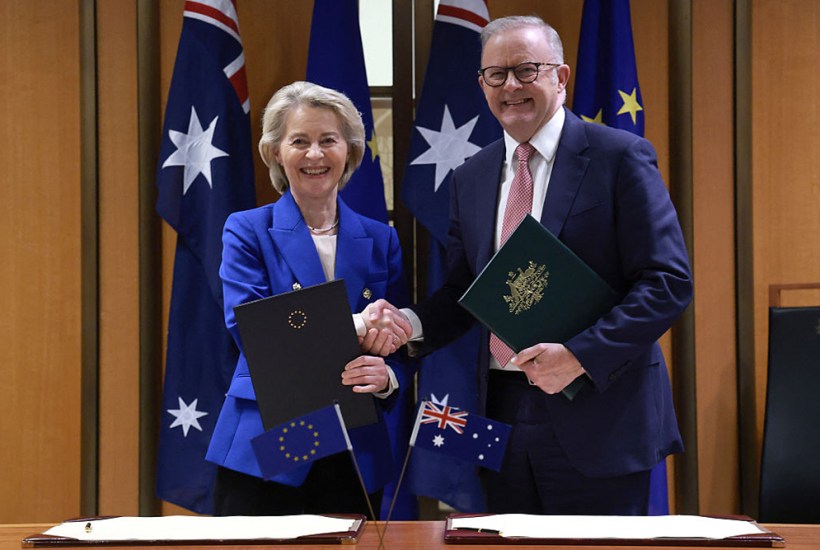
But to confirm the proposition that too many FTAs are never enough, the Albanese government is now crowing about the final finalisation of an agreement between Australia and the European Union. This agreement has been literally years in the making, held up mainly because of the intransigent position of pampered and entitled EU farmers. There were also some bitter, ongoing disputes about the use of terms such as ‘prosecco’, ‘feta’ and a few others.
But our man on the case, Senator Don Farrell, the current Trade Minister, is a scrapper from way back, albeit in the industrial relations sphere. He understands give and take, folding and holding. The fact that the President of the EU, Ursula von der Leyen, was prepared to travel to Australia to celebrate the finalisation of the FTA added impetus to the negotiations.
In the end, it was a dud deal for Australia, especially for beef and sheep meat producers as well as dairy farmers. Some of the quotas are so derisory that they could be met by a single producer. It is particularly telling that the New Zealanders achieved bigger meat quotas in their FTA with the EU.
The fact that several of our meat quotas had been significantly cut back so the EU could accommodate the demands of the Trump administration a while back was simply forgotten. All that celebratory discussion about quotas increasing eight times overlooks the fact that eight times a small number is still a small number.
Sure, we get to continue to use the term ‘prosecco’ – for the time being – but ‘feta’ is out. The fact that prosecco has been produced in Victoria for many decades may have counted for something, but you can never be sure.
Of course, Albo didn’t want to hear negative remarks from the naysayers – the National Farmers’ Federation described the FTA as the worst ever – and simply declared that the FTA was worth $10 billion a year. (This is quite a small figure given annual GDP is around 2 trillion dollars.) The fact that Ursula had quoted $8 billion was unfortunate, but what the heck – it seems like a big number.
Like many FTAs, this one broadened the coverage by including a chapter on decarbonisation and environmental standards. Indeed, Ursula was particularly excited about the fact that the EU and Australia are on the same page about the importance of decarbonisation.
The suspicion is that the FTA is a backdoor attempt to lock in the Australian government’s dastardly climate targets and policies for decades, although B1 – the Climate Change and Energy Minister, Chris Bowen – wasn’t prepared to admit this.
It’s just a pity that the DFAT blurb reads as follows: ‘Australia and the EU are likeminded partners, with high standards on environment and climate. The Australia-European Union FTA includes a range of legally binding commitments to ensure our trade and investment policies reflect these high standards. For the first time in a free trade agreement, Australia (and the EU) has made a binding commitment to implement obligations under the Paris Agreement on climate change.’ Oops.
From the point of view of retail politics, the FTA is a clear nothing-burger. With households, businesses and farmers grappling with the rising price of fuel as well as the possibility of shortages, any political advantage to the Albanese government disappeared on the day after Ursula addressed the parliament.
The chance that international trade flows will once again be governed by a global rules-based system is now Buckley’s and none. Each country is out for themselves, it’s a game of cat and mouse and cheating is widespread. The World Trade Organisation based in Geneva is completely ineffective, although it does provide some very desirable, cushy jobs for its bureaucrats.
So, when you hear the term Free Trade Agreement, have a chuckle and recall that there’s nothing free about these hefty documents gathering dust in an important room in DFAT.
Got something to add? Join the discussion and comment below.
You might disagree with half of it, but you’ll enjoy reading all of it. Try your first month for free, then just $2 a week for the remainder of your first year.