There has been so much news of late that stories which might once have caused a splash have sailed by all but unnoticed. One in particular seems worthy of bringing into a greater light, not least because it has been almost entirely ignored by the English-language media.
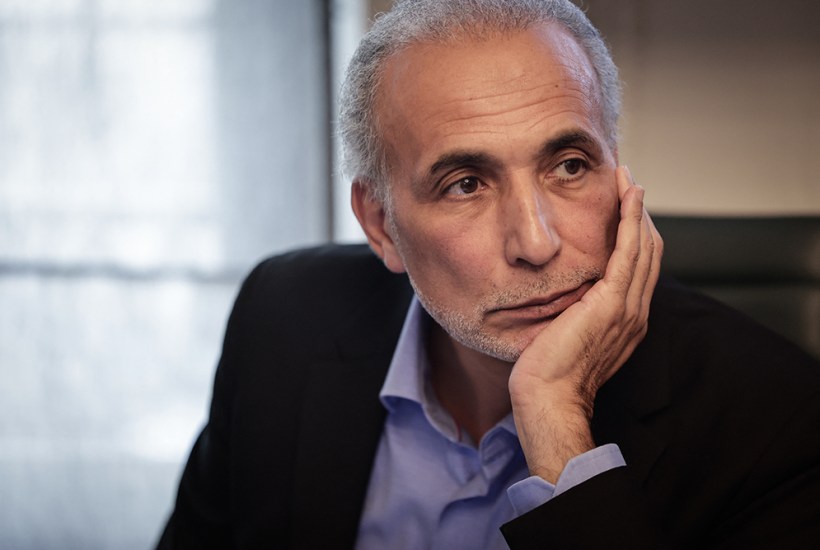
Tariq Ramadan is the grandson of the founder of the Muslim Brotherhood. In recent years he was probably the most famous Muslim intellectual in the West. Last month, a court in Paris found him guilty of the rape of three women and sentenced him to 18 years in prison.
To Islamic audiences he preached one message, to western audiences he told another
The case is the culmination of several trials since allegations were first made against him in 2017. Clearly expecting a guilty verdict, despite denying the charges, Ramadan broke a court order and skipped France. The 63-year-old is currently hiding out in Switzerland, claiming he was unable to attend his Paris trial because he is suffering from anxiety and depression linked to an alleged flare-up of multiple sclerosis. The court found him fit to attend. But now he has been sentenced, Ramadan will presumably continue to try to evade French justice and stay in Switzerland.
The trial was held behind closed doors due to potential witness intimidation. Ramadan and his defenders will doubtless continue to insist that he is the victim of persecution by an ‘Islamophobic’ justice system. But the most extraordinary thing about Ramadan is not his fall but his rise.
For a time in the 2000s and early 2010s, he was regularly referred to as one of the most important voices on the planet – certainly one of the most important Islamic voices. In many ways, this was a mystery.
Ramadan’s scholarly credentials were questionable and principally came from his being awarded a PhD by the University of Geneva. On multiple occasions he misrepresented the subject of his thesis – the political thought of his Islamist grandfather, Hassan al-Banna. It was initially rejected but seems to have been crowbarred through the academic system despite much opposition, not least because Ramadan was accused of having whitewashed much of his grandfather’s fascistic thought.
Ramadan’s French-Swiss accent and suave-ish demeanour impressed some people. But had he not come from Islamist royalty he would most likely have remained unknown. Fortunately for him he was born who he was and when he was – specifically coming of age at a time when the West had a deep need of ‘public moderate Muslim figures’ and a small supply of them.
This was how I first encountered him in the 2000s. I had helped arrange an English publication of Caroline Fourest’s Frère Tariq, in which the French journalist devastatingly showed how Ramadan spoke out of both sides of his mouth. To Islamic audiences he preached one message, to western audiences he told another.
On the rare occasions he was put on the spot, Ramadan was evasive. In a French TV debate in 2003, Nicolas Sarkozy – not then president – tried to get him to condemn the Islamic teaching that a woman should be stoned to death for adultery. The most he could say was he thought there should be a ‘moratorium’ on stoning for such a crime.
Ordinarily such talk would go down badly. But at around this time the situation in Europe was getting worse. After the 7/7 bombings in London in 2005, Ramadan was one of the Muslims appointed to the UK government’s counter-extremism taskforce. A number of us were sharply critical of this, but nothing seemed able to stop Ramadan´s remorseless rise. In television studios and debating chambers across many countries he and I debated and argued against each other for years. I once called him ‘my closest enemy’. He always came across to me as both fraudulent and cunning.
In 2005 he was made a professor at St Antony’s College, Oxford, and held a teaching position at the university right up until the first sexual assault allegations were made against him more than a decade later.
Why he should ever have been given such a position at Oxford was itself a mystery. One of the people who put him forward for the role once admitted to me that he had no knowledge of Ramadan’s academic history, nor his Islamist track record. So why was he appointed to St Antony’s? The college had always been known as the ‘spook college’. Was it a sign that parts of the Establishment had found a way to embed and elevate Ramadan? As the years went on, and no allegation or misstep seemed to touch him, that certainly became my own suspicion.‘Language! You’re not the President of the USA.’
As the relationship between Europe and its Muslims came under an ever-greater spotlight it was in the interests of officials, like those in the Blair government, to promote ‘moderate’ Muslim voices – whether they were actually moderate or not. Ramadan fitted a bill. One explanation as to why (until recently) no criticism or exposé of him ever landed is that he was simply too important to certain people.
When the Obama administration came into office in the US, Ramadan had an almost equally gilded ride. Past travel bans relating to his alleged funding of terrorist-linked groups and connections to extremists were forgotten.
From Athens to Oxford, whenever I encountered him I could never understand the entitled, arrogant attitude he projected as he mouthed evasive platitudes. It was as though he knew he was always going to be fine. Life was good to Tariq.
All of this has come to an end due to something I suppose not many people could foresee. But, as I say, the more striking thing about Ramadan is not his fall, but his rise.
He will doubtless appeal the French verdict. But I would be surprised if we hear much from him again. The accounts of his victims tell us too much about him. But the supply and demand problem that created him says an awful lot about us, too.
Got something to add? Join the discussion and comment below.
You might disagree with half of it, but you’ll enjoy reading all of it. Try your first month for free, then just $2 a week for the remainder of your first year.