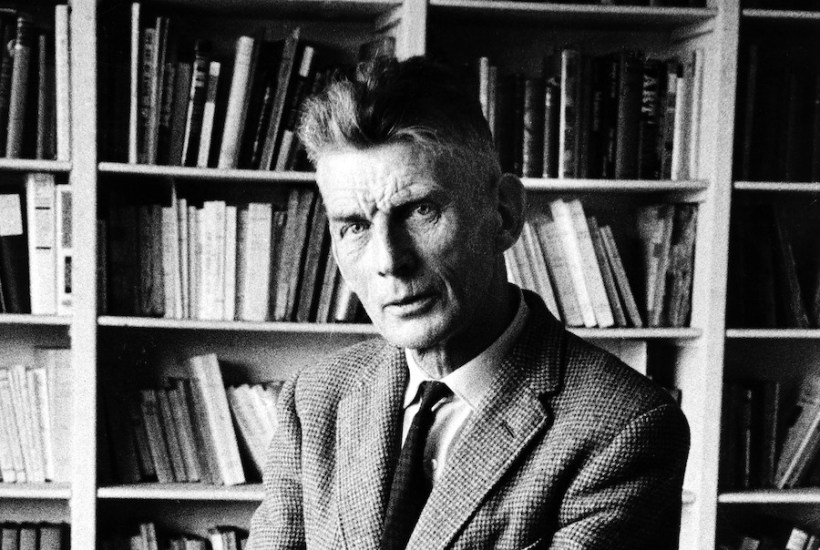
Samuel Beckett, with his quizzically peering gaze and handsome, hawk-like appearance, has long been the academic’s pin-up. Endless PhD dissertations exalt the Irish writer, who was born 120 years ago in Dublin on 13 April 1906, as an unsmiling existential hermit figure when he was really nothing of the sort. Over the 60 years of his writing career, Beckett created a memorable gallery of tramps, waifs and other ‘crotchety moribunds’ who find a lugubrious comedy in human failings. ‘Nothing is funnier than unhappiness,’ declares a character in Endgame, while Estragon in Waiting for Godot pines for death in a dry climate where they ‘crucify quick’.
Beckett’s terminal vision was bleakly humorous – and comedy often intruded on his life. In 1969, an admirer purporting to be a Monsieur Godot congratulated Beckett on winning the Nobel Prize: ‘I am very sorry to have kept you waiting,’ he wrote. Not at all, Beckett replied, and thanks for revealing yourself so promptly. Godot had been greeted with boos and catcalls when it hit the London stage in 1955, yet it made Beckett famous. In Miami, wonderfully, the play was billed as ‘the laugh hit of two continents’, a verdict that was not far wrong. The very name ‘Godot’ suggested comic theological dread. The story goes that Beckett once made a dash for the exit of an Air France flight when the pilot introduced himself as ‘le capitaine Godot’.
Beckett was even ‘having fun’ as the end approached
We should celebrate Beckett’s wit, which was almost Wildean in its repartee and not without its terse put-downs. The publishers Chatto & Windus, having rejected Beckett’s early book, More Pricks Than Kicks, was rebaptised ‘Shatton & Windup’. The schoolboy scatology never left Beckett. The narrator of his mid-period novel Molloy praises the Times Literary Supplement as being ‘impermeable to farts’ when he lines his greatcoat with it against the winter cold.
Later works by Beckett such as Company and Ill Seen Ill Said, with their hermetic sparsities and bleak lyricism, were in some ways a distillation of the whiskey-fuelled blarney that the author had known as a student in 1920s Dublin. The down-and-outs and philosophical strays that crowd Beckett’s literary imagination even sound like broken-down barroom virtuosos. ‘You must go on, I can’t go on, I’ll go on,’ stutters The Unnameable.
In 1936, bizarrely, the young Beckett wrote to the Soviet film director Sergei Eisenstein stating his ambition to work under him in Moscow. The ambition was never realised and Beckett wondered if he should train instead as a commercial airline pilot. (‘I do not feel like spending the rest of my life writing books that no one will read,’ he told a friend, adding tetchily: ‘It’s not as though I wanted to write them.’) All his life Beckett suffered from a number of disabilities ranging from panic attacks to herpes, but even then his humour was uppermost. ‘Since my double dry pleurisy at Xmas I cannot point to any precise affliction,’ he wrote to the Irish critic Arland Ussher, ‘unless it be a sebaceous cyst in my anus, which happily a fart swept away before it became operable.’ Elsewhere, Beckett said of himself: ‘I was always a great one for cysts.’
He had a gift for friendship. ‘Must be a bit of a bitch,’ the critic James Knowlson commiserated with Beckett after doctors advised him to stop drinking. ‘No Jim, it is not a bit of a bitch. It is a bugger of a bastard of a bitch.’ (Knowlson was later appointed Beckett’s official biographer.) Other instances of Beckett’s humour are no less cheering. A French friend recalled how Beckett once gave a brassy-looking waitress in a Paris bistro a packet of cigarettes as a gift, which she gratefully tucked into her stocking top. ‘So, Madame, do you put everything in your stockings?’ he asked, adding after a pause: ‘Even your legs?’
In 1961, Beckett married the former French Resistance fighter Suzanne Dechevaux-Dumesnil; awkwardly, his mistress Barabara Bray (a professional translator who worked in London for the BBC) moved to Paris that same year to be near Beckett, who continued to see her all his life. His letters to Bray are tender, affectionate – and funny. From his country retreat outside Paris he wrote to Bray of ‘sex-obsessed nightingales’, ladybirds, moles and, in the freezing cold New Year of 1963, the yellow tits that came for their margarine, ‘though they clearly prefer butter’. Bray remained Beckett’s confidante and anchor point at times of marital strife.
Beckett’s last days were spent in Paris in an old-people’s home. Oxygen canisters stood by his bedside for emphysema, yet he smoked cigarillos regardless and was often mildly squiffy from tots of Paddy, his favourite Irish whiskey. He appeared to be looking forward to death (‘the end of a life is always vivifying,’ says the old bedridden man in Malone Dies). Beckett was even ‘having fun’ as the end approached, remembered the poet Derek Mahon, who visited him a month before he died in 1989 at the age of 83.
As we look back now on Samuel Beckett and his extraordinary work 120 years after his birth, we can justly claim him as one of the great writers of the 20th century. In all his gleeful, Dürer-like imagination, the Irish writer lives on.