The debate about whether or not to include Pluto as a planet is part-nostalgia, part-history, part-historical justice, part-science, and part-aww, come on!
Public consensus preferred adding more planets to the solar system, including the likes of Ceres, Haumea, Eris, Quaoar, Sedna, and others.
Why not?!
The scientific community were not so keen, and fretted about all those textbooks that would have to be re-written…
It remains a debate that makes people uncomfortable because there is no clear definition, in nature, between planets, moons, and debris. Some moons are bigger than planets (Ganymede and Titan are larger than Mercury). Some rocks behave like planets. Would a passing alien say we had 30-odd planets? Maybe. We began defining these things before we really knew what they were.
And look, I get it, there are moons larger than poor little Pluto, but humans are not wholly rational creatures – they are emotional, nostalgic, and deeply rooted in cultural stories.
Pluto’s story cannot be unwritten.
As a chunk of ice and rock orbiting in the Kuiper belt, Pluto has five moons. It is possible to argue Pluto and its largest moon Charon are a binary planet system with moons. The celestial object was discovered in 1930 by US Astronomer Clyde Tombaugh and was declared the ninth planet. ‘Pluto’ was chosen from Roman mythology partly because it was the best of the options on offer, but also because the ruler of the underworld used a magical cap to master invisibility. Pluto spent a lot of time hiding from astronomers.
Pluto is for (space) lovers. ♥️
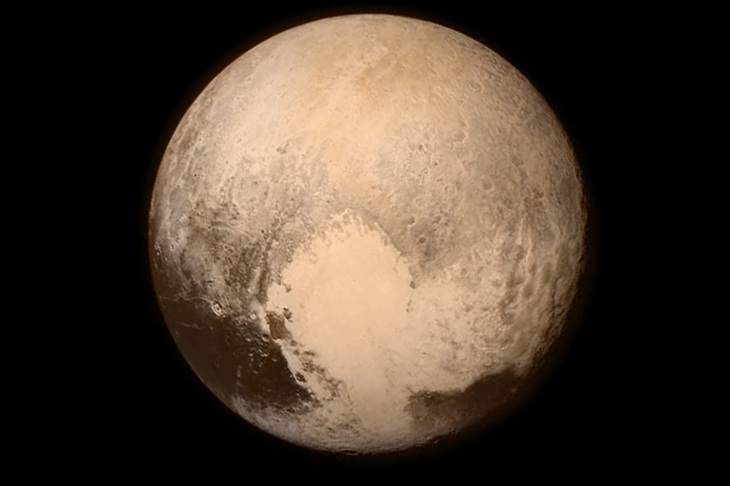
In 2015, the New Horizons spacecraft photographed the dwarf planet Pluto and revealed that it had a heart. #ValentinesDay pic.twitter.com/X3jjOk1fiT
— National Air and Space Museum (@airandspace) February 14, 2026
The existence of Pluto was prophesied by quirks in the astronomical math all the way back in the 1890s when the hunt for Planet X began before being formalised with Percival Lowell’s hypothesis. It’s a little cruel when you realise Lowell (the famous ‘canals on Mars’ guy) managed to photograph Pluto in 1915, but died in 1916 without realising it. His initials, ‘P.L.’ were stylised into the astronomical symbol for Pluto.
Astronomers had been circling around Pluto for decades, and when the planet was officially discovered, it became a cultural focus, even following the tradition of lending itself to the newly created element of plutonium.
Humans love an outsider, and Pluto, for whatever reason, became a sentimental body in the world of astronomy. It wasn’t just that the planet existed, it’s that the discovery proved a crazy theory that there should be another planet after Neptune.
Sadly for Pluto, the planet turned out to be much smaller than the original estimate of six-to-seven Earth masses in Lowell’s Memoir of a Trans-Neptunian Planet.
In 2006, the International Astronomical Union excluded dwarf planets, including Pluto, from the official definition of ‘planet’. This vote involved roughly 400 astronomers and plenty of astronomers and ordinary people ignore their ruling. There were even resolutions passed in support of Pluto’s planethood by some senates.
With the discovery of more Pluto-like objects littered throughout our solar system, the scientific community insisted that we would end up with dozens of planets. (Does that matter?)
They could have simply done what scientists have often done and just … make an exception to the rule. Grandfather the Pluto classification.
This whole debate reached a crescendo when NASA’s New Horizons mission, launched in 2006, performed its flyby of Pluto in 2015.
The first thing the world saw was Pluto with a giant red heart. A love letter to Earth.
Pluto’s heart was named Tombaugh Regio after Clyde.
The reason we are taking about this again is because of what happened on April 10 when NASA Administrator Jared Isaacman replied to a handwritten letter sent by a child.
Ten-year-old Kaela wrote a heart-felt letter to NASA asking for Pluto to be re-instated as a planet.
Dear @NASA. From 10 year old Kaela. She is mailing to you today. Too cute not to post. She and her family are friends of ours. #bringplutoback pic.twitter.com/goPIb55iQG
— Mike's Weather Page (@tropicalupdate) April 9, 2026
Dear NASA,
Please make Pluto a planet again. I really want it to be a planet again. Here are some reasons that Pluto should be a planet again:
-
- It is a part of our solar system and used to be a planet.
- It is a dwarf planet and deserves to be an actual planet.
- It might make a lot of people happy.
It might not be your choice but if it is, please please please make it a planet. It would make me very very very happy. If you can’t make it an actual planet, please consider it a planet. And I’m sorry if my handwriting or spelling is hard to read. Anyway, it will make me and my friends very happy.
To which NASA’s Jared Isaacman replied: ‘We are looking into this.’
Will NASA reclassify Pluto as an honorary planet?
Probably.
It’s a feel-good story at a time when the world needs good news. It hurts no one. It’s politically neutral. And the US is looking to build up public interest in space again as it becomes the next frontier of competing empires.
I have been a Pluto supporter my whole life and yes, as Kaela says, it will make a lot of people very happy.