In this article, I seek to trace a continuum between the distant past of my homeland, Iran, and its imagined future. It is an effort to revisit the legacy of Iranian women’s struggle for freedom and to reflect on their enduring role in shaping the cultural and social fabric of the nation, from a proud historical foundation to a hopeful and dignified horizon.
From Atousa, among the earliest women in antiquity to hold royal authority, to Princess Noor Pahlavi, a contemporary figure situated within a very different historical context, we encounter two women separated by centuries yet connected through a shared trajectory of agency, visibility, and the elevation of women’s status. This continuity is not merely historical; for me, it carries a personal and intellectual significance that invites reflection rather than simple narration.
Within the Iranian intellectual tradition, power is not understood solely in political or material terms. Rather, it is a quality that derives its legitimacy from wisdom, ethical conduct, and devotion to the homeland. In this sense, Queen Atousa of the Achaemenid period and Princess Noor of the Pahlavi lineage may both be interpreted as embodiments of a form of authority grounded in identity, cultural belonging, and reflective consciousness.
Atousa occupies a singular position in the history of ancient Iran. As the daughter of Cyrus the Great and the wife of Darius I, she stands among the most influential women of her time. Historical accounts suggest that her presence within the Achaemenid court extended beyond ceremonial visibility, reflecting a degree of political influence that shaped imperial continuity. As the mother of Xerxes, she contributed to the consolidation of dynastic power and stability.
Her association with the support of cultural and intellectual development, including the expansion of administrative literacy and the preservation of royal discourse, invites comparison with later historical figures such as Empress Farah Pahlavi. Classical historians, including Herodotus, have noted her influence and described her as perceptive and politically capable. In this light, Atousa can be understood not as a peripheral figure, but as an active participant in the formation of history, a model of intellectual and symbolic authority for women in the ancient world.
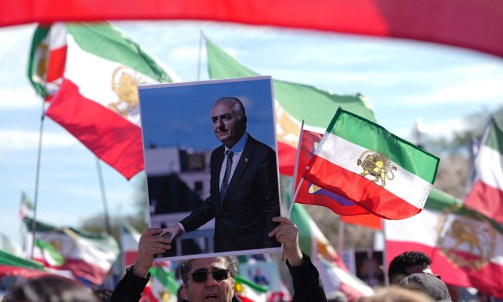
Extending this historical perspective into the present, I interpret Princess Noor Pahlavi as a continuation of this symbolic lineage. She represents a possible future in which Iranian women may live with dignity, autonomy, and visibility. While such a future is not yet fully realised, it remains imaginable, and it is within this space of imagination that her symbolic relevance emerges.
Her public presence and her association with a historical legacy shaped by figures such as Empress Farah Pahlavi contribute to her position as a figure situated between continuity and transformation. She may be seen as bridging tradition and modernity, embodying both inherited identity and contemporary relevance. In this sense, her image resonates particularly with younger generations seeking models of representation and continuity.
At the same time, a critical engagement with history requires acknowledging rupture as well as continuity. The political transformations of 1979 resulted in significant restrictions on women’s rights in Iran, reshaping their legal and social position. Efforts undertaken during the Pahlavi era toward expanding women’s participation and rights were substantially reversed. In this context, the discourse of justice and equality shifts from abstraction to historical necessity. Public engagements and statements by Princess Noor Pahlavi in support of the Iranian people may be interpreted as part of a broader narrative that recalls earlier aspirations toward social reform and gender equity.
On the occasion of the centenary associated with the Pahlavi period, my book A Hundred Light-Years includes an opera titled From Atousa to Noor. This work seeks to translate the historical and conceptual trajectory outlined above into a sonic and musical form. The opera may be understood as an auditory movement from silence to articulation, and from historical memory to symbolic illumination.
The composition begins in F major, establishing a restrained and introspective atmosphere. Through shifts in modality and the introduction of contrasting harmonic tensions, the work gradually develops before returning to its initial tonal centre. This structural return suggests continuity and the persistence of hope. The opening chord progression (F – Dm – Bb – C) creates a reflective sonic space, while the presence of female vocal lines alongside the flute establishes an interplay between delicacy and strength.
Structurally, the opera unfolds in distinct sections, each corresponding to phases of a broader historical and symbolic experience: emergence, tension, anticipation, rupture, and reconstruction. This progression may be read as an abstract representation of women’s historical trajectory in Iran, moving from silence toward articulation and presence. The use of polyphony in the vocal writing is central, as multiple female voices engage in a continuous dialogue, while the tenor narrator gradually recedes. This compositional choice suggests a transition from singular narration to collective expression.
From a musical perspective, the interplay between major and minor tonalities, along with modal shifts, articulates a dynamic relationship between tension and release. Rhythmic pacing, including the use of sustained pauses, reinforces a sense of suspension and anticipation. The orchestration also carries symbolic weight: the flute functions as a representation of light, while the piano evokes the ground of memory and historical continuity.
Conceptually, the opera attempts to situate historical motifs within a contemporary musical language. Non-lexical vocal elements such as ‘ha’, ‘Shahbanu’, and ‘Shah’ operate beyond literal semantics, generating a sonic texture that invites affective rather than purely linguistic interpretation.
Ultimately, this work may be understood as an exploration of the relationship between form, history, and identity. It does not seek merely to recount the past, but to participate in shaping a future narrative.
Within Iranian cultural thought, the term ‘Shah’ is not inherently gendered. It signifies merit, a quality grounded in wisdom and ethical responsibility rather than biological distinction. In this framework, sovereignty is associated with justice and generosity, principles articulated in classical texts such as Ferdowsi’s Shahnameh, where righteous rule is defined through ‘justice and giving’.
The official motto associated with the Pahlavi dynasty, inscribed within its imperial emblem, reflects this enduring philosophical tradition of justice under a higher moral authority.
By Leila Naseri: Author | Composer | Social Cultural Activist