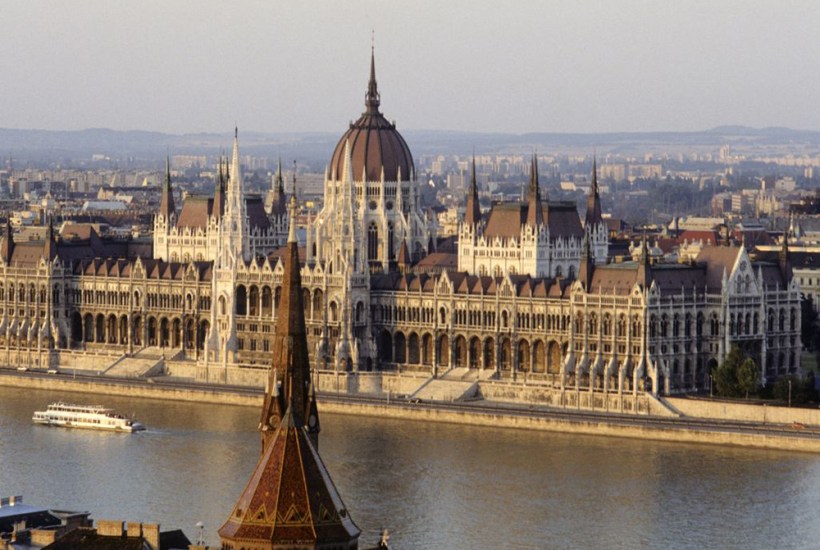
I’ve known a few Hungarians in my time. Immensely hospitable, deeply proud of their history and scientific achievements, resilient people who said no to Soviet oppression. The aftermath of the 1956 uprising saw 2,000 dead, 45,000 wounded or imprisoned and 200,000 made political refugees – you remember that category. Within Europe, where identifying national stereotypes is more popular than golf, Hungarians are recognised for being hardworking and exceptionally honest, if sometimes bluntly direct.
Since the early-2000s, Hungary has become a moral escape room for the European left. Whenever respectable opinion in Brussels or Berlin wants to feel better about the crazy-high levels of taxation and immigration it has imposed upon the good burghers of Europe, it points at Viktor Orbán, mutters ‘illiberal democracy’, and congratulates itself on still possessing courts, a free press, and a sufficient number of rainbow lanyards. The great advantage of Hungary, as Europe’s official scapegoat, is that it allows everyone else to quietly sweep the dystopias of Malmö, Bradford and Saint-Denis under the carpet and go back to feeling reassuringly normal again.
Set that aside for a moment and ask a less satisfying question. How bad is life in Hungary, actually?
This is not a defence of Orbán or his system. His association with Putin shows a real lack of judgment. J.D. Vance is due in Budapest this week to give Orbán the Maga seal of approval – no mean feat for a country of 10 million people. Orbán’s real claim in that universe is not merely that he wins elections, but that he protects a civilisation organised around family, nation and God rather than the liberal cult of the sovereign self.
If we look at Orbán dispassionately, what Brussels and the Canzuk Labourites find so challenging is the simple refusal of Orbán’s conservative Fidesz party to let institutional diagnosis float entirely free of lived reality. Formed as a centre-left opposition to the Marxist-Leninist establishment in 1990, by the time Fidesz entered government it was the pragmatists of their centre-right faction who had formed a substantial programme to reverse five decades of leftist trashing of the family and the economy.
Countries are not experienced as constitutional diagrams. They are experienced as places to live, and on that more pedestrian test, Hungary does not obviously resemble a society in breakdown. Unlike Malmö, public order is not a daily anxiety. Unlike Bradford, crime is comparatively low. The state has made sustained – if sometimes blunt – efforts to stabilise family formation in a continent that appears to have quietly mislaid the future. The results are not miraculous, but neither are they trivial.
More difficult to measure, but not hard to observe, is a degree of social cohesion that now feels faintly exotic elsewhere in Europe. Hungary is not free of political disagreement, but it is not yet a place where large sections of the population inhabit mutually unintelligible moral universes – where disagreement has gone so deep that the parties no longer share enough common ground to even conduct the argument properly. Younger Hungarians have not entirely severed themselves from the assumptions of their parents. The transmission belt, such as it is, still functions.
If you visited Hungary today, you’d find something of the Australia that people in the capital cities are starting to complain no longer exists. Stability, continuity, pride, tradition.
Orbán and his associates appear to have enriched themselves to the tune of tens of billions. Victoria has recently offered its own tutorials in what happens when corrupt networks, political protection and studied official incuriosity settle into a working arrangement. In Hungary, the same principle seems to have been elevated from industry racket to governing method. Plenty of Hungarians, aware that something fishy is going on, seem to consider it better than the typical European alternative.
And this is the real test. If Péter Magyar wins government this month, it will test this calm island in a sea of pain. Magyar is no social-democratic relic, but a defector from Fidesz who now leads a deliberately non-ideological coalition under the banner of the Respect and Freedom Party (Tisza). An Erasmus man to his bones, he is likely to fold before Brussels. Hungary may get cleaner government. The trouble is that the €13 billion currently frozen by the EU will not be released out of sentiment. Tisza says it opposes mandatory migration quotas, but once the money starts arriving it is hard to believe the party will do anything except submit to the multicultural programme.
The familiar argument – made with clarity by respectable figures such as Michael Ignatieff – is that democracy is not merely elections. It requires functioning courts, a free press, independent institutions, universities able to teach without interference. That is surely right. It is also, in a particular way, beside the point when stacked up against the bigger picture.
What the liberal definition does not capture is the stubborn fact that societies can remain recognisably orderly, cohesive, and functional while institutional guarantees erode. Hungary is interesting precisely because it appears to sit in that uncomfortable space – not a dictatorship, not a liberal democracy, and, more awkwardly still, not a place that most of its citizens experience as intolerable. Liberal theory finds this difficult to account for. Hungary does not especially care.
There is, too, a wider inconsistency in how these questions are discussed. Japan has operated under near-continuous one-party dominance for most of the post-war period without provoking comparable outrage in Western commentary, while Hungary is treated as apostasy: a white Christian European country that has betrayed the creed it was supposed to inherit. Western liberals are harsher on such cases because the offence is felt as familial betrayal, whereas non-Western societies are more readily granted a pseudo-anthropological indulgence. The difference, in other words, is not simply institutional form. Some systems are judged by what they are; others by what they produce – and for whom. That indulgence is itself a form of condescension, though polite opinion would sooner die than admit it.
If Orbán prevails, the system continues with its strengths and contradictions. If the opposition wins, Hungary will be praised for returning to ‘normal’.
Hungarians may take a dimmer view of what ‘normal’ now means in Europe: low trust, low birth rates, high crime, managed decline and endless lectures from Brussels.
Hungary is supposed to be a warning. What the European class — those who run Europe without quite having to live in it — cannot forgive is that, for all its corruption and compromise, Hungary remains recognisably a nation: cohesive, continuous and stubbornly itself.
That is why it irritates them so much. It is not merely a problem to be solved, but a standing reproach.
Got something to add? Join the discussion and comment below.
You might disagree with half of it, but you’ll enjoy reading all of it. Try your first month for free, then just $2 a week for the remainder of your first year.