The historian of naval warfare is to be envied by his land counterpart. The Duke of Wellington wrote to a confidant after Waterloo:
The history of a [land] battle is not unlike the history of a ball. Some individuals may recollect all the little events of which the great result is the battle won or lost, but no individual can recollect the order in which, or the exact moment at which, they occurred, which makes all the difference as to their value or importance.
The fear of invasion by Bonaparte had been real enough, and widespread
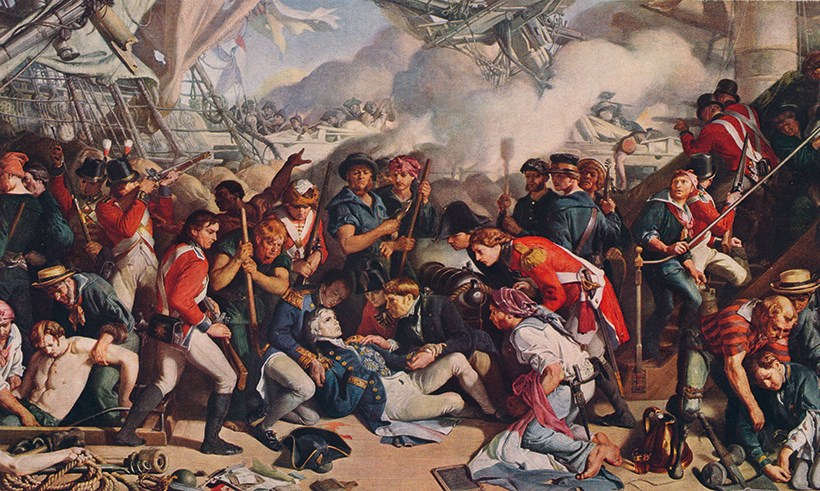
The naval historian, however, has the advantage of the meticulous recording of orders and manoeuvres in the ship’s log and the logs of the signal midshipmen and flag lieutenants, and, in the case of Trafalgar (21 October 1805), the notes of Nelson’s conference with his captains before the battle. Thus, while arguments continue about whether the culminating point at Waterloo was the guards’ volley against Napoleon’s middle and old guard as they broached the ridge of Mont St Jean, or the 52nd light infantry’s fleet-footed manoeuvring to volley in enfilade (an issue that still fills pages), let alone the arrival of the Prussians, there is no really comparable controversy over Trafalgar.
What, then, is there new to say about the battle that was fought to prevent the French from taking control of the English Channel long enough to ship across their wishfully named Armée d’Angleterre? The extensive bibliography in Paul O’Keeffe’s Trafalgar alone would suggest a sufficiency of narratives. However, what makes this account so original and compelling, and quite possibly the best all-round book on the subject yet, is its political, social and cultural context, both before and after the fighting. That, and the lively, detailed and sometimes grisly picture of the battle itself.
It is easy to forget the less glamorous aspects of the Royal Navy’s two decades of war with France – the protection of trade, the taking of French possessions in the Caribbean, which in turn funded the continental powers’ campaigns on land; and especially the blockades. As Alfred Thayer Mahan, the 19th-century naval Clausewitz, wrote:
Those far distant, storm-beaten ships, upon which the Grand Army never looked, stood between it and the dominion of the world. Holding the interior positions they did, before – and therefore between – the chief dockyards and detachments of the French navy, the latter could unite only by a concurrence of successful evasions, of which the failure of any one nullified the result.
These aspects of the navy’s work, especially the ‘concurrence of successful evasions’ both before and after the death of Nelson, O’Keeffe handles with great assurance. The sad, protracted and often forgotten demise of Nelson’s second-in-command, Admiral Cuthbert Collingwood, who sealed the victory by resuming and maintaining the blockades, is nicely done.
In fact none of the big names in the great story survived to see the end of the war. Federico Gravina, the Spanish commander-in-chief, died of wounds in May 1806. Pierre-Charles Villeneuve, the French admiral to whom Gravina was subordinate in the combined fleet, died by his own hand (an extraordinary story in itself) in France a fortnight earlier, having been paroled. O’Keeffe notes the customary parole rate of exchange: four post captains to a full admiral.
Although the fear of invasion had been rapidly receding in the months before Trafalgar, as Bonaparte withdrew troops east to face a renewed Austrian threat, the result of the battle put an effective end to the fear. It had been real enough, and widespread. A Miss Tomson wrote to her brother of the French occupation of Hanover that her thoughts of what took place there ‘freeze every drop of blood in my veins… [She was told] not a woman had been spared…neither youth nor age; all were indifferently abandoned to the brutality of the soldiers’. A Norfolk woman wrote to her married sister in the same vein:
I think we shall be in a very unprotected state if the French should land while my father is away, without a single man, or even boy, to take care of us. As soon as ever we hear the news of their arrival, we six [unmarried sisters], Danny [12-year-old brother] and the Nurse and, if we can manage it, Molly and Anne [the maids], are immediately to set off in the coach-and-four for Ely… as my father thinks it is a very safe place, being so completely surrounded by marshes.
Little wonder that when Nelson delivered the country from evil he was apotheosised, although four decades would pass before he was raised up on his London column. His ‘pillar’ in Dublin was erected in far quicker time, the foundation stone laid just three years after his death. Alas, it is no more. In 1966 a ring of explosives was placed under the observation platform just below the statue:
The effect on detonation was to direct the force of the explosion upwards to the statue itself, smashing it to pieces and leaving just two-thirds of the monument standing as a broken reminder of British dominion.
The authorities described it as ‘the work of experts’ – former IRA members – and turned to the Irish Army’s Corps of Engineers to raze what remained:
The charges were less expertly laid than previously and instead of tilting northwards as intended the truncated column disintegrated on the plinth, shattering windows in the vicinity, including the General Post Office.
In 2020, at the height of the Black Lives Matter campaign, a petition was submitted to parliament to ‘remove the statue of racist and white supremacist Horatio Nelson from Nelson’s Column in Trafalgar Square, instead displaying it in context elsewhere’. Parliament nicely side-stepped this by declaring the issue solely one for the local authority. It may therefore indeed be only a matter of time.
Got something to add? Join the discussion and comment below.
You might disagree with half of it, but you’ll enjoy reading all of it. Try your first month for free, then just $2 a week for the remainder of your first year.