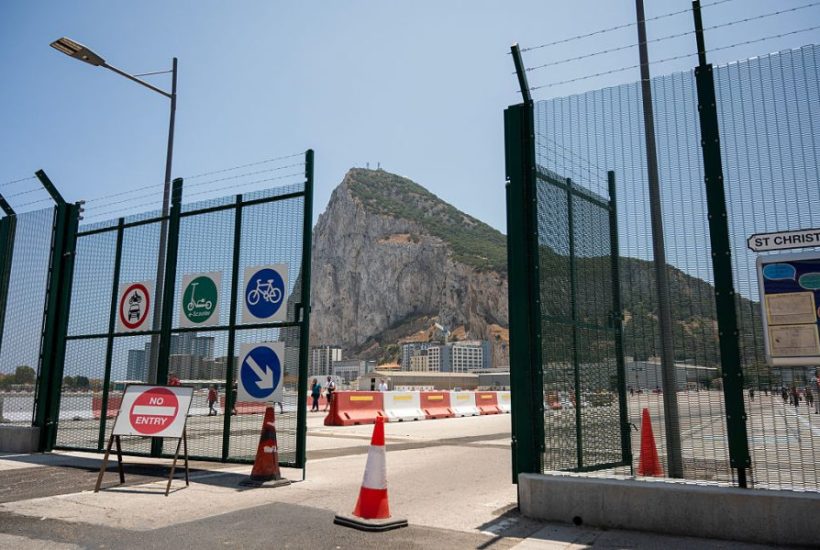
Almost a decade after Brexit, Gibraltar is entering a new era. As stipulated in a thousand-page treaty published on 26 February, which sets out the terms agreed by the UK and EU, Spanish guards will check the passports of travellers entering the Rock, as the British Overseas Territory (BOT) is known, and the 0.7-mile chain-link fence separating it from Spain will be dismantled.
Though the treaty requires ratification by the European and British parliaments, it is expected to be provisionally in place from early next month. It is the long-awaited result of an agreement made last year between Spain, Gibraltar, the UK and the EU. According to Fabian Picardo, the Rock’s chief minister, it will remove ‘the physical barriers of a bygone era of friction’.
The removal of what Spanish foreign minister José Manuel Albares has called ‘the last wall in continental Europe’ will have enormous symbolic importance for Spain. Madrid has never renounced its sovereignty claims over the Rock and says that Britain’s occupation of the isthmus – the thin strip of land connecting Gibraltar with Spain, on which the airport is located – is ‘illegal and contrary to international law’. Pedro Sánchez, Spain’s Socialist prime minister, is soon expected to visit the Campo de Gibraltar, as the neighbouring area of Andalucía is called, to commemorate the historic removal of the fence. The treaty published last month does not address the 300 year-old sovereignty dispute between Britain and Spain, which will no doubt rumble on.
It will take more than Spanish border guards and a fenceless frontier to hispanicise the Rock
Still, one might have thought that this long-awaited agreement would be a cause for celebration amongst Gibraltar’s 40,000 residents. 96 per cent of them, after all, voted to remain part of Europe in the 2016 referendum. It opens up the frontier with Spain and the EU, effectively – though not formally – incorporating the Rock into the Schengen Zone. A dreaded hard border, which would have created serious problems for the 15,000 people who cross it daily, has been avoided; Gibraltarian guards will still perform passport checks at the airport alongside their Spanish counterparts; and perhaps most importantly, Gibraltar remains a self-governing territory, autonomous in all respects except foreign policy and defence.
However, the treaty’s reception on the Rock has been mixed. Though Gibraltarians are overwhelmingly pro-European, they are also fiercely protective of their status as a BOT – a dual loyalty that has become problematic since Brexit. Gibraltar has twice rejected the prospect of Spanish rule, in referendums held in 1967 and 2002, and many of its residents remain opposed to any dilution of their autonomy, no matter how trivial it may seem to outsiders. The debate over who should have border guards in Gibraltar’s airport has been particularly heated, extending even to the colour of their uniforms.
Erika Pozo, an accountant and member of Together Gibraltar, the Rock’s newest political party, feels uneasy about the future. ‘I have to say that personally I will feel less British and less secure than I once did,’ she said last week:
The most crucial thing for me is the reality of having Spanish officers operating at our entry points and on the ground in Gibraltar, however limited or technical that role may be.
Owen Smith, leader of the Gibraltar Federation of Small Businesses, is concerned that the 15 per cent ‘transaction tax’ on goods to which Gibraltar is now subject will be ruinous for local businesses (the tax will rise to 17 per cent by 2029). Like Pozo, Smith also believes that the treaty endangers Gibraltar’s way of life:
We have British names on our high street, British products in our shops. We have a UK three-pin plug in our wall and all of those things, I think, are under threat.
Picardo has introduced more black taxis and red phone boxes to guarantee the Rock’s British aesthetics – but one suspects that won’t reassure those who fear a renewed drive for sovereignty from Madrid.
Gibraltarians’ sensitivity about the perceived encroachment of Spanish control is understandable. But it will take more than Spanish border guards and a fenceless frontier to hispanicise the Rock. Its singular blend of influences is evident everywhere you look in the old town, as well as in the local dialect of Llanito, a fascinating mix of Spanish, English, Genoese, Maltese and Hebrew. And there is still a community of Barbary macaques living on top of the 1,400-foot-high rock, Europe’s only population of wild monkeys.
According to legend, Gibraltar will remain under British rule so long as there are macaques on the Rock. Numbering around 300, these loyal residents show no signs of going anywhere. As the 18th century Spanish historian Ignacio López de Ayala wrote: ‘Neither the incursions of the Moor, the Spaniards or the English, nor cannon nor bomb of either have been able to dislodge them.’ Spanish border guards, no matter how unwelcome they might be on the Rock, are unlikely to have more success.