Bulgaria isn’t known as a source of humour, but back in the days of the Eastern Bloc and the Iron Curtain, there was a popular joke circulating in the country: ‘Bulgaria has the longest cow in the world; it grazes in Bulgaria but it’s milked in Moscow.’ It just so happens that Western Australia has an even longer cow, grazing in Western Australia but milked industriously by the Canberra kleptocracy.
There has never been a better time for the great state to determine its own independent future, to disconnect from Canberra’s milking machine, and repurpose its vast resources for the benefit of its own people.
Secession would not mean severance from our common cultural heritage – there is an ‘Australianness’ we will always share with our brethren to the east – and neither does it mean that we cannot be partners in trade, defense, and other critical functions. Indeed, Australia will have every incentive to have cooperative arrangements with post-secession Western Australia for functions like defense and trade, given Western Australia’s more than 13,000-kilometre coastline, state-of-the-art ports, and strategic location near Southeast Asia.
So, secession doesn’t need to be adversarial, but it does mean that Western Australians assume control over their own wealth and give birth to an enlightened and efficient form of governance that works for the people, in place of the Canberra model of governance that operates for the greater glory of the government. We envision shifting power back to local communities, freeing our businesses from regulation and company taxes, putting all take-home pay in the pockets of our workers by eliminating personal income taxes, and taking full advantage of a once-in-a lifetime opportunity to redesign health, education, and other systems so our people can live healthier lives, and, perish the thought, our kids can actually learn useful skills and knowledge about who they are, where they came from, and what their role is in society.
According to Western Australia’s own budget documents, there is a huge gap between what the state remits to Canberra in corporate and personal income taxes, GST and other payments and what the Commonwealth spends on Western Australia’s behalf. In the Financial Year 2024 the Treasury estimates that the state paid out $39 billion more than it got back ($112 billion outgoing versus $73 billion incoming). Permitting this to happen is arguably as grave an indictment of the Western Australian government as it is of the Commonwealth, but either way, if secession is successful then that money would be retained by Western Australian workers and businesses. This savings translates to $13,000 more retained in Western Australia for every man, woman, and child. Funding for the slimmed-down government of the new Western Australia would come primarily from a higher, simpler, fairer royalty rate on the state’s resource extractions. Since the companies subject to the royalty rate would no longer have to pay corporate tax on their Western Australian operations, most would still come out ahead or neutral under the new system.
Better governance and wealthier businesses and workers would stimulate growth and make Western Australia a magnet for investment and immigration from other states. We would expect people from the east who have been subject for years to chronic government mismanagement, skyrocketing housing and energy bills, over-regulation, and rising crime rates to be knocking down the door to get into the new independent nation of Western Australia.
Of course, this is a scenario that will scare the living daylights out of the eastern states’ elite. The folks in Canberra are already circling the wagons and spewing out soundbites to make the idea of secession look idiotic. Scare tactics, lies, and ad hominem attacks have already been launched and will be coming thick and fast in the days, weeks, and months ahead. As usual, this behaviour displays disrespect for the people these elites purport to represent, and particular contempt for the aspirations of Western Australians.
This proposal will be unique in the recent annals of Australian politics: in almost all ‘standard’ political debates, our politicians simply pull on their party guernseys and fight along tribal lines. In this instance, nearly everyone, left or right, will be uniformly horrified, unless they actually care about the people – in which case, whether left or right, they will be deeply intrigued and eagerly await more details.
The kneejerk horror of self-serving politicians is understandable. In FY2024, Western Australia, with 11 per cent of the country’s population, accounted for 17 per cent of its GDP, and 45 per cent of its merchandise exports, thanks to its fantastic mineral and agricultural sectors. Gross State Product (GSP) per capita was a phenomenal 57 per cent higher than the national average. Located on the Indian Ocean in close proximity to its major Asian markets, Western Australia is also in an advantageous position geographically. And while fiscal mismanagement by the Commonwealth and other states has led to high and rising debt ratios, Western Australia’s net debt to GSP ratio remains the lowest in the country.
Despite the fact that Western Australia is such an economic powerhouse, we expect Australia, post-WA-secession, to do just fine and that cooperation between the two countries will be smooth and mutually beneficial. Moreover, the border between the two countries will be open in a manner similar to the way the Schengen Agreement permits visa-free travel among European countries. Let’s be clear: we want Australia to succeed – this is about self-determination, and not about rejection.
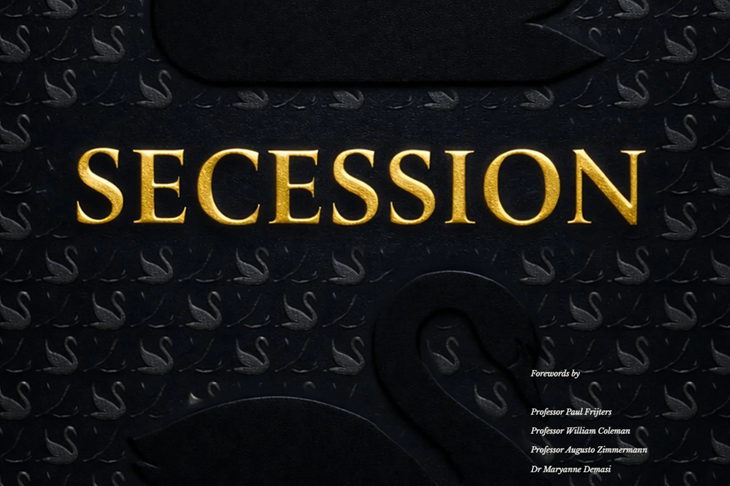
A mammoth 400-page book, Secession by Western Australia, is now available outlining how Western Australia might look as an independent nation. It provides a blueprint for taxation, financial management, banking, health, education, defense and even an anti-corruption framework, topped off with a draft Constitution for the new nation. But it is just the beginning: the platform for what will be required to ensure the new nation of Western Australia starts on a solid footing. The next step will be the creation of an institute (provisionally called the ‘CoreWest Institute’) that will call in the best expertise in each field to undertake the detailed policy research needed to fine-tune the initial proposals laid out in the book, and to spearhead community consultation with WA residents about which policy settings they need, and which they don’t.
Make no mistake: the road to secession will be difficult and the forces lined up to oppose it, which sadly include the sitting WA government, will be relentless in trying to derail it, ultimately to keep Western Australians paying taxes they don’t need to pay. Successful secession will need some important names throwing their prestige and financial strength behind it. Now is the time for those people to step forward, for the sake of all Western Australians.
If this is you, contact us now on secessionWA@proton.me.
You can watch the book launch below.
Julian Gillespie
LLB, BJuris
Julian Gillespie is a former Australian barrister and the principal author of Secession by Western Australia, recognised for his covid research, advocacy, and legal challenges against vaccine approvals. He has led efforts to protect public health and medical autonomy through landmark cases and community education. For this project he focuses on constitutional design, institutional integrity and practical nation-building reforms. He writes on governance, resource stewardship and the civic case for a stronger, sovereign Western Australia.
Professor Gigi Foster
BA Ethics, Politics and Economics, PhD Economics
Professor Gigi Foster is an economist at the University of New South Wales, specialising in behavioural economics and public policy. She contributes rigorous economic analysis, institutional design and a focus on group influence, corruption, welfare, education and incentives. Professor Foster is active in public engagement on economic and social issues, serving in professional roles and contributing to national debates on policy choices and their wider societal impacts. She is a founding director of Australians for Science and Freedom.
Michael Baker
BA (Econ)
Michael Baker holds a BA (Economics) from the University of Western Australia. He is an independent economic consultant, author and freelance journalist focused on policy analysis and clear, evidence-based public communication. For this project, he supports fiscal analysis and practical implementation pathways, helping translate complex assumptions into testable scenarios. He also writes and speaks on civil liberties, science-based freedoms and informed public discourse in Australia.
Professor Ian Brighthope
Dip Ag Sci, MBBS, FACNEM
Professor Ian Brighthope is a pioneer in nutritional and environmental medicine, with qualifications in agricultural science and medicine. He founded the Australasian College of Nutritional and Environmental Medicine (ACNEM) and has long advocated integrative, prevention-focused health care. He contributes a wellness and health-governance perspective to the book, drawing on extensive clinical experience, professional education and public advocacy aimed at strengthening community health and individual autonomy.