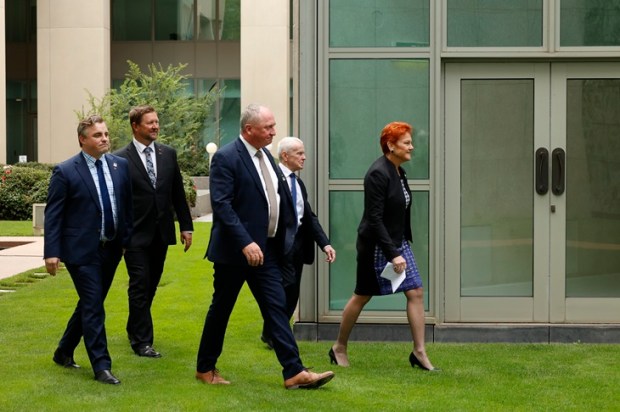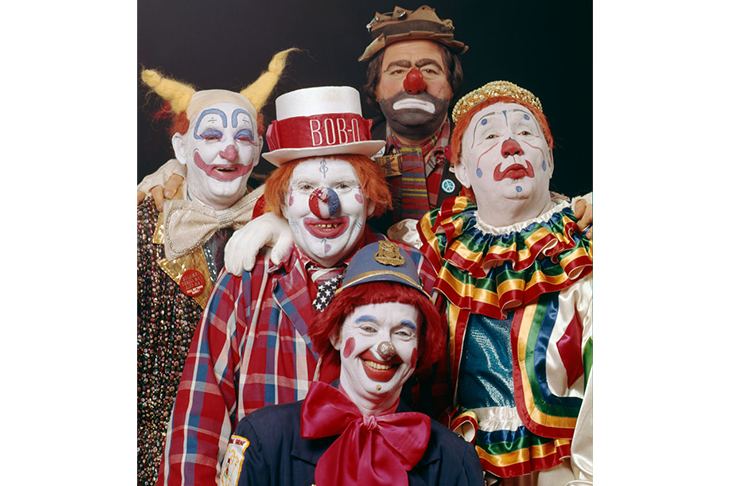
‘Clowns to the left of me, jokers to the right, here I am stuck in the middle with you.’
It is not often that a 1970s folk-rock satire captures the strategic dilemma of a modern political party, but there it is. The Liberal party in Australia finds itself increasingly wedged – Labor to one side, One Nation to the other – watching its vote fragment and its path to government narrow.
In Britain, the same story looks more likely to end badly. Despite Kemi Badenoch’s recent polished performances, the Conservatives, stuck between Labour and a more right-wing Reform, now look less like a government-in-waiting and more like a party in managed decline. Under first-past-the-post, one side on the divided side simply dies. Votes split, seats are lost, and there is less opportunity for reunion.
Across the West, politics is breaking apart: lower barriers to organisation and communication, and a fragmented media environment, have made it easier than ever to start a political movement, and harder than ever to hold one together. Even Reform faces threats on its right flank from a variety of more populist threats.
Australia looks similar on the surface, but in truth there is a huge difference. The difference is not cultural. It is institutional.
At federation, the Commonwealth adopted the familiar British model of plurality voting. But that did not last. In 1918, after the conservative vote split at the Swan by-election threatened to hand victory to Labor, preferential voting was introduced for the House of Representatives. It was a practical solution to a practical problem: how to allow political competition within a side of politics without delivering government to its opponents by accident.
The system that emerged is now distinctively Australian: preferential voting in Australia, compulsory in its full form for the house of representatives. Voters may express protest, even anger, through their first preference. But they must also indicate where that vote ultimately lands if their preferred candidate cannot win. The winning candidate must, in the end, command an absolute majority after preferences are distributed.
This history tells us something important about what our system was designed for. It was not designed to flatter every insurgency with instant power. It is designed to hear protest, count it, and then force it back through the disciplines of parliamentary government.
It is arguable that this design sits comfortably within the deeper logic of the Westminster system. Westminster was never built around a single national figure. The prime minister is not directly elected, nor is he or she endowed with a personal mandate separate from the parliament. The office exists because its holder can command confidence in the lower house. Cabinet is collective with a PM first among equals. Power is mediated through parties and parliament. Effective Westminster governments require teamwork and without it a party or coalition cannot govern.
Over centuries, through the evolution of Westminster the roughest edges of faction al and personal rule were increasingly constrained. Party discipline hardened. Government became synonymous with the ability to assemble and maintain a majority in the House. Australia’s special tweak has been to embed that discipline not just in parliamentary practice, but at the ballot box. Voters are free to revolt; but for their vote to count they must provide a valid one which helps to produce a majority-backed representative.
None of this means that elections on the right are won by drifting to some flaccid notional centre. The Liberal party’s most successful leaders have been recognisably conservative figures. And for Liberals, elections have only ever been won from opposition by unapologetically conservative leaders.
What the system does do, however, is impose a hard constraint: you cannot win from the extremes alone. In a compulsory preferential system, victory requires not just intensity, but reach.
The broad impact is clear enough: Australia’s electoral machinery has tended to pull politics inward rather than push it outward. Preferential voting does not eliminate insurgency. It channels it. The protest is not only registered, but distributed.
In the South Australian election, support for One Nation surged to levels that would once have been unthinkable. As I have written numerous times, the anger is real, concentrated in outer suburbs and regions where less-well-off voters feel economically squeezed and politically ignored.
And yet the effect of that surge is not a conservative revival, but a conservative split. The vote fragments. Preferences flow. And way more often than not, the final beneficiary is Labor.
Long term this may not benefit Labor. Systems shape outcomes, but they do not determine them. Compulsory preferential voting does not – and never should – rescue parties. It simply recalibrates the field on which they compete. It permits fragmented votes to be recombined, but it does not ensure that they will be.
The surge in support for One Nation reflects something deeper than momentary discontent. It speaks to a cohort of voters who feel not simply unheard, but structurally distant from power – geographically, economically, and culturally. David Goodhart’s distinction between the Somewheres and the Anywheres is imperfect, but it captures something essential. Those furthest from the centres of decision-making have, over time, borne the costs of policy decisions made elsewhere. Those who have borne the burdens of the luxury beliefs imposed on them are mostly the ones who can least afford it. These very unhappy voters are responding rationally to a system that has not, in their view, responded to them.
Preferential voting ensures that their votes do not disappear. But neither does it allow the system to remain indefinitely fractured. The pressure, eventually, in the past has always been toward consolidation. Who wins in the consolidation depends upon who is the most persuasive over time. One Nation has failed that test on many occasions before.
Preferential voting can also soften the edges of political competition. Many will disapprove, but that, too, reflects a choice made in 1918 and now embedded in our unique Australian system. It privileges stability over rupture, and governability over ideological purity.
Which brings us back, unavoidably, to that line from the song.
Being ‘stuck in the middle’ is often spoken of as though it were a position of balance, even comfort. But as anyone who has seen the movie Reservoir Dogs will recall, the middle is not always a place of control. Sometimes it is a place where the real contest is happening around you, and the outcome depends on forces you do not fully command.
Australia’s electoral system was designed to ensure that, in the end, someone does command them. It does not prevent the clowns or the jokers from taking the stage for a time. But it does insist that, when the music stops, the system produces a majority.
The question is not whether the middle exists. In Australia it absolutely does. It is which party in the end, and over time, is able to hold it.
Got something to add? Join the discussion and comment below.
You might disagree with half of it, but you’ll enjoy reading all of it. Try your first month for free, then just $2 a week for the remainder of your first year.