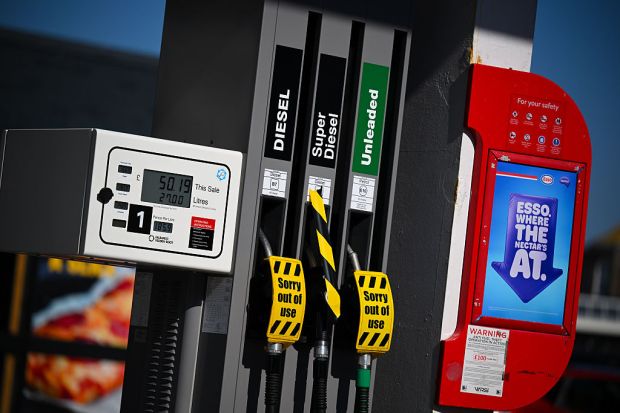
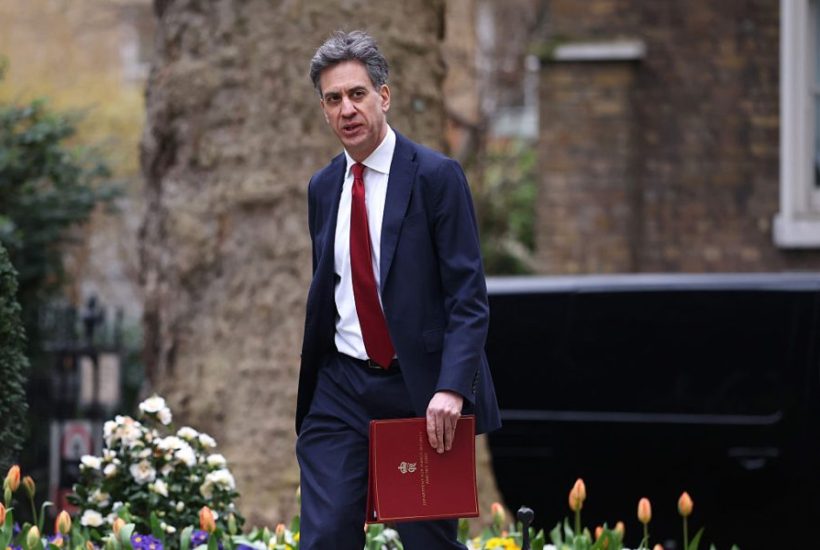
Sooner or later it is going to dawn on Ed Miliband and the rest of the government that anger over Britain’s sky-high energy prices is not going to go away. They are no longer going to be able to conceal the obvious evidence that UK consumers and businesses are paying significantly more for their energy than their counterparts in comparable countries. They are also not going to get away with blaming the war in Iran, nor with maintaining the pretence that the government’s green policies are helping to bring down bills.
Yesterday it was the turn of Marks & Spencer chief executive Stuart Machin to highlight the issue. Green levies and other policy costs, he revealed, now make up more than half of his company’s energy bills. While war in Iran has driven up wholesale prices, he said, the greater misery has come from the extras added to bills, not from wholesale prices. Prior to the Iran crisis, wholesale prices were standing much lower than they did in 2022 after the Ukraine invasion. But government levies have gone firmly in the other direction.
It is plain to everyone except Miliband that something is not right with his claims
Machin’s intervention highlights something which has been largely missed since Chancellor Rachel Reeves’s budget last November. While she said she would remove green levies and other policy costs from domestic energy bills from April (by shoving them onto general taxation instead), thus saving an average household around £150 a year, she did not make the same move with commercial energy bills. Moreover, commercial customers (other than especially light consumers) have to pay the Climate Change Levy in addition to the levies which households have been paying. Last year, the Chancellor did announce some relief for energy-intensive industries such as steel-making, but this change will not take effect until next year.
The astonishing premium which UK businesses must pay for their electricity is laid bare in statistics which the government itself publishes. In 2024, small companies paid an average of 29.92 pence for their electricity, 62 per cent more than the average in a basket of 14 European countries. Medium-sized businesses paid 28.67 pence, 107 per cent more than the European average and large businesses paid 26.77 pence, 131 per cent more. There is less of a discrepancy in commercial gas prices: large companies paid 6 per cent more than the European median, medium businesses paid the same as those in other European countries and small UK companies actually paid 17 per cent less.
Looking further afield, the median UK business is paying 63 per cent more for its electricity than the median for member countries of the International Energy Agency. The median gas price is 1.5 per cent lower. All the above price comparisons include taxes.
Miliband’s parroted line about his green energy policies freeing us from ‘fossil fuel dictators’ is seriously beginning to grate. It is plain to everyone except the Energy Secretary that something is not right with his claims: Britain has embraced wind and solar energy more enthusiastically than almost any other developed country, and yet far from cutting our bills, it is driving them ever upwards.
Many businesses are in serious trouble thanks to high UK energy bills and will not survive long enough to enjoy Miliband’s net zero nirvana – even if by some unlikely miracle it did succeed in lowering energy bills. UK energy prices are helping to make our industries uncompetitive, and for those who do not survive, Miliband will deserve some of the blame.
Marks & Spencer is not going to be the last business to point out the truth on UK energy bills. On the contrary, I suspect that such interventions are going to be hitting the government on a daily basis from now on.