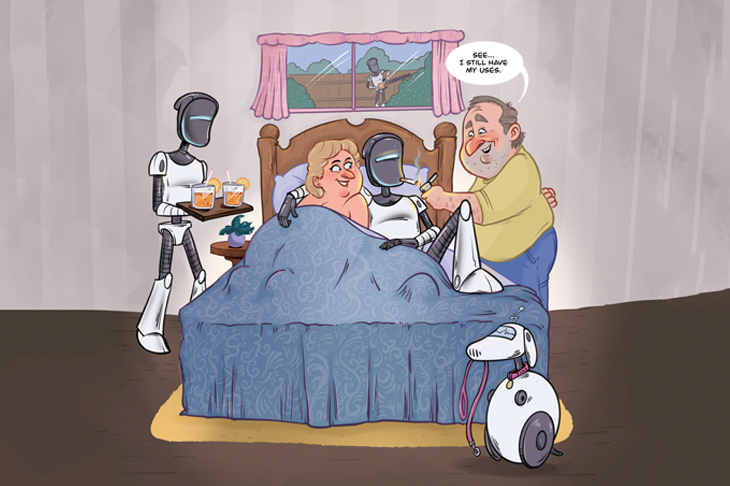
A popular 1960s superhero comic book series which never made it to the big screen, for reasons which will become clear, was Magnus, Robot Fighter in which a superstrong muscleman battled rogue robots in the year 4000. Trained by the original, wise 1A robot to protect humans, Magnus lived in a world in which feeble, spindle-limbed humans did nothing for themselves except waft and lounge about, served by an army of bots, thus becoming easy prey for steel robots running awry. ‘Man is becoming a race of weaklings, able only to play and watch TV,’ says Magnus sadly at one point. It’s hard to make such a dark vision of the human race appealing, which is why I assume Hollywood never ran with a Magnus film.
We are about to have to consider such outcomes, as capable humanoid robots are barreling down the tech superhighway much faster than we think. Just as AI is taking over mental tasks, so AI-powered robotics promises a Great Leap Forward for physical tasks in the next couple of years. Nvidia boss Jensen Huang says humanoid robots will be in widespread daily use in three to five years. 2026 is being touted as a breakthrough moment for robotic commercialisation, with both Musk’s Tesla and California’s Figure AI (backed by Microsoft, Amazon, Nvidia and Intel) expecting to start selling robots to the public or deploying them at scale between late-2026 and 2027.
China is leading the global humanoid robot race, producing 90 per cent of units in 2025, according to Google’s AI. China’s cutting-edge Unitree Robotics, which already gets half its revenue from humanoid robots and robo-dogs, displayed a spectacular and terrifyingly athletic synchronised robot dance scene at China’s premier variety show last month, ahead of a Shanghai IPO. On X you can see videos of robots folding clothes and making beds, playing tennis, dancing ballet and kung-fu style, weeding crops, serving drinks. And closer to the home front, a server robot just went loco in a California hot pot restaurant, flinging its limbs about wildly until three people brought it under control. (No kill switch?)
A recent booster piece by polymath US entrepreneur Peter Diamandis spoke breathlessly of seeing the near future at Figure AI’s San Jose factory: ‘We’re talking about fully autonomous humanoid robots running neural networks end-to-end, doing kitchen work, unloading dishwashers, organising packages – for hours at a time, with no human intervention.’ Currently that’s 67 hours at a time, with one error.
Here’s a deeper dive into the detail: Figure’s 03 robots are no longer using thousands of lines of laborious code written for each specific task, but ‘neural nets’, a computer model which learns from experience, not instruction. These robots are self-teaching, constantly collecting data and feeding it back into their training. And what one Figure computer learns, they all learn, like the hive mind in the sci-fi TV series Pluribus. ‘When one Figure robot masters folding laundry, every Figure robot on the planet instantly knows how to fold laundry,’ Diamandis says.
This year Figure is trialling robots doing home cleaning, laundry, organising, dishes, aiming to obviate human oversight or intervention. Multiple commercial clients already use Figure robots in their factories, warehouses, and logistics operations, not as pilot programs but revenue-generating contracts. Figure boss Brett Adcock is adopting a more cautious timeline for home use, taking more time to iron out any safety or privacy bugs; it’s no good if a robot spills boiling water on your baby or elderly parents. Adcock plans on mass availability of thousands of units in 2028-29. Elon Musk, by contrast, plans to roll out his humanoid robot Optimus next year.
Ultimately Adcock sees households leasing USD $20,000 bots for around $300 a month, undercutting your average Hispanic maid and always ‘on’. He argues (optimistically) the market for humanoid robots is around $50 trillion annually, or half of global GDP, because half of all economic activity is human labour. And soon he will have robots building his robots.
Two big questions arise out of these advances; firstly, how will humans support themselves and their families? And second, what will humans, newly redundant, do?
The tech wizards seem to me to be enormously sanguine about the benefits of these technologies, and silent on adverse effects. A common line of argument, from Musk and others, is that we are about to enter the Age of Abundance, when goods and services are freely available to all since robots will be producing them at near-zero cost. Already dark Chinese factories are churning out phones automatically, with humans only in oversight and maintenance. ‘All jobs will be optional,’ says Musk.
This, I’ll believe when I see it. Would it even be a good thing if it happened? There are character developments we must all go through as we rub up against life’s difficulties; if we never have to persevere with learning, building skills, dealing with setbacks and failures, will we not become the adult equivalent of spoilt children, ungrateful for what we have and expecting ever more to land in our lap? Challenges are highly beneficial, and we know who finds work for idle hands.
Then there is the question of what humans will do. Shorn of the daily battle to survive, there will be no pressing distractions from life’s great existential questions, which have confounded us for millennia. No doubt inventive fantasists will come up with even more silly ‘problems’ like climate change and DEI, given the lack of real ones. A few like Musk will use this new time to aim for the stars, be creative or self-motivated in beneficial ways. But humans won’t abandon their prejudices; Islamists may decide to program bots to murder Jews, e-Karens will want to curtail speech, enforce vaccinations and, sorry, definitely no second glass of wine for you. There will be hold-out communities like the Amish of course, and religious communities. But for most people, I fear Magnus had it right – we will play and watch TV. And eat. We will not be the skinny weakling humans of his world, but more like the degenerate humans of the movie WALL-E, fat blobs of flesh with atrophied limbs. It is idle to imagine our captains of industry have any real idea of what they are unleashing.
Got something to add? Join the discussion and comment below.
You might disagree with half of it, but you’ll enjoy reading all of it. Try your first month for free, then just $2 a week for the remainder of your first year.