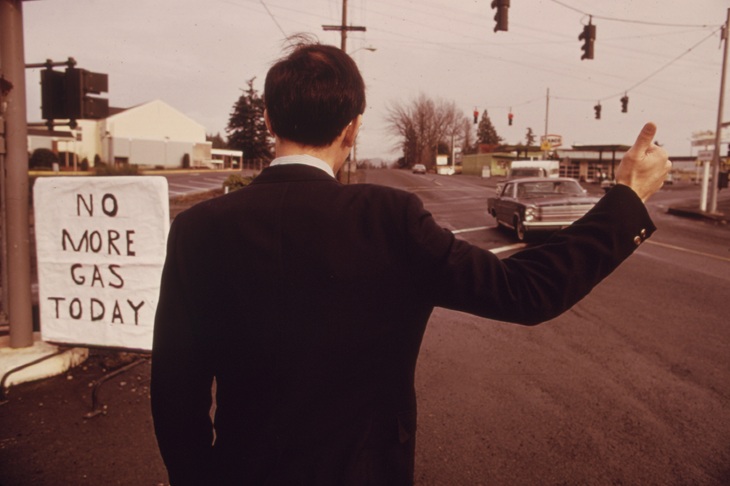
The severity of the global fuel crisis hitting Australia – that may well reverberate for years to come – is not because Iran shut the vital Strait of Hormuz. It has resulted from decades of incompetent Australian political leadership.
This was epitomised recently by Minister for Agriculture, Fisheries and Forestry Julie Collins saying of the current crisis that you can’t predict war.
Well, we can’t predict droughts, so we build dams to ensure water supplies. We can’t predict cyclones and bushfires, but we run resilience community exercises and provide a national disaster fund for Australians affected by natural disasters. We pay insurance to mitigate accidents and disasters.
When it comes to liquid fuel security, Australia has done nothing but demonstrate gross negligence, despite many warnings.
- John Blackburn’s NRMA report (2014) warned how Australia’s reliance on imported liquid fuels left us highly vulnerable.
- The late Senator Jim Molan warned many times that Australia was dangerously vulnerable due to its reliance on just-in-time supply chains.
- The Defence Department’s 2019 Defence Mobilisation Review, with 17 leading engineers considering scenarios like Australia faced during Covid and now in the Middle East, concluded that Australia would grind to a halt and face major civil unrest within a few months if fuel imports were interrupted or cut (this warning was recognised in the 2021 Senate inquiry into Australian manufacturing industry).
- Rand Australia’s 2021 Defence Mobilisation Planning Comparative Study issued similar warnings.
- Australia’s 2023 Defence Strategic Review (DSR) urgently warned that the 10-year window for a major conflict, on which the military had operated, had ‘vanished’ and is no longer a valid basis for strategic planning.
None of the warnings were heeded. None!
Pathetic reserves
Macrobusiness chief economist Leith van Onselen reveals that, of 27 Western countries, Australia comes last in terms of national liquid fuel reserves, only about 30 days. The next lowest is Turkey with 100 days, while the Netherlands holds over 400 days of reserves.
Australia’s oil exploration expanded after the second world war and again after the 1970s oil shock. However, the mantra that there would be no future oil shocks, that free trade and ‘the markets’ would guarantee imported supplies and that the nation could reliably run on renewables saw our refineries dwindle from eight in 2000, to just two today. Now, Australia imports around 83 per cent of its liquid fuels (2022), or about 1.1 million barrels per day.
Almost all of this comes from refineries in Asia, in particular South Korea, Singapore, Malaysia, and China. In turn, about 60 to 70 per cent of their crude oil originates in the Middle East, mostly through the blockaded Strait of Hormuz.
To conserve fuel for their own markets, China, Vietnam, and Thailand have banned exports of refined products. South Korea imposed a cap on exports at 2025 levels. The United States may restrict/ban exports so Trump can keep US petrol prices down in the run-up to November’s mid-term elections.
And if the crisis continues, then the effects on world oil supplies will be prolonged. Gulf states will be forced to shut down refineries when their storages are filled, and wells will also have to stop pumping. These are not easily switched back on again.
Restarting a refinery can take months to being back into production. Wells have to be cleaned and serviced before restarting, which can take months, while heavy crude wells can take years to restart.
How foolish are we?
Chris Bowen’s Department of Climate Change, Energy, Environment and Water (DCCEEW) admits that 90.7 per cent of Australia’s total energy use (electricity, vehicles, and industry) comes from fossil fuels, with only 9.3 per cent from renewables. Yet the Labor government pays endless homage to flawed renewables policies, while straitjacketing Australia’s vast underutilised energy resources.
These resources have been documented by Geosciences Australia:
- 14 per cent of the world’s coal: with enough in Queensland to fire all of Australia’s coal-fired power stations for hundreds of years, yet federal and state policies are to shut down all coal plants by 2050.
- 32 per cent of the world’s uranium: but federal and state governments have banned civilian nuclear-power plants. Yet European Commission President Ursula von der Leyen now confesses that curtailing Europe’s nuclear-energy sector was a fundamental ‘strategic mistake’.
- Gas: Australia exports vast amounts of its plentiful gas, yet only Western Australia quarantines some of its reserves for domestic use. Further, the Federal Government axed subsidies for converting cars to gas a decade ago, while many service stations are quitting gas because of prohibitive requirements to test their tanks every five to ten years, forcing motorists to depend on imported oil.
- Oil: Geosciences Australia says that Australia has only small domestic reserves of gas and other liquid fuels, by world standards (about 1 per cent). However, this has to be qualified. Australians don’t really know how much gas and oil reserves are commercially available.
Why? Because, in nominal dollar terms, exploration has crashed by 80 per cent since 2012, according to ABS data. In the year to September 2025, only $1.1 billion was spent on exploration, compared with $3.95 billion for minerals exploration (2024). Meanwhile, the federal Clean Energy Finance Corporation has a $32.5 billion fund – for renewables only.
Political forces skewing investment into renewables has collapsed oil and gas exploration, despite oil and gas supplying 65.4 per cent of Australia’s energy needs.
What is to be done?
- Ration fuel and prioritise farmers, road transport, ports, essential services, and diesel trains that supply coal to power houses.
- Use Australia’s gas exports as a bargaining chip to keep liquid fuels coming from overseas refineries.
- Beg the US to supply Australia before Trump curtails exports.
- Urgently restore second world war fuel storage depots and build large new storages across the country.
- Spend the necessary billions to restore, and build new, oil refineries capable of handling all grades of crude oil.
- Immediately announce attractive incentives to oil and gas exploration and for converting cars from petrol and diesel to gas.
Australians, prepare to get used to fuel rationing, working from home again, relying on public transport, interrupted food supply chains, and higher inflation and interest rates.
Patrick J. Byrne is the immediate past national president of the National Civic Council.