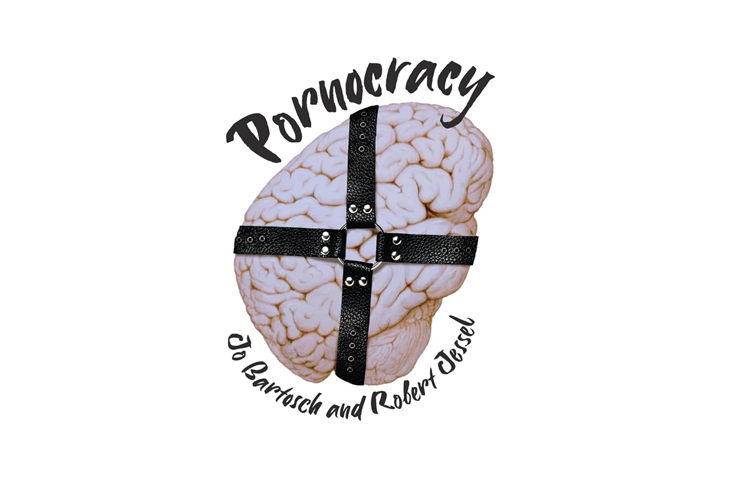
In a world where political discourse can be difficult to shape, Pornocracy by Jo Bartosch and Robert Jessel’s is an essential read for those wanting to arm themselves with knowledge and quite a bit of righteous indignation about what the porn industry is doing to those we love and those who govern us.
Pornocracy is defined by Bartosch and Jessel as:
a society in which political power, culture, relationships, and identity are shaped and dominated by the purveyors of pornography.
It’s a bold claim to make at the beginning of a book, but by the end of this engaging read, you’ll have been convinced by the weight of evidence that porn has become, to use an overused parlance, an existential crisis in the modern West.
Pornocracy is a small book, and a third of its size is references, making it as much a summary of the current porn-critical literature and arguments as anything. If you are brave enough to face it, Pornocracy will leave you more aware of the horrors, but also well-armed to engage in the debate.
Among the most startling statistics in Pornocracy are:
The porn industry is now worth twice as much as Hollywood. In May 2023, 10.1 million men in the UK accessed porn. Given that there are 30 million adult men in the UK, that’s one-third of men. Males make up 73 per cent of porn consumption.
35-45 per cent of pornography involves physical aggression, almost always against women and girls. Incest is the fastest-growing porn category. The ‘barely legal’ and teen categories are the most popular subset of porn.
In terms of employees of the porn industry, what we now fashionably call ‘sex workers’, 88 per cent of porn performers have been sexually abused as children, 65 per cent claim to have been raped as part of their performance, and 80 per cent have a diagnosed mental illness. Occupational hazards of being a porn performer include sexually transmitted infections, overdoses, and suicide.
I have frequently said that if prostituted women had the sympathy of male chickens, then porn and prostitution may suffer the same legal censure as cock fighting. We see that the rationale for this is that animals are deemed unable to consent, while young women and girls take payment for porn performances.
It is no mystery why ‘choice’ and ‘sex positive’ feminism are the chosen models of feminism for all government organisations. The shift from protection to empowerment empowers the mythology that porn is a regular and lucrative job for girls and women.
Pornocracy argues that the widespread use of porn has allowed corrupted narratives for the continued protection of porn as an industry to infiltrate systemically into society and law. This may sound conspiratorial until you look at the legislation being influenced by our own peak LGBTIQ organisations in Australia.
I wrote recently of a case in Victoria of a man who sexually abused his daughter while playing out sissy porn fantasies with another man. The abusive father was recast, by the defence’s forensic psychiatrist, as a female victim of male oppression because he had played the submissive party in the porn fantasy and he had changed his birth marker to female just before the trial. Submission is cast as female in porn and in governmental trans ideology.
A registered Victorian charity supported the defendant during his trial. The charity is registered for Indigenous people, females, and families, and is predominantly funded by government grants, including from the Victorian Department of Health.
The link between sissy porn and trans identification is becoming well established in research, and Pornocracy highlights the growing field of research shining a light on harmful porn-positive or ‘sex work’ positive narratives now accepted by governments.
In 2023, the Equality Legislation Amendment (LGBTIQA+) Bill 2023 was drafted that initially proposed the removal of all prostitution offences from the New South Wales Summary Offences Act 1988.
The removal of Section 15A of the Act was proposed in State Parliament, which prohibits ‘coercive conduct or undue influence [to] cause or induce another person to commit an act of prostitution’. It was argued that this ‘offence creates complications and risks for sex worker businesses in recruitment, sex workers talking about their work with friends, and support services helping a person starting in sex work’.
Pornocracy outlines the unsurprising fact that ‘persons starting in sex work’ are predominantly very young women and girls being groomed on tube sites from their bedrooms. The sale of sexual services by a minor female person is increasingly how girls get ‘started in sex work’. Pornocracy includes the stories of women who went down this very path, and spoiler alert, they didn’t find the experience empowering, nor did they end up on the Forbes rich list.
Pornocracy can be a useful concept in explaining the reframing of age-old exploitation as an empowering home-based business, and the institutional depiction of men engaging in child sexual abuse as oppressed and marginalised women.
What Pornocracy made this old-fashioned feminist realise was that the arguments I have been making about the exploitative nature of the porn industry for girls and women are increasingly losing currency in a world that is devaluing the lives of young women with a constant stream of graphic sexual violence that legislators are unwilling to oppose and increasingly willing to enable.
Bartosch and Jessel do a respectful acknowledgement of the long-term feminist criticism of pornography, including the contribution of radical feminists and feminist separatists, to the porn problem. The solution of separatists is admittedly not for everyone, as it involves women opting out of men, the way vegans opt out of dairy.
To separate the feminists who are fighting porn to those who actively institutionalise porn and porn narratives, Bartosch and Jessel call popular intersectional feminism ‘zombie feminism’, describing it as ‘a brain-sucking monster that inhabits the body of a once great movement’. I’m not altogether comfortable to see true feminism placed as a legacy or fringe movement, but this is a small criticism, given a full analysis of feminism as an ongoing useful concept would be well out of the scope of the book.
Pornocracy does propose some ways forward and some that I agree with, including the addressing of porn as a health crisis. Health promotion as a government doctrine is one of the ways porn narratives have been embedded in institutions, as we saw with the child sexual abuse case I cited. It makes sense to combat the pornocracy where it lives.
Bartosch and Jessel argue that porn is rewiring men’s brains, not just in attitudes to violence against women and girls, but it’s making men literally impotent and incapable of the relationships they need to build meaningful lives and families. Pornocracy is as harmful to men and society as it is to women.
Pornocracy is an easy and engaging read and a tremendously useful resource. I should give a small trigger warning for survivors of sexual assault, like me, but the book doesn’t go into any unnecessary detail or scale voyeuristic terrain. Given Pornocracy’s accessible language, I would also not hesitate to recommend it for older teens. Buy two copies and send one to your local member.
Edie Wyatt has a BA Hons from the Institute of Cultural Policy Studies and writes on culture, politics and feminism. She tweets at @msediewyatt and blogs on substack