By arguments presented in Australian Federal Court this week, it is my strong opinion that the Australian Human Rights Commission is attempting to make a historic branch of feminism illegal in Australia via the Sex Discrimination Act.
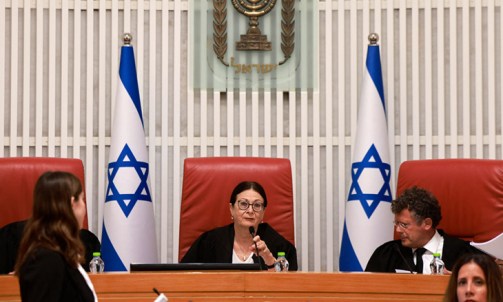
Arguments were heard this week in the Federal Court in the case of Lesbian Action Group Inc. v Australian Human Rights Commission where The Lesbian Action Group (LAG) is appealing a decision by the Australian Human Rights Commission (AHRC). The AHRC have ruled that LAG cannot lawfully publicly assemble to the exclusion of males who identify as lesbians.
I listened to the arguments this week, as I have listened to the arguments the AHRC has made through the Tickle v Giggle case and the Giggle v Tickle appeal, as well as the 2021 Tasmanian case where Jessica Hoyle was refused permission for the public meeting of female lesbians. It’s an ongoing TV show that I find less and less enjoyable.
The rules of play between gender critical feminists, like myself, and the AHRC have long been recognised. The first rule of play is that The AHRC have taken away the words we need to form our arguments, by changing the definitions of those words. The fun part of the game, is that we have to construct traditional feminist arguments, not just without our words of woman and female, but without the political and moral capital those words contain. This political and moral capital has been stolen by the AHRC.
Our argument this week, and every week, is that ‘female’ is a class of people that should be recognised in the law as a group with rights of political and cultural assembly to the exclusion of males. The AHRC’s argument is that trans identified males should be included in the sex class of female, legally, culturally, politically, and for all purposes, because they are the most oppressed of all women.
What AHRC need to make their argument sound reasonable and compassionate, is for us to be unable to use the words we need to describe ourselves. The AHRC have given trans identified males, not just the identifier of woman, but the entire category of female as something they can own with an identity declaration.
The AHRC have followed international population management models, where they construct arguments that in excluding males with a declared female gender identity from the class of female, we are not just being discriminatory, but morally repugnant.
I have known Carol Ann from LAG for some time, and this is not her first rodeo. Ms Ann has been fighting for single sex spaces against the AHRC for 30 years. The reason LAG and its members have been at the forefront of this fight around sex and gender identity is not just that they are lesbians, but that they come from a radical feminist separatist perspective.
Radical feminism is not feminism that is super radical. Radical feminism emerged in the 60s from the foundation belief that females as a class are oppressed by males as a class. Radical feminists view gender as a cultural system that is imposed on women to enforce patriarchal oppression. Radical feminists don’t just see lesbianism as an inherent sexuality, although it may be that, but as a choice that women make to separate themselves from patriarchal systems.
Therefore, the idea that a man can perform the gender stereotypes that societies impose on women, and use that ‘gender identity’ to enter the sex class of female, and to be a lesbian, is patriarchal in its nature and structurally incompatible with radical feminism.
In addition to ‘female’ and ‘lesbian’ being sex and sexuality classes for radical feminists, ‘female’ and ‘lesbian’ are political classes that are exclusive of all males. From the 60s until now, radical feminist separatists have rejected postmodern re-engineering of sex and sexuality that has been embraced by regime feminism.
With the rules of play between radical feminism and regime feminism well established, counsel for LAG came to the game contesting the AHRC rules of play. They argued that women should have their own sex class in law, that includes trans identified women (trans men), and men should have their own sex class in law that includes trans identified men (trans women), and from that position of biological reality, we should negotiate the rights of people with a gender identity to services and language in society. They further argued that it is the erroneous placement of trans identified males into the sex class of females that has caused problems.
It has been previously suggested by the AHRC, that while LAG cannot have public meetings or advertise their meetings, they can have members meetings, and screen members in accordance with what was referred to as their ‘ideology’. The part of LAG’s ideology that is problematic for public expression is not radical feminism, but that trans identified males do not belong in the sex class of female.
The private expression of the importance and immutability of human sex was not openly contested by the AHRC. You can legally whisper the reality of human sex to the cat in your house in Australia, but to openly express the belief that human sex is immutable, and that being a member of the female sex is politically consequential, and that the political consequences of being in the female sex class requires public assembly and action, is a step too far.
It was also suggested by the AHRC that LAG would still be allowed to hold public protests. When question about what these protests would look like, the counsel for AHRC became very vague, not clarifying if people could be invited to the protest, given that the protest obviously couldn’t be advertised. At one point, counsel for the AHRC made the caveat that the theoretical protests should not include people saying hateful things. Remember that the main thing the AHRC claim is hateful about LAG’s ideology is that trans identified males don’t belong in the sex class of female.
So, the possible lawful political activity of LAG, according to the AHRC, if LAG want to politically organise and challenge the current human rights laws, is to have a private meeting in their own house, or have a protest that they can’t advertise where they can’t say that trans identified males don’t belong in the female sex class. What is very obviously happening in Australia is the political oppression of feminism by the Australian government.
LAG brought to the court examples of relevant exemptions approved by the AHRC, where groups of people were legally permitted to discriminate against other groups of people based on sex and sexual orientation. These examples established that it is not unlawful, under the intention of the law, for discrimination to take place in Australia on the basis of sex or sexual orientation. One example was of a hotel for gay men who have an exemption to the SDA, to hold events that exclude heterosexuals and lesbians. The very telling response from the AHRC was that the assembly of those gay men was not for political purposes, getting to the crux of the problem that the AHRC have with LAG.
For radical feminists, sex and sexuality are inherently political. Radical feminist separatists seek to build a life and a culture, separate from men, to separate themselves from systems of male oppression. You may not agree with this lifestyle, you may think this lifestyle is impractical, but this branch of feminism has been alive a long time, and it now forms a key part of the broader gender critical feminist resistance to the gender identity laws that the AHRC impose on Australians.
The LAG appeal contested the accuracy of alleged associations made by an expert witness for the AHRC at the tribunal between a radical feminist and Nazi fascists. These tropes originate from constructed links between gender critical feminists, who attended a women’s event, and a group of Melbourne-based fascists who crashed that event. These false and defamatory links were comprehensively disproven in the Federal Court in Deeming v Pesutto.
The AHRC were thereby forced in the Federal Court to say that the radical feminist is not associated with fascism.
The question lingered then, if this feminist is not politically extreme, if radical feminism is not politically extreme, if therefore LAG is not politically extreme, why are their political activities being marginalised by the AHRC using the Sex Discrimination Act? This exercise of state power is particularly pertinent, at a time when our government claims to be unable to control genuinely hateful speech against our Jewish community by religious extremists.
The political assembly of women for the rights of females is the essence of the feminist movement. It is my opinion that the Sex Discrimination Act is being used by the AHRC to marginalise political action of women, and the academic school of feminism that supports the political action of women for the rights of females. This is a structural infraction by human rights organisations in our liberal democracy that must be addressed at the political level.
A revealing moment of note this week, was when counsel for the AHRC replied to examples of exemptions sought and granted in relation to the Sex Discrimination Act on the basis of sex and sexual orientation. Counsel for the AHRC said that we mustn’t make too much of exemptions to the Sex Discrimination Act because these were, by their nature, interim until equality in society is achieved.
Equality, according to the AHRC, is a society where sex is immaterial to women’s politics. In a world of Australian equality, women would never seek a separate space from men who had a ‘woman’ gender identity, because in a world of perfect equality, women would see no difference between a human with a female body and a human with a male body, when both people identified with the mystical gender of woman.
Equality, according to the AHRC, is men being allowed access to women’s prisons, because that’s the price women pay. Equality is men undressing in public facilities that were previously assigned for the exclusive use of girls and women.
Equality in Australia is the total removal of women’s sexual boundaries.
Edie Wyatt has a BA Hons from the Institute of Cultural Policy Studies and writes on culture, politics and feminism. She tweets at @msediewyatt and blogs on substack