The first thing that struck me as I crossed into central Gaza yesterday was how ordinary the landscape looked. Grassy hills, dark sandy banks, a coupe of stray dogs barking at the military jeep which drove me in.
Warnings. Leaflets. Shots in the air. The idea is to avoid fatal misunderstandings
As the gate opened for us to pass into the still mostly sealed off strip of coastal land we passed the unremarkable concrete blocks and barbed wire which separated Israel from its battlefield. We drove the stretch of road under the hot winter sun, along grassy fields that gave little away. After months of headlines, speeches and diplomatic theatrics, the entrance itself felt merely procedural. A short pause as the IDF (Israel Defense Forces) gave the all clear, and then we were inside.
I had come to see the yellow line.
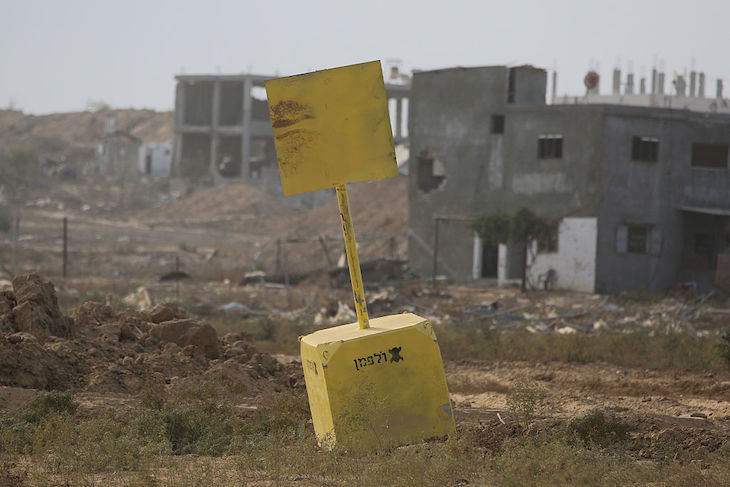
On paper, it is a ceasefire boundary agreed by both sides. On the ground, it is a strip of churned up land with bright yellow concrete blocks marking a dotted line across central Gaza, separating territory under Israeli control from areas where Hamas still governs. Israel currently holds roughly 58 per cent of the Strip. Beyond the line lie Deir al-Balah and the dense belt of refugee camps that have defined central Gaza since 1948. From the distance, these areas of built up urban centres look to me little different from before the war.
From the IDF post at Kissufim, this line is visible, unmistakable. It runs in a jagged, deliberate trace across the territory. There is no ambiguity about where one side ends and the other begins. And the line was agreed by all during the Trump-lead ceasefire process. But there is no actual fence or barrier. Instead the Israeli soldiers themselves are the fence.
I leaned against the newly constructed mound made from several feet thick of compacted earth, dotted with lookout points and Israeli soldiers with their guns trained outwards towards the other side.
“By the way, last time I was here, this whole wall wasn’t here,” Nadav Shoshani, the IDF’s international spokesman, said as we arrived. He rested a hand against the mound. “The reason it’s here is because Hamas keeps violating the line, sniping at our troops. Just in the last week, there were three attacks against our troops.”
He described them without flourish. “One was four terrorists coming out of a tunnel shaft, and the two others were snipers firing at our troops standing in an area that is agreed as an Israeli controlled area by an agreement that Hamas itself signed.” He nodded towards the boundary. “So there is a sniping rifle all along the yellow line, because Hamas keeps violating the agreement.”
It was quiet while we stood there. Wind over sand. A distant, dull crack of small arms fire. The kind of quiet that carries tension rather than relief.
Earlier, we had driven through the Kissufim humanitarian depot just inside Gaza. Pallets of aid were stacked in rows around the edges of the compound. On the Israeli side, the corresponding warehouse was empty, its contents already transferred. “This is aid that has been approved and tested and checked and inspected by Israeli authorities and now waiting to be picked up by the international community,” Shoshani told me. “Usually this is the situation that the depot on the Israeli side is empty and the depot here is waiting to be picked up.”
He said around 4,200 trucks a week now enter Gaza through multiple crossings. Kissufim, one of the smaller crossings, handles dozens rather than hundreds, but the system is functioning. Inspection, transfer, distribution. The process is methodical. It is also fragile.
From the elevated post, Deir al-Balah stretched out in concrete buidings and clustered streets. The central camps – Nuseirat, Bureij, Maghazi – sit in this same belt, their origins in the tent encampments of 1948 long since replaced by permanent housing and crowded neighbourhoods. Over decades, they became not just places of residence but political ecosystems. Hamas built much of its grassroots support in communities like these.
Between that history and the position where we stood lies the yellow line.
“The most challenging thing,” Shoshani said during our interview, “is Hamas violations every single day in this area and other areas. Hamas violates the agreement, tests us, checks our response time and tries to carry out attacks.”
He pointed out that the IDF post had been deliberately positioned 200 to 300 metres from the boundary to allow time for graduated responses. Warnings. Leaflets. Shots in the air. The idea is to avoid fatal misunderstandings. Yet he insisted the line itself is not the kind of place one crosses by accident.
In this sector alone, he told me, there are dozens of tunnel shafts. Even after extended operations in Rafah, new tunnels continue to be discovered and even built according to recent reports from reservists in the ground. “The IDF are world class experts in dealing with terror tunnels,” he said, “and still, after a year plus in Rafah, there are still tunnels. Which tells you the enormous amounts and the complexity of this vast terror tunnel network.”
The debate within Israel now turns on what to do with this reality. Some argue that holding 58 per cent of Gaza while maintaining sustained pressure on Hamas keeps Israeli civilians out of immediate range without incurring the costs of renewed full-scale war. Others question whether containment without disarmament merely defers the problem.
Shoshani returned repeatedly to the question of weapons. “The agreement says… Gaza will be a terror free zone. The agreement speaks about Hamas disarming.” Without that, the line becomes a defensive posture rather than a resolution.
Gaza, for now, is held in suspension. The war is paused
The strategic tension becomes sharper in light of recent statements by Hamas leaders abroad, including Khaled Meshaal and Osama Hamdan. Both have spoken openly about refusing disarmament and about the possibility of a long-term hudna, a five, seven or even ten-year truce, framed not as an end to conflict but as an interval. From their perspective, the October 7th attack altered the regional equation and demonstrated Israeli vulnerability. A temporary calm would serve consolidation rather than reconciliation: survival first, reconstruction next, rearmament over time. In that context, proposals for technocratic governance and the deployment of thousands of Indonesian troops as part of an international stabilisation force raise a further question: whether an external presence along the yellow line would restrain Hamas, or primarily constrain the IDF’s freedom of action. The answer to that will shape whether this pause stabilises Gaza or simply freezes it.
As we stood there, the proximity to Israeli towns was striking. “We are literally standing between Hamas and our civilians,” he said. “It’s a kilometer or two, just from where we are to where civilians live in Israel.”
That distance is short enough to feel.
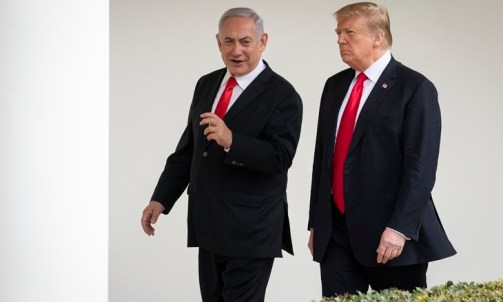
Beyond Gaza, diplomatic initiatives multiply. President Trump is expected to announce a major funding programme for reconstruction and to update plans for an international stabilisation force. Israel has joined his Board of Peace. Negotiations with Iran continue. The language of councils and charters circulates in Washington.
From the sand and concrete of the yellow line, those developments feel remote. What exists here is simpler: a wall that was not here two weeks ago, a boundary that is clear to the eye, aid waiting to be collected, and soldiers scanning a horizon where snipers have fired in recent days.
Gaza, for now, is held in suspension. The war is paused. The structures that sustained it are not yet gone. The yellow line marks control, not settlement.
I left as the sun hung low in the sky, struck more by the quiet than anything else. The last time I was in this area, constant artillery fire echoed through the air – the continuous booms of war. Now the warm setting sun and still February air cast a hazy calm over the strip, with only the soft buzz of the occasional drone in the sky.
But this may yet prove to be the calm before the storm. Standing there, the sense was not of resolution, but of containment – a narrow strip of territory carrying the weight of decisions that have yet to be made.