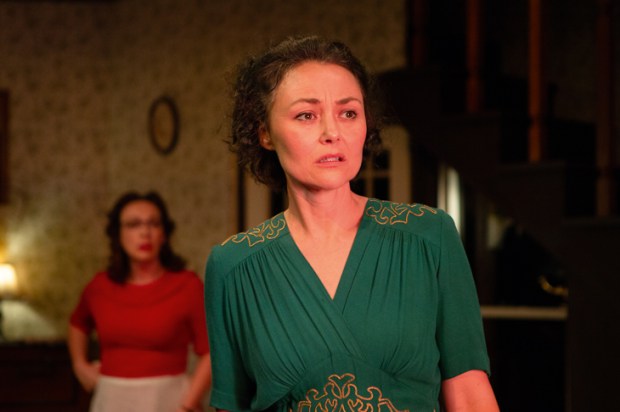
One of the excitements of seeing Ngaire Dawn Fair in the full trilogy of The Summer of the Seventeenth Doll is that anyone who saw her in Annie Baker’s The Flick directed by Nadia Tass in 2014 knows what it’s like to see a great actress in a great play with a great director. When we chatted she told me she would still like to play Titania, Queen of the fairies, in Shakespeare’s A Midsummer Night’s Dream and that she would also like to play Rosalind in As You Like It. Later that night she leaves a message saying she would love to do Heisenberg by the contemporary playwright Simon Stephens as well as People, Places and Things by Duncan MacMillan.
Heisenberg is a two-hander in which a middle-aged woman tracks down a 75-year-old Irish butcher. Where is truth in this world of heightened revelation? Georgie shifts, she swivels, she is the creature of her passions and uncertainties and that’s also true of Macmillan’s People, Places and Things which begins with Nina’s final soliloquy from Chekhov’s The Seagull and then presents Emma in therapy outsmarting everyone including herself.
But Ngaire Dawn Fair is a fascinating prospect as Olive in The Summer of the Seventeenth Doll and its fellows because she so often glitters in whatever she does. She also agrees with Sigrid Thornton that no actor chooses her career.
It’s fascinating to see Jack Thorne adaptor extraordinaire at work again. He co-wrote with J.K. Rowling Harry Potter and the Cursed Child, the day-long Hogwarts extravaganza. He did the adaptation of Dickens’ A Christmas Carol with a legion of Scrooges including David Wenham which had Melbournians, like Londoners, throwing money onto the stage.
In 2023 he did The Motive and the Cue which was about the 1964 Richard Burton Hamlet on Broadway directed by John Gielgud which had Mark Gatiss as an improbably plain and unstylish Sir John, a man who dripped the music of iambic pentameter and Johnny Flynn as only a faint shadow of the actor whose Hamlet rivalled his George in Who’s Afraid of Virginia Woolf. Johnny Flynn was marvellous in Martin McDonagh’s Hangmen. The Motive and the Cue might reach a more ideal form on film – let’s say with Ralph Fiennes as Gielgud and Matthew Rhys as Burton though that wouldn’t solve the problem that Burton was as handsome as his voice was burnished. But let’s not beat about the bush with Jack Thorne. He wrote Adolescence which is a masterpiece that even scared our politicians and he’s just written and produced a four-hour adaptation of William Golding’s Lord of the Flies (available now on Stan).
This 1954 parable is about a group of schoolboys who find themselves by misadventure – is there a world war all around them? – on a tropical island in the South Seas where they revert to their natures whether benign and decent or savage and crypto-fascist.
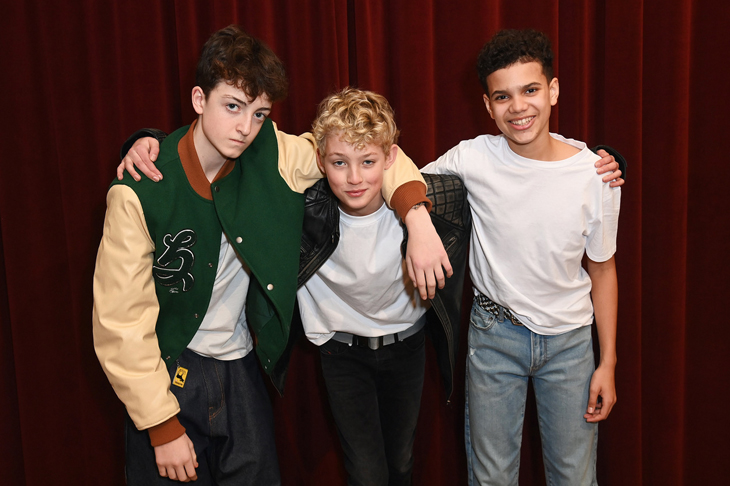
Jack Thorne’s Lord of the Flies begins brilliantly with an instantly recognisable Piggy who sings, ‘Hello, I must be going’ and combines democratic seriousness and his love of Harpo Marx jokes about fighting elephants in his pyjamas (‘What was he doing in my pyjamas?’). His voice has a Celtic burr and this hyper-intelligent boy who has to wear specs is weighed down by his intelligence and his natural tendency to seek a rational path. Winston Sawyers gives a magnificent performance as Ralph who eventually calls the stout spectacled boy (David McKenna) by his real name Nicky where the sado-jock boys stick to Fatty or Piggy. But this is a dazzling piece of acting and convinces us at a stroke that Jack Thorne has a telepathic entry card to this world of eleven-year-olds amid the savagery and slaughter in a paradisal setting.
And Winston Sawyers as Ralph, the school captain type who’s elected chief is extraordinarily vivid too and we believe in his hesitancy as well as his goodness as his stout mate in glasses shows him that whoever holds the conch has the God-given right to speak and the rule of law must prevail. Sawyer’s Ralph is soft-spoken, unsure of himself and extraordinarily brave. The characterisation is a throwback – he’s modest, he’s kind, he talks proper – and we trust him implicitly even in flashbacks when he’s learning what a grand petty officer his father was.
Things get a bit more problematic with Jack, the head of the choir group and the dark lordling of violence. It’s under Jack’s aegis that we hear all these injunctions to kill the pig, cut his throat. And there is an hour-long episode where we’re brought up close to his worries. We see him singing his Latin Masses and images of him in his war paint. We see him tottering on the edge of a fall and the way the dazzle of war paint is a walking insignia of a potential fascism. It’s all done beautifully – and with a full sense of the insecurity that lies behind political extremism but it’s a bit random (as the kids say).
Every scene of the Jack Thorne Lord of the Flies is magnificently achieved but the essential line of the story comes and goes. You feel especially uncertain about the premonitions of Simon, which depart from the tone of the book, about Samneric, about the flickering insecurity of the hunters.
At times it reminds us of how fleet and sparkling the Golding original is. It is, after all, a parable, a story that could be enunciated by a rhapsode. Golding was a self-taught reader of Ancient Greek.
There is a 1990s version of Lord of the Flies with Balthazar Getty but most people will compare this Jack Thorne version to the lean black and white version – done by the great stage director Peter Brook who made the film of Paul Scofield’s Lear – that has the vibrancy of fresh print. It is utterly credible, utterly unadorned. The sight of one of Jack’s hunters applying a cane to one of the younger boys says it all. Watch Jack Thorne though and revere him but don’t forget Golding’s masterpiece, so strange and so familiar.
We should kneel to Jack Thorne though because he has retrieved the kids’ story in Lord of the Flies and its beauty and terror. The bromance of Ralph, the brave boy, and his friend who has been known as Piggy and Fatty and is finally known as Nicky is beyond praise. It captures with an absolute poignancy the heart-rending power of friendship. Contra mundum.
Got something to add? Join the discussion and comment below.
You might disagree with half of it, but you’ll enjoy reading all of it. Try your first month for free, then just $2 a week for the remainder of your first year.