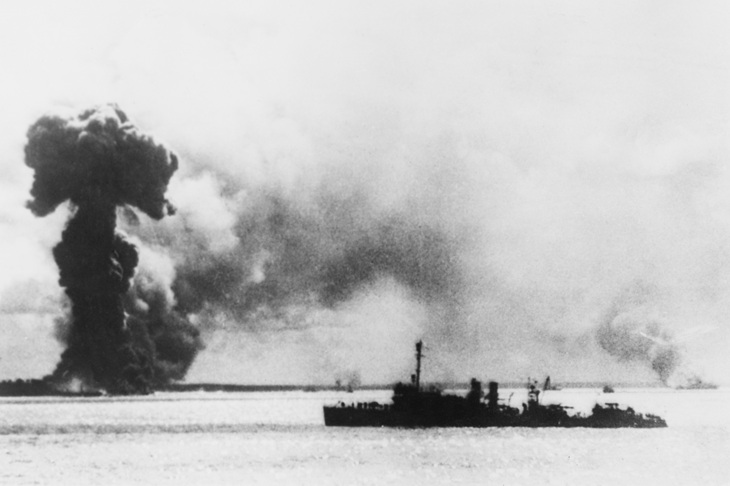
The anniversary of the first air raid on Australia occurs every year on February 19. The numbers associated with the 1942 attack – and beyond – give some measure of the huge extent to which northern Australia was involved in the second world war.
Two hundred and thirty-six is the number of deaths of Australians – and 128 of those were in American service – which occurred on the day. The raid was massive. One hundred and eighty-eight Japanese aircraft had taken off from four aircraft carriers, part of a 17-ship flotilla to Darwin’s north-west. The battle group went unnoticed, despite regular patrols by both the Australian and American forces. The previous month, there had been plenty of indications the Japanese were nearby: a four-submarine flotilla had laid mines outside the harbour and attacked ships with torpedoes. But that venture had not ended well: one of the submarines was sunk by the corvette HMAS Deloraine – it remains with its 80 crew members entombed outside the northern harbour to this day.
As the approaching Japanese aircraft neared the Tiwi Islands to Darwin’s north, a patrolling US Catalina was shot down, without being able to radio a warning in time; and nine Zero fighters were sent off to attack a twin-engine transport spotted on the runway of Bathurst Island. They sprayed it with gunfire, some of which overshot and hit the radio hut of Father McGrath, a missionary broadcasting a warning. These aircraft then proceeded in a straight line to Darwin, rather than the planned circular track which would bring the rest of the air armada in from the south-east, giving it the element of surprise and making the attack with the sun behind them. The nine Zeroes set about strafing the small ships at the boom net – the world’s longest – which stretched across the harbour from East to West Point. No warning was given, with the ships’ companies racing to their action stations to return fire.
Two is the number of Japanese who died, when their Val bomber was brought down by gunfire, crashing near Berrimah. Four is how many of their aircraft were brought down: another Val and a Zero fighter making sea landings, with their crew rescued, and a Zero crash landing on Melville Island, with its pilot captured. There was a claim that two more Vals were shot down, made by a US fighter pilot several months after the event. However, there is no evidence to support that; the supposed wrecks have not been located, and the Japanese carrier deck records only show four aircraft not returning, and two personnel dying. However, more than 30 of the Japanese aircraft were hit; testimony to the massed fire of the approximately 10,000 defenders; their rifles and machine guns, and the 3-7-inch anti-aircraft guns ranged in a circle around the town.
Six hundred and eighty-one was the total number of bombs released over Darwin. Four hundred and twenty-one is how many were released over Pearl Harbour, incidentally by the same aircraft and aircrew. However, the figure is somewhat misleading: the tonnage was greater in the Hawaii raid – 133,420kg of weapon weight, including 40 x 800kg torpedoes. Darwin’s tonnage was 114,100kg and torpedoes were not used. The loss of life in Pearl Harbour was far greater: 2,403 people were killed.
Thirty is the number of aircraft destroyed in the first Darwin raid. These included nine of the 10 P-40 Kittyhawk single-seat fighters being flown in defence by the US Army Air Force. Four of the pilots died as the 36 Zeroes set upon them with the advantages of height, speed, surprise, and experience. The pilots of the other five parachuted to safety or survived their crashes. Incidentally, they were not the first US military men to die. On February 15, Lieutenant Robert Buel had fought a four-engine Japanese flying boat north of the Tiwis. The aircraft shot each other down; one of the Japanese died; and Buel and his aircraft have never been found. The rest of the flying boat crew were later captured, and sent south to Cowra Prisoner of War camp.
Eleven is the number of ships sunk as a result of the raid. Two were attacked near the Tiwi Islands. The others were sunk in the harbour. The destroyer USS Peary was the largest loss of life, with 88 of her crew dying as she fought the aerial attackers to the end. It was revealed in 2020 that her propellers had become separated from her as she sank, with the stern virtually blasted off – testimony to the fact that there are still more stories to be found in Top End history. As part of that one of the ships has still not been found: the small Navy tanker Karalee is somewhere in Darwin Harbour. But given the harbour is larger than Sydney’s, and perpetually murky with the sand stirred up by the tremendous tides, perhaps this vessel will remain lost for a while longer.
Seventy-seven is the number of air raids carried out against Darwin. Sixty-four was a previously much-used figure, until research carried out in Japan for my book The Empire Strikes South showed a greater total. This was out of 135 combat flights over the Northern Territory – many being reconnaissance to ensure useful targets were available for the massive combined raids of Zero fighters and Betty bombers. The total number of individual enemy aircraft flights over northern Australia is 1,883, with the last aircraft shot down in July 1944 over Truscott Airfield in Western Australia.
Many of the Japanese aircrew remain in Australia forever. Sixty-two of the Imperial Japanese Navy aircraft were brought down in Australian territory, most in the sea. Only some of the wrecks have been found. One hundred and eighty-six of the airmen died here. Sometimes their bodies were buried at the crash sites by the Allied personnel seeking intelligence from the crashes. It was a lonely ending for men who fought hard and well in a strange land.
Dr Tom Lewis OAM is a military historian. One of his most recent publications is Australia’s Coastal War (Big Sky), which outlines all of the enemy submarine, aircraft, and surface attacks around the country in the second world war.