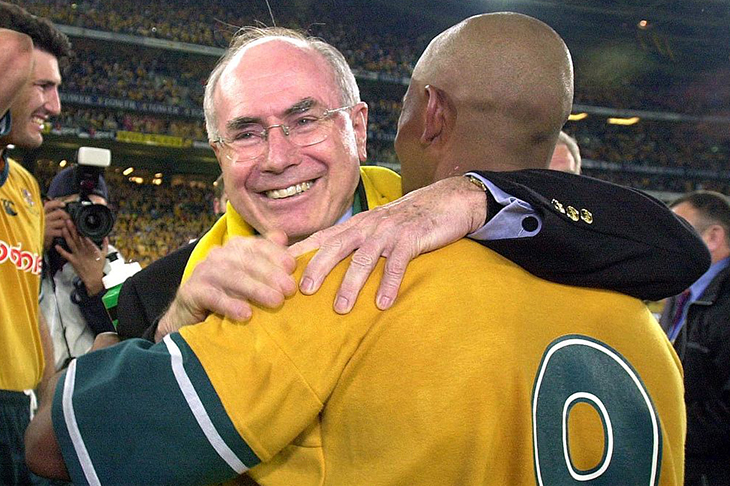
This week marks the thirtieth anniversary of the election of the Howard government. On 2 March 1996, John Howard led the Liberal party into government after 13 years in the wilderness, defeating Paul Keating’s Labor in a landslide.
Mr Howard became Australia’s second-longest serving prime minister, after the founder of the Liberals, Sir Robert Menzies. Maybe that was because Mr Howard, like Menzies, understood the Liberal party’s values and the importance of fighting for them.
Upon resuming the Liberal party leadership on 30 January 1995, Mr Howard told Australians, ‘I’ve always believed in an Australia built on reward for individual effort, with a special place of honour for small business as the engine room of the economy. I’ve always believed in a safety net for those amongst us who do not make it. I’ve always believed in the family as the stabilising and cohering unit of our society. And, I believe very passionately in an Australia drawn from four corners of the earth, but united behind a common set of Australian values.’
By that time, Mr Howard had been in the parliament for 20 years, and Australians knew what he stood for. Indeed, as Gerard Henderson wrote in A Howard Government?, one of Howard’s greatest strengths was that ‘He was a committed Liberal defending Liberal causes when the intellectual fashions were moving to the left.’
Where there is conviction there will be impact. That is what, since the defenestration of Tony Abbott by Malcolm Turnbull, the Liberals have failed to understand. Today, most Liberal MPs wouldn’t know where to begin a policy contest or even what one looks like.
The electoral numbers tell the story. At the 2013 election, the Coalition, led by Abbott, won 90 seats (the Liberals winning 74 of those), defeating Labor in a landslide. After the last election, the Liberals hold a record low 28 seats. So, since 2013, the Liberals might have lost seven seats to the Climate 200 Teals, but they also lost another 39 elsewhere.
The recently deposed leader Sussan Ley has been in politics for 25 years and it is still not clear what she stood for or what she has achieved in public life. Hence, under Ley, the Liberals’ primary vote collapsed from 32 per cent to just 18 per cent.
It is also the failure of style over substance. How often was it said that John Howard and Tony Abbott were ‘unelectable’? However, the public knew they stood for certain things. They might not always agree with those things, but at least Howard and Abbott had convictions.
Politics is the battle of ideas and to communicate ideas you need leadership. Remember the GST? It was arguably the biggest gamble of Mr Howard’s political life, but it was rewarded because he was able to convince voters it was for the good of the country. Just as we saw during the Voice referendum, leadership can change public opinion.
The same conviction was seen in Mr Howard’s immigration policy. In August this year, it will be 25 years since the Howard government turned back the MV Tampa, the Norwegian freighter carrying boat people who, having passed by many safe-haven ports in other countries, wanted to get to Australia. Following this, Mr Howard made that famous declaration: ‘We will decide who comes to this country and the circumstances in which they come.’ It was the mantra that guided Tony Abbott to a landslide victory in 2013.
Now, Europe, after decades of playing Pollyanna on immigration policy, has decreed a new chapter for migration control, ‘guided by the principle that Europe decides who comes to the EU’.
Often derided as the ‘dour Sydney solicitor’, Mr Howard realised that outside of noisy self-appointed cultural dietitians and the political class, most Australians have neither the time nor the luxury to get excited about politics. Their concerns centre on how to pay the mortgage, put food on the table, and get the kids to school.
This is perhaps why, in an interview given to the ABC’s Four Corners during the 1996 election campaign, Mr Howard declared that he wished to see Australians ‘comfortable and relaxed’ about three things: their history, their present and their future.
In 1995, not unlike the present, Australia was facing severe economic problems, but Mr Howard told Australians that we could be a nation based on hope, on reward and incentive for the individual, confident of its history and its place in the world, and that our best days lay ahead of us.
It is quite possible that he was inspired by these words of Robert Menzies at the founding of the Liberal party in 1944: ‘It represents our great chance to give a means of expression to the deepest feelings to hundreds of thousands of Australians who are frustrated by the present and who are seriously alarmed about the future.’ Voters have moved away from the Liberals because they have not provided leadership on the issues voters care about, especially thanks to a lack of policy differentiation from Labor. Voters need to be presented with the clearest possible choice and, rather than a pale imitation, they will pick the real thing every time.
Even so, the Howard government was not perfect. Having received a majority in both Houses at the 2004 election, it proceeded to overreach with the WorkChoices legislation. It has arguably led to the re-regulation of the industrial relations system, taking Australia back to the 1970s.
It is a pity since the Workplace Relations Act enacted after the 1996 election was up to that time the most serious industrial relations reform in the history of this country and helped lay the foundation for the economic prosperity that Australia enjoyed during the Howard years. However, as Mr Howard stated himself in his memoirs, Lazarus Rising, it is difficult for a government to remain in office for much longer than a decade unless the opposition is dysfunctional. Just as was the case in 1995, there are now millions of Australians aching for a change of government, and it required John Howard, a man with conviction, who could brawl with Paul Keating, to convince them to make that change.
Thirty years later, the Liberals need to fight like John Howard did, with conviction and authenticity, for those millions of Australians who are frustrated by the present and who are seriously alarmed about the future.
Got something to add? Join the discussion and comment below.
You might disagree with half of it, but you’ll enjoy reading all of it. Try your first month for free, then just $2 a week for the remainder of your first year.