Music has the odd quality of being an abstract art as well as one that generates great gulfs and legions of feeling. That’s why that great actress Sheila Hancock – who came to Australia a lifetime ago to play Nancy in Oliver! – could say (with extraordinary conviction) that Bach’s St Matthew Passion was the greatest expression of human feeling ever made.
The best Fagin I have seen – and I did not see Barry Humphries portrayal of him as a European Jew of dazzling, in fact unequalled, charisma –was Richard Wordsworth. He had a family connection with the poet of that name, and in the mid-1960s – soon after the D’Oyly Carte copyright lapsed – he came to Australia to play the comedian roles in The Mikado, The Pirates of Penzance, The Gondoliers and Trial by Jury. The productions – were they directed by Betty Pounder? – were stylishly produced and directed and in the memory they outshone subsequent productions. Richard Wordsworth was a consummate master of the patter song, those extraordinary bits of sprechgesang that contain Gilbert’s most scathing and sparkling lyrics.
Gilbert and Sullivan wrote Monty Python before the letter. Paul Eddington (from Yes, Minister) cut a swathe here in Australia back in 1978 – when he played the Ruler of the Queen’s Navee – and if you want to examine that great film director Mike Leigh’s devotion to the culture of the British people, take a look at his semi-doco about a G&S Topsy-Turvy. It has Jim Broadbent as Gilbert and a pile of upper class Britishers talking in French (which apparently they did, like the Russians). It also includes a breathtaking performance by Martin Savage as George Grossmith who sang the patter songs and created the comedian roles. Grossmith was also a morphine addict who wrote a classic Diary of a Nobody.
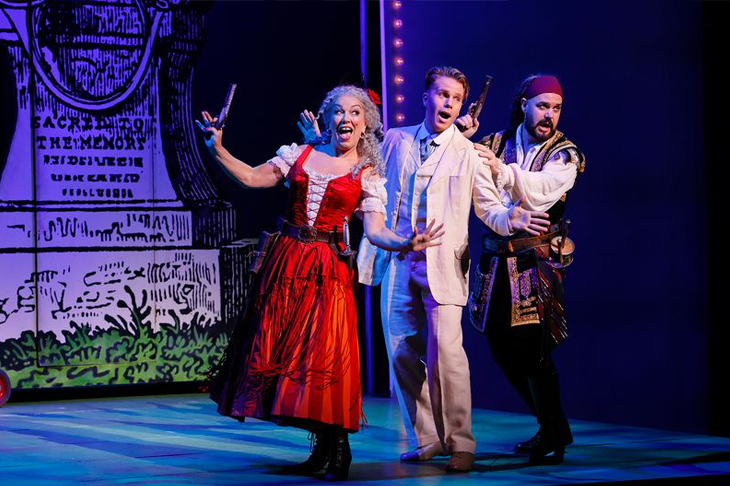
The most famous mid-century figure to play roles like the Major General was Martyn Green though Groucho Marx did a wonderful, abridged CBS version of The Mikado in his pure New York accent. It’s fascinating to see Richard Piper – who is a lover of twelve bar blues – having to sing ‘I am the very model of a modern major-general I’ve information animal vegetable and mineral’. He gave a great performance as Shakespeare’s Henry IV and the Victorian Opera production of The Pirates of Penzance is worth the price of admission to see him handle the fastest and most exacting of the patter songs and it’s pleasing to report that he has all the speed and brio you could wish for. This is not to deny that it was an extraordinary camp indulgence for the Gilbert and Sullivan veteran Stuart Maunder to allow Richard Piper to prance about in a kilt.
Everything is surrounded by a box effect of bright lights and it would have been nice to have surtitles to make the chorus a little more intelligle. It’s great to have Nina Korbe’s supreme creaminess of tone in her rendition of ‘Poor Wandering One’ but her chorus of maidens are just musical mouthfuls of sound. James Pratt is the conductor and he has a programme note talking about his first Pirates of Penzance with Dennis Olsen with his ‘whipsmart presence’ and ‘machine gun patter’ turning him into a convert.
The difficulty with Gilbert and Sullivan in all the major operas is that they require—ideally—to be directed like Mozart or Shakespeare and not like a high school romp however much of a pull of nostalgia ancient memories hark back to the knockabout amateurism of early encounters. Stuart Maunder’s Pirates for Victorian Opera pulls in opposite directions. Ben Mingay is vocally a superbly endowed Pirate King—and he doesn’t have to fall back on Anthony Warlow imitating Johnny Depp imitating Keith Richards—but he and Nicholas Jones, the superb tenor who is a principal of Paris Opera, would benefit from a production a bit less knock-about than this one, amiable though it is. Yes, it’s a fine thing that the police sergeant is played by Christopher Hillier who has in his stalwart time sung Don Giovanni and Gunther in the Melbourne Opera Ring and performed in the premiere of Richard Mills’ Galileo but you’re not going to compete with the classic version of Owen Brannigan singing ‘A policeman’s lot is not an ‘appy one’ unless the whole production is seriously vibrant as theatre.
You can look at this in two opposite ways. You can say with Mike Leigh that Gilbert and Sullivan is absolutely the voice of the folk, that it creates at a level of genius an in for people who have no automatic access to Verdi or Mozart let alone Wagner to penetrate a world where high musical art meets with satire to create something like the high art of a form of comedy. Dick Hamer, onetime premier of Victoria, said, ‘You start with G&S and that cuts the mustard and leads on to the rest of it.’ Kiri Te Kanawa was the context from memory. But the other way of looking at this which you could have here expressed by seasoned theatre people was that Gilbert and Sullivan was the voice of English imperialism at its most intoxicated, its now shoe thumping and repellent form of Little England-ism, the uncontrolled roar of the British reich. And all the more so for Sullivan’s mastery of the melodic sentiment of contemporary European criticism. In other words Gilbert and Sullivan can have the weird kind of ambivalence that Kipling could create, in George Orwell among others. Peter Hall, the founder of the Royal Shakespeare Company and the head of National Theatre, was a serious director of opera and described Gilbert and Sullivan as representing everything that he despised about England.
On the other hand it’s worth remembering that Sir Charles Mackerras had two great extramural enthusiasms (apart from the Mozart and the Wagner): one was Janáček and the other was Gilbert—both in combination with Sullivan ––or in the ballet piece he created with choreographer John Cranko, Pineapple Poll which was based on Gilberts’ ‘The Bumboat Woman’s Story’. But we are consolidating our sense of modernity, our sense of music. There are new biographies of David Bowie. In Melbourne, the ever enterprising Red Stitch Actors’ Theatre are doing the whole of Ray Lawler’s Doll trilogy with the vastly talented Ngaire Dawn Fair and Richard Roxburgh is soon to embark on a national tour that dazzling play Art by Yasmina Reza.
Got something to add? Join the discussion and comment below.
You might disagree with half of it, but you’ll enjoy reading all of it. Try your first month for free, then just $2 a week for the remainder of your first year.