There is (isn’t there always?) a crisis in nonfiction publishing. But this time it really is a crisis, or at least, it seems more of a crisis than the previous ones. The problem is: not enough people are buying the stuff anymore. Last year’s nonfiction sales were down fully six per cent on the 2024 figures, and the long-term graph gives a picture of consistent, rapid, decline.
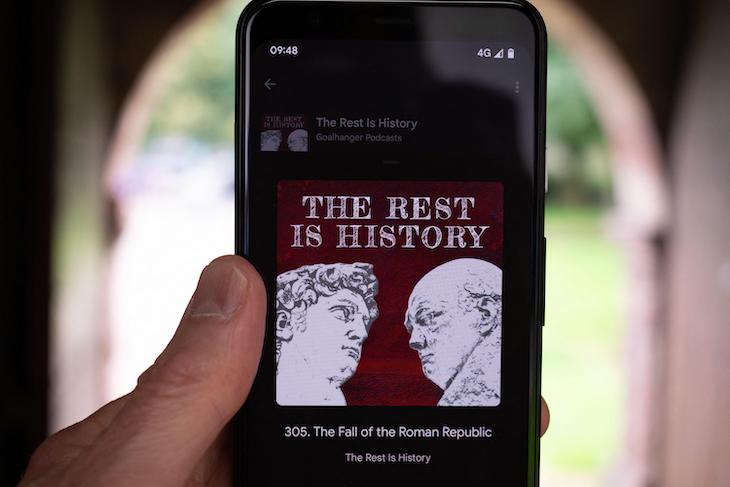
Tom Holland and Dominic Sandbrook, who host the superb podcast The Rest Is History, are part of the problem as well as part of the solution
Woe to the world. As someone who has skin in the game – not a lot of skin, admittedly; more like one of those sore bits you get when you’ve been chewing the corner of your thumb – this grieves me. Some of us, who grew up in the 1980s and 1990s, saw the nonfiction shelves of the library as the intellectual world’s equivalent of the city on the hill.
Here was the sum of the world’s knowledge, filtered and distilled in each case by the individual voice, prose and sensibility of great writers who had put in countless hours researching and weighing the results of their research. Wikipedia may, in some sense, make more of the world’s store of knowledge available than ever before – and a great boon that is, too – but a well-organised pile of facts is a different proposition from a library of nonfiction books.
The problem now is not just about quantity: it’s about type. Such nonfiction as is being sold is not of the sort that I describe above. The only four nonfiction books to make it into last year’s top twenty bestsellers were Charlie Mackesy’s Always Remember (that’s the Boy, The Mole and the Ferret guy; not really nonfiction as we know it anyway), Mel Robbins’s The Let Them Theory (self-help cobblers), Jamie Oliver’s Eat Yourself Healthy (self-help celebrity recipes) and, because it always sells tons, The Guinness Book of World Records.
Hwaer cwom, as an Anglo-Saxon would wonder, Michael Holroyd and Peter Ackroyd? Hwaer cwom Claire Tomalin and Jenny Uglow and Germaine Greer? Hwaer cwom Richard Ollard and Richard Ellmann and Antony Beevor? It is hard to imagine publishing careers like theirs – many of which continue honourably though in a lower key – being launched today.
This is a pipeline problem. Because sales are down, publishers are not able to offer the sorts of advance that make it possible for, say, a biographer or historian to spend the two or three or several years it takes to research and produce something that brings anything genuinely new to the table. Academics can sometimes spin something out of the research they are salaried to do – but the requirements of the Research Excellence Framework tend to mitigate perversely against publishing trade books, and most academics have been rigorously trained to write badly anyway.
As a result, publishers increasingly, and understandably, bet on sure things. That is, celebrities, self-help, big-idea books, food stuff, and authors with a giant Instagram or TikTok following. Subject-wise, you still can’t go wrong with Nazis – though am I right in detecting that Napoleon is at last dropping off in popularity? Perhaps TikTokers struggle to spell his name). Instant books about AI, Ukraine and Gaza are plentiful – I assume because the hope is that by hewing to the headlines you get a penumbral benefit from the existing interest in such subjects.
But ‘instant books’ it tends to be. Even where we’re looking at political or literary biographies, or books of narrative history, the economics means that ever more of these are being churned out from secondary sources. Those secondary sources are often the standard biographies published in the 1970s or 1980s. The big thing, though, is memoir. Why? Because memoir doesn’t (with some exceptions; looking at you, The Salt Path) tend to require pesky fact-checking, because it doesn’t ask its authors to do much research, and because it has that easy emotional human-interest hook.
A few years back I suggested writing a popular biography of Daniel Defoe – super interesting figure, rackety life, fabulously important in literary history – and was told that no publisher would bid on it. If I were to write about how reading Defoe saved my life or improved my mental health, though, it was suggested, I could be away to the races. Unfortunately, I was able to claim neither of those things with any plausibility. I just thought Defoe was interesting. And he is.
People haven’t ceased to be interested in the lives of great men and women, or in the history of this or that period, though. The indication seems to be that now they would rather take in that sort of information from a podcast. As a report in yesterday’s Sunday Times had it, that’s ‘not just because authors who appear on them give away the best bits of their books, but because listeners can absorb from podcasts the kind of knowledge they would once have only been able to get from thoroughly researched tomes’. I’d quibble with that, a little, and not just because of the use of the word ‘tome’: I don’t think even a very good podcast can impart the depth of knowledge a book can. But it can certainly give the illusion of it. And, of course, these podcasts rely for their content on the very books whose production they are making impossible.
My old friends Tom Holland and Dominic Sandbrook, who host the superb podcast The Rest Is History, straddle the before-times and the now. They are part of the problem as well as part of the solution. They have both written fine and substantial history books; now, they make one of the podcasts whose success is eating away at the market for just such books. Why, I find myself wondering, would they bother writing books these days when they’re making the equivalent of a very chunky book advance every month just by having a chat (admittedly, a very erudite chat) on the internet? It’s to the credit of their self-respect that they still try.
Nevertheless, we who care about books as vectors of deep and lasting knowledge – and of personality – are in a tight spot. If you want a picture of the future, imagine a podcaster stamping on a shelf of books – for ever.