Sir Keir Starmer’s announcement last February that the government would increase defence spending to 2.5 per cent of GDP from April 2027 seems a long time ago. It was trumpeted as the ‘biggest sustained increase in defence spending since the Cold War’, but in fact represented a very modest rise from the 2.3 per cent of 2024/25. Events of the past year have now left it looking cautious and inadequate. As a direct consequence of this measly funding, Britain now looks set to lose out on the opportunity to update its stock of military helicopters, putting jobs – and the country’s defence – at risk.
In recent days, we learnt that the Ministry of Defence (MoD) estimates it will need another £28 billion over the next four years to meet the commitments it has set out. This includes making the ‘step-change in British defence’ laid out in last June’s strategic defence review (SDR). The Chief of the Defence Staff, Air Chief Marshal Sir Richard Knighton, set this out to the Prime Minister and the Chancellor of the Exchequer at a meeting shortly before Christmas. Starmer was reported to be unhappy and disappointed, having believed that the SDR had been fully costed. It is, however, unclear whether Starmer persuaded himself of this implausible scenario due to inattention, a basic failure of understanding or an impressive degree of self-deception.
What credibility the government had is draining away quickly, perhaps irretrievably
This situation is made worse by the fact that the headline funding figure published last February obscured the detail that the Ministry of Defence’s Equipment Plan 2023-33 already had a shortfall of nearly £17 billion between requirements and resources. This was large enough to potentially absorb most or all of the additional funding and did little more than echo a pledge made by Rishi Sunak’s Conservative government in April 2024 to raise spending.
The immediate outcome is that the defence investment plan, a 10-year implementation strategy for the SDR which was due to be published last autumn, has now been delayed and is being heavily revised. It is unlikely it will be revealed at least until spring this year, and if it does not include a significant extra increase in funding for the armed forces – an outcome which few, if any, seriously expect, given the state of the public finances – the MoD will be forced into billions of pounds’ worth of deferrals, delays and cuts.
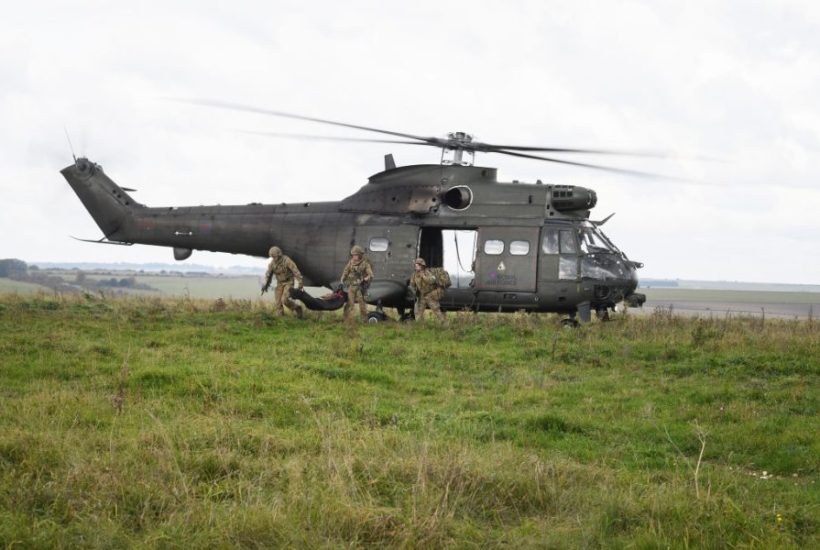
These are not theoretical problems: one of the consequences is charging down the line towards the government at high speed. In May 2022, the MoD announced a competition for a new medium helicopter (NMH) to replace the RAF’s Airbus HC Mk 2 Pumas, workhorses which first saw service in 1971. The following October, four contenders for the contract were selected: Airbus, Leonardo UK, Boeing and Lockheed Martin. The bidding process then opened in February 2024, but by the deadline of August of that year, Italian-owned Leonardo UK was the only competitor.
Awarding a contract when there is only one bidder is never ideal from a commercial point of view, though it is a situation with which the MoD is familiar enough. That, at least, should have moved the project forward and provided a neat kind of continuity: Leonardo UK’s helicopter division is the successor to AgustaWestland S.p.A., formed in 2000 by a merger between Italian firm Agusta and Yeovil-based Westland Helicopters, the latter of which had collaborated to manufacture the Puma. But the MoD sat on its hands and delayed awarding the contract.
The £1 billion contract to build up to 44 helicopters (though the total may end up being rather fewer than that) has still not been awarded. Late last year, Leonardo’s chief executive, Roberto Cingolani, wrote to Defence Secretary John Healey. He warned that the ongoing delay in finalising the NMH contract, a ‘cornerstone’ of his company’s UK strategy, was threatening the viability of its Yeovil facility, which employs 3,000 workers directly and supports a supply chain of another 9,000.
Not only that: Cingolani warned that ‘any delay or cancellation in the programme award… would force a reevaluation of Leonardo’s UK presence, including investment in electronics and cyber security divisions.’ It has facilities in Edinburgh, Newcastle, Lincoln, Luton, Bristol, Basildon, London and Southampton, employs nearly 9,000 highly skilled workers and contributes an annual £2.5 billion to the British economy. But Cingolani has made it clear that his company’s current offer expires in March and that a positive response is vital before then.
The MoD’s response to this urgent plea?
The UK’s New Medium Helicopter programme is ongoing and no final procurement decisions have yet been made. That outcome will be confirmed in due course.
The dawdling, non-committal attitude of the MoD is made yet more astonishing and unacceptable by the fact that the Puma fleet, which the new medium helicopter is supposed to replace, was retired by the RAF in March last year. There is currently a major capability gap in transport helicopters, and the government has not yet even decided how to fill it.
Ministerial bromides on ‘war-fighting readiness’ and ‘the biggest boost to defence spending since the Cold War’ are utterly worthless unless they are matched by action. The case of Leonardo shines a harsh light on this: the RAF needs new helicopters, only one company is in the running to supply them, the previous aircraft are now out of service and without the contract it may be forced to close its whole UK-based operation. And still the government does nothing. What credibility it had is draining away quickly, perhaps irretrievably. There are no excuses.