In a city awash with visual propaganda, one mural in Caracas is especially striking for the western visitor. In it, Jesus Christ stands alongside Imam Mahdi, a prophesied messianic figure who many Muslims believe will appear with him during the End Times to restore peace and justice to the world.
There is only one Venezuelan – the late president Hugo Chavez – among the six smaller figures on the mural. Three are Iranian, including Qasem Soleimani, a commander in the Islamic Revolutionary Guard Corps elite Quds Force, killed by a US airstrike in 2020. One is an Iraqi commander killed in the same strike, and the last is Lebanese, Imad Mughniyeh, a founder of Islamic Jihad in Lebanon and number two in Hezbollah until his assassination in 2008. ‘The way of the martyrs is derived from the way of the divine prophets,’ reads the legend.
The ‘Mural de Salvadores’ is a reminder of the close ties – spanning military, security and terrorist (Hezbollah) co-operation, sanctions-busting, money-laundering, drug-smuggling, cyber, technical assistance, cultural centres, educational scholarships, ideological and industrial support, even car manufacturing – which have steadily strengthened between the revolutionary regimes in Caracas and Tehran in recent years. Donald Trump’s spectacular decapitation of the Nicolas Maduro government has just dealt this anti-imperialist alliance, a key part of Tehran’s much-vaunted ‘Axis of Resistance’, a powerful blow from which it is unlikely to recover.
It deals Tehran’s much-vaunted ‘Axis of Resistance’ a powerful blow from which it is unlikely to recover
The love-in between Iran and Venezuela dates back to the beginning of this century. The rabble-rousing Chavez, mastermind of a Bolivarian Revolution which helped transform a rich democracy into an impoverished dictatorship, visited Iran several times, with his counterpart President Mohammad Khatami returning the compliment. President Ahmadinejad continued the affair with Chavez, the two men signing more than 270 bilateral deals and regularly declaring brotherly love.
In 2006, Chavez pledged that Venezuela would ‘stay by Iran at any time and under any condition’. Ahmadinejad called Chavez ‘a brother and trench mate’, a relationship commemorated in the topography of both capitals. While Caracas has its ‘Mural de Salvadores’ and the Iran-Venezuela Friendship Avenue, Tehran has its Simon Bolivar Boulevard and a statue of the 19th-century Venezuelan independence leader.
Under the banner of revolutionary resistance, both regimes have intensified their mutual support. In 2009, Chavez reported that Iran was helping Venezuela explore for uranium at a time when reports were surfacing of Hezbollah operatives entering the country. When, in 2019, Venezuela was hit by one of its worst electricity blackouts in living memory (Caracas blamed the US for a cyber attack), Maduro claimed that Soleimani immediately offered to assist. There were reports of Iranian experts on the ground within a couple of days to rescue the stricken energy grid.
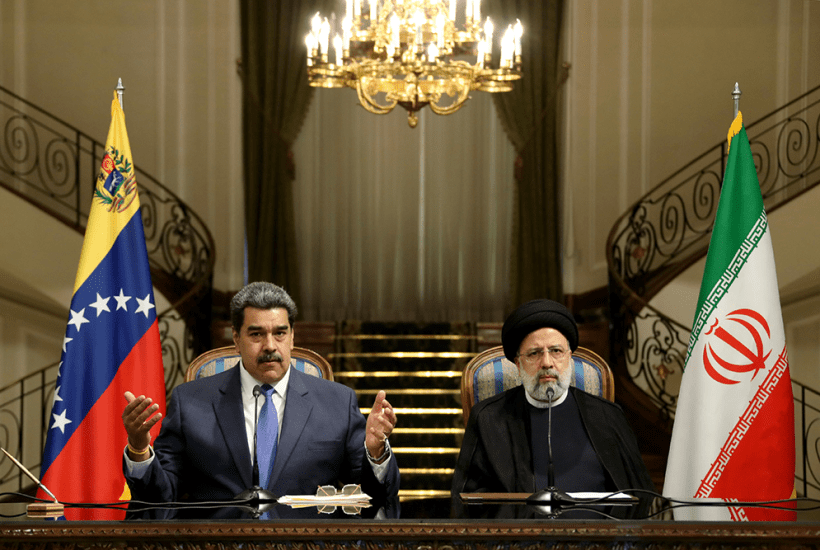
More recently, in 2022, presidents Maduro and Ebrahim Raisi signed a 20-year co-operation deal covering oil, petrochemicals, defence and security, tourism, culture and agriculture. Raisi praised Venezuela for its ‘exemplary resistance against sanctions and threats from enemies and imperialists’. Last year, a paper from the US thinktank RAND reported that the Chavez and Maduro regimes had established Venezuela as ‘an operational hub for Hezbollah’, enabling the terrorist group to maintain active cells engaging in drug trafficking, money laundering and smuggling. Only last month, Iran’s President Masoud Pezeshkian pledged ‘unconditional support’ to Maduro while condemning the American military build-up in the Caribbean. Much good it did Maduro.
Trump’s snatch of the Venezuelan leader is unquestionably a strategic setback for Iran. At a stroke it reduces Tehran’s influence in the West and weakens the Axis of Resistance’s anti-western narrative, says Sanam Vakil, director of the Middle East and North Africa Programme at Chatham House. ‘It was important for Iran to show that it was not isolated, and had a reach into the western hemisphere. The two regimes collaborated on energy and sanctions-busting, building a network of mafia-like actors across the region, bringing Hezbollah and Russia into the mix, and possibly sharing intelligence.’
It is not as if Tehran doesn’t face any other existential challenges, regime survival foremost among them. After the audacious special forces strike against Maduro, Iran’s mullahs – already beset by spreading nationwide protests, a currency in freefall and a tanking economy crippled by sanctions, mismanagement and corruption, plus inflation estimated by the International Monetary Fund at 40 per cent or higher this year – will be sleeping less easily in their beds.
‘The regime will have watched with concern the developments in Venezuela, another regime in which they have invested extensive moral and political capital,’ says Ali Ansari, a professor of Middle East history at St Andrews University. ‘It will undoubtedly be a worry for them, especially in light of Trump’s defence of Iran’s protestors.’
Precisely what Trump means by his ‘locked and loaded’ threat to Tehran in the event of the regime shooting protestors – as it continues to do – remains unclear. ‘Without putting boots on the ground he cannot protect protestors,’ says Nicholas Hopton, director-general of the Middle East Association and a former British ambassador to Iran. ‘The most he would likely be able to do is bomb specific regime targets. Iran is a more complex country than Venezuela and the US will understand that simply grabbing the Supreme Leader or President Pezeshkian – even if they could – would not achieve regime change by itself.’
Though few Iran watchers are predicting the imminent collapse of the regime (does anyone remember Said Aburish’s 1994 book The Rise, Corruption and Coming Fall of the House of Saud?) many now believe it is running out of revolutionary road. Simply put, it has no solutions for either the economic catastrophe over which it has presided or the crisis of political legitimacy which is inherent in the theocracy. ‘The only way to address that is negotiations or a deal with Trump and, though they’ve discussed it and flirted with the idea, they haven’t yet arrived at the point where they can do that,’ says Vakil. Repeated US and Israeli strikes on Iran last year have hardly helped prepare the ground for a return to diplomacy.
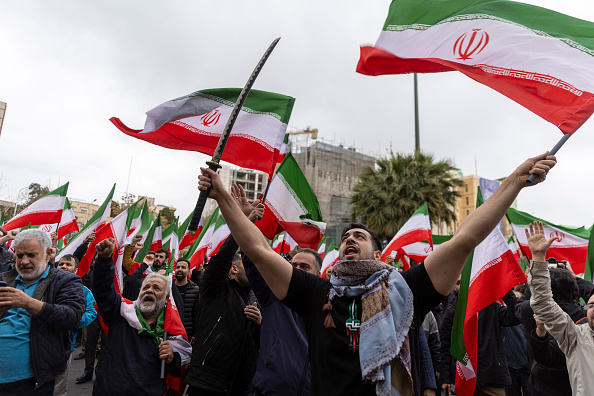
Absent regime collapse or meaningful reform, the likeliest way forward, at least in the short term, is continued repression. The fact that protests have broken out with increasing regularity this century (the Green Movement of 2009-10, nationwide protests in 2017-18, the Mahsa Amini uprising of 2022 triggered by her death in police custody after being arrested for not wearing a hijab) before their successful and bloody suppression does not mean that this latest outbreak of dissent is without risk. Ominously for the mullahs, the traditionally loyal bazaari merchant class has joined in this time.
‘They can’t afford not to take this seriously,’ says Charles Gammell, a former Foreign Office official and Iran expert. ‘Each protest carries with it the ghosts of protests past. They’re now caught between the Scylla of the demands of their own people and the Charybdis of the foreign pressure they’re facing. Do we give subsidies or rebuild our missile programme?’ These latest protests, says Ansari, are ‘another nail in the coffin of a regime’ devoid of answers.
Outwardly, at least for now, it’s business as usual for the mullahs. On 3 January the Tehran Times (in its own words, ‘not the newspaper of the government; rather it is a loud voice of the Islamic Revolution and the oppressed people of the world’) ran an article by Faramarz Kouhpayeh on ‘Everything you need to know about recent protests in Iran’. To paraphrase, there was nothing to see here, just ‘a healthy sign of a living democracy’, a spot of light turbulence exploited by America and Israel. As courageous protestors are bundled into custody or killed, and Iran’s professional middle classes descend into poverty and hardship, the gap between revolutionary rhetoric and reality is wider than ever.
When Chavez died in 2013, Ahmadinejad, who many felt was unhinged, said the Venezuelan revolutionary president would be resurrected. ‘I have no doubt Chavez will return to Earth together with Jesus and the perfect [Imam Mahdi] to establish peace, justice and kindness,’ he said.
With Maduro gone in Venezuela and the mullahs still clinging to power in Tehran, millions of Iranians, however much they revere Jesus and the elusive Imam Mahdi, will be hoping that they do not have to wait until the End Times for their salvation.
Got something to add? Join the discussion and comment below.
You might disagree with half of it, but you’ll enjoy reading all of it. Try your first month for free, then just $2 a week for the remainder of your first year.