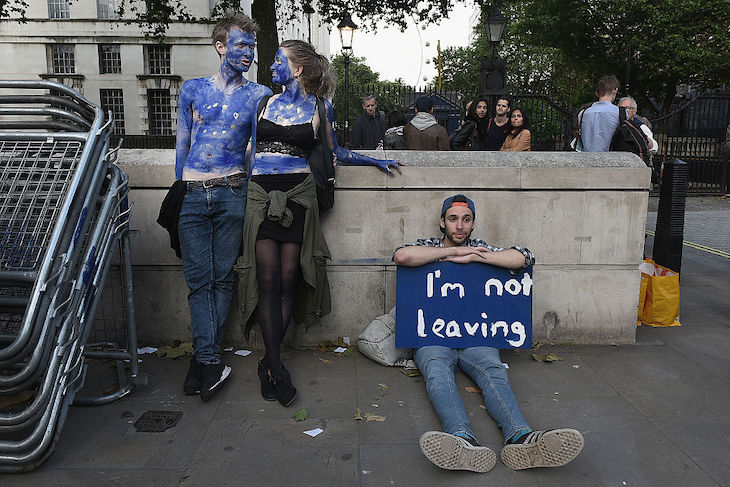
With all the talk of Brexit, do you ever get the sense that social media is stuck in 2016? Well, now it really is. A trend has taken off online involving people posting throwback pictures from a decade ago. A Tumblr video captioned ‘Welcome back #2016’ kicked off the nostalgia. It has resulted in a 450 per cent surge in ‘2016’ searches across platforms, as those born between 1997-2002 share photos, songs like Drake’s ‘Views’ and Pokemon Go memories.
A Tumblr video captioned ‘Welcome back #2016’ kicked off the nostalgia
The year 2016 is being described as one in which pop culture peaked. But perhaps the most remarkable thing about those 12 months is how little has changed in the decade since. While younger folk wish they were back in that simpler, pre-pandemic era, here’s the truth: they never really left.
To anybody now over, say, 45 years old, 2016 surely feels like last week. It’s a cliché that time passes very differently for the individual as he ages, slowing right down as the years clock up. But it’s one of those clichés that we don’t think about enough. This 2016 nostalgia trend pulls it into the sharpest relief.
Because one is young for what feels like geological ages, and then – particularly after one whizzes like a non-stopping express train past what might (fingers crossed) be classed as the halfway mark – everything starts to fly by like the figures in a cartoon flick-book. For me, at 57, the last ten years feel like a few months by the experiential metric of my youth, which lasted about a century.
But despite the passage of time, the culture and aesthetic of 2016 looks and feels exactly the same as the culture and aesthetic of today.
I thought I ought to check with some young people to determine whether I was deluding myself. I pause here to acknowledge that this tic among the old to consult the young is itself incredibly irritating – indeed, I found it annoying when I was a kid. ‘Haven’t you a mind of your own?’ I wanted to snap at those elderly folk who questioned me. Well, now I’ve become one myself.
We see an example of this questioning the young in its most tedious form in Fearne Cotton’s recent podcast interview with Dawn French, 68, as French says she has to ‘catch up’ and get told what to think about political hot potatoes by children. This inane impulse is one of the reasons we’ve got in such a cultural mess.
But my youthful informants were equally nonplussed by the 2016 trend. ‘It’s odd,’ one told me, ‘because I was 19/20 in 2016, so in any other era you’d expect me to be nostalgic for it. But I checked my photos from the time, and though I look ten years younger, everything around me looks exactly the same’.
Another chum, who was 14 ten years ago, chipped in: ‘The trend made me scoff at first, but it made me realise there has been a fashion shift among young people; the mullets and moustaches on blokes, and women wearing vintage charity shop stuff and spot stickers as fashion items. Undercut hairstyles have totally disappeared since then; they used to be big!’ But, he concludes, ‘I think the trend is just ‘look at this picture of me taken ten years ago’ vanity, though’.
The 2016 trend reminded me of the ‘school disco’ craze of the noughties, where people in their twenties pretended they were teenagers. I found this bemusing too, until I remembered the uproarious reaction in pubs and clubs in 1988 when a record from 1982 was played. To an 18-year-old, the seconds of their internal clock dragging along slowly, six years ago might as well be the Pleistocene epoch. I think also of the biography of novelist Barbara Pym, who spent the rest of her life replaying her university days in her books, toying with fictional versions and permutations of its characters and events.
So the empirical side of it I can understand. But the nostalgia for the pop culture? No. It was notable when watching 2020s TV shows like Disclaimer and Quiz, set in the early noughties, that everything about the aesthetic bar the phones looked pretty much identical to the year they were made.
As my first young informer told me, ‘Think about how totally different Life On Mars (set in 1973) and its sequel Ashes To Ashes (set in 1981) are. But a time travel show going back to 2013 and 2021 would be the same show twice’.
The speed at which fashion and aesthetics in general moved in the old century was dizzying. I vividly recall how Mod revival Harrington jackets went out of fashion around Christmas 1979, to be replaced by the Dexys Midnight Runners donkey jacket look. There was no social media, no explicit signal, barely any television coverage of youth culture – and yet everybody at my school year (of 11 and 12-year-olds!) – somehow flipped like a cascading line of dominoes to fall in line with the new trend.
Looking back, the post-war West was a historical outlier in the way in which fashions changed so quickly. For whatever reason, there were frequent dynamic shifts that pulsed through pop culture, fashion and design. The new century has seen us go back to normal pace.
What a remarkable time it was. And I thought that was just how things were. I wish I’d appreciated it more – in fact, I could even get (slightly) nostalgic. But not for 2016, at least.