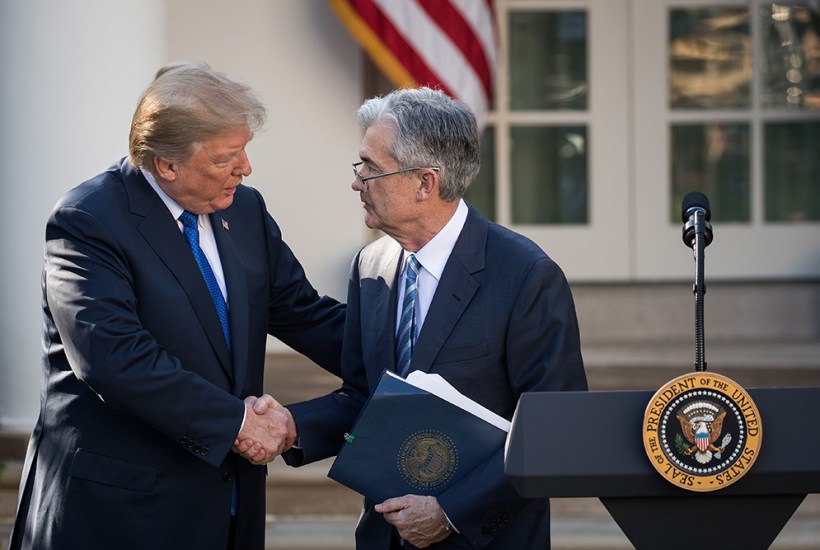
The phrase ‘trumped-up charges’ dates from the 18th century, I learn, and derives from the Old French tromper, to deceive. It has certainly acquired new resonance with the threat of criminal indictment against US Federal Reserve chairman Jerome Powell, somehow relating to the cost of Fed building renovations. The President says this Department of Justice action has nowt to do with him, but it’s plainly another exercise of what some commentators are calling ‘the Maduro option’: sod constitutional niceties, just drag your opponent into the dock.
For all his foreign-policy fireworks, Donald Trump knows November’s US midterm elections will largely be driven by domestic cost-of-living concerns. He has castigated Powell for not cutting interest rates faster to boost the economy and make mortgages cheaper, while Powell has stuck rigorously to the Fed’s anti-inflation mandate. But US rates are expected to fall anyway this year and Powell – looking old and tired in a video released on Sunday declaring he would continue ‘standing firm in the face of threats’ – is due to retire from the chair in May.
The legal assault is essentially a spiteful tactic to neutralise Powell while Trump picks a compliant successor, packs the Fed board and politicises an institution admired by the world as a model of central-bank independence. So what, you might say: this President isn’t always wrong, the Fed hasn’t always been right about rates – and markets don’t seem to be panicking.
The safe havens of gold, silver and bitcoin blipped up but US stock markets shrugged off early selling to close on Monday at record highs. After all, if rates fall quicker, tech stocks will do even better. I’d say the more significant indicator was a sell-off of US Treasury bonds, causing their yields to rise slightly and indicating that ‘rates may not start sinking as the President has demanded’, as CNN put it. If global investors start to shun US government debt for fear of an emasculated Fed, the trumped-up Powell gambit will come to be seen as a pivotal moment of hubris.
The shipping forecast
One of the objectives of the US intervention in Venezuela, we’re told, was to impede shipments of oil to China, which knowledgeable sources say accounted for more than half of Venezuelan crude exports last year. Some shipments were disguised by passing through third countries such as Brazil and Malaysia; others were allocated as repayment for loans from the Chinese government. Beijing ‘strongly condemns’ America’s ‘typical act of bullying’ in redirecting the oil flows – and must have been even more provoked by seizures of Venezuela-linked tankers, including the Russian-flagged Marinera, taken in the North Atlantic by US coastguards with support from British forces.
Trump’s stated objective is to restrict Chinese influence in the western hemisphere. Analysts say his secondary aim is to make it more difficult for China to import all the fuel it needs to power its world-beating factories and data centres. Which brings me to some intriguing photographs that popped into my WhatsApp this week from a Scottish reader with a long lens.
The first shows the Chinese supertanker Cosflying Lake about to load two million barrels of crude from the North Sea Forties Field at Ineos’s Hound Point terminal on the Firth of Forth, before sailing round the tip of Africa to Tianjin. Another shows the carrier Xiang Tai Kou bound for Leith from Qinzhou with a cargo of wind turbine pylons destined for the Inch Cape offshore array east of Arbroath.
Never mind the environmental impacts of these and many similar voyages, the short story is this: with very little refining capacity left in the UK, we’re selling huge volumes of ‘our’ oil to China, where we’re buying most of the kit for Ed Miliband’s rush to wind and solar. Is that a pragmatic trade, or does it handcuff us to a hostile power – for which, incidentally, our government is expected next week to grant permission for an espionage gigafactory disguised as the new Chinese embassy at Royal Mint Court? And might it ever occur to President Trump that Scotland – his mother’s birthplace and the home of golf, still rich with offshore oil and gas – should be his next takeover target after Greenland?
Eat local
If Trump thinks anything about the French, it’s probably that they lack grit. After an icy northbound drive across their map with no spreader lorries in sight, I’d say he’s right. But I’m more worried that they’re forgetting how to cook. Among four old favourite stopover hotels, only Les Airelles at Neufchâtel-en-Bray in Seine Maritime produced a dinner respectful of seasonal local ingredients and truly worth the detour.
The others all offered what our much-missed Spectator food columnist Simon Courtauld would have called ‘buggered up’ dishes, with novelty flavours that can best be blamed on globalisation. On a day when furious French farmers were surrounding the Arc de Triomphe with tractors in protest at the EU’s trade deal with the Mercosur bloc of South American countries – passed by a member-state majority despite opposition from France, Ireland, Austria, Hungary and Poland – I heard endless radio voxpops expressing consumer solidarity with the agricultural community. But Carrefour shoppers will still pick Argentine beef if it’s a bargain, just as tweed-clad Waitrose customers buy year-round Peruvian asparagus.
My point is that we should all relearn eating local, to reduce our fragile reliance on imported food, to shrink the food-miles on our plates and to sustain our own rural producers, who may sometimes protest too much but whose interests are repeatedly trampled, ignored and negotiated away by governments too focused on urban voters. The irony is that if the French were to follow that prescription, they would rediscover their own marvellous bourgeois cuisine, whereas a reversion to traditional British fare without global ingredients would be like going back to school dinners.
Got something to add? Join the discussion and comment below.
You might disagree with half of it, but you’ll enjoy reading all of it. Try your first month for free, then just $2 a week for the remainder of your first year.