Standing at the site of the Bondi attack recently, I was moved, yet again, to send messages of solidarity to my Jewish friends and colleagues.
Yet again, they were received with grace. Composed and dignified. But also, unfair.
That this gesture is becoming ritual is itself an indictment. Or perhaps I am simply ignorant of the contemporary version of a ‘tolerant’ Australia: one which expects the Jewish community to perpetually endure hostility and simply move on?
That is what a rising tide of antisemitism does. It diminishes the value of Jewish Australians who, once again, find themselves having to justify their safety, their belonging and their right to live openly. Too often, the response from our political leaders is not to uphold those rights, but to manage Jewish life as a public-order problem, something to contain.
Recent events make something else plain: the arc of the moral universe can bend backwards, and quickly, when a society loses its nerve. After a long history of persecution, it is incomprehensible that Jews are still required to defend their right to exist. When hatred targets Jews, it is never ‘just another incident’. It echoes a repugnant chapter in history that I trusted the world had vowed never to repeat.
Nearly nine decades after the Holocaust, the global Jewish population is yet to return to its 1939 level. That is not trivial.
Australia cannot claim ignorance. Jewish Australians are not newcomers seeking special pleading. They have been here since the beginning of European settlement. Across generations, they helped build the civic, cultural and commercial life we take for granted, not as a separate ‘interest group’, but as Australians. Small in number, enormous in contribution.
Belonging – but on condition
Yet Jewish belonging has often been conditional. The crisis years of the 1930s and 1940s exposed it. As Europe became an engine for Jewish extermination, Australia debated whether it should accept Jewish refugees at all. That debate did not end with the war; it was carried into the machinery of government policy, most clearly under Arthur Calwell as the new Minister for Immigration.
In Australia, the Jewish community has remained tiny, around half a per cent of the population, for well over a century. And that smallness was not always accidental. In the post-war period, policy and bureaucracy often treated Jewish intake as something to be rationed in response to fears of public backlash and antisemitism. It was also designed to protect the political viability of the wider immigration program by keeping Jewish arrivals ‘manageable’ and out of controversy. The message, then as now, was that Jewish safety could be weighed, bargained, and delayed.
Appointed Australia’s first Minister for Immigration in July 1945, Arthur Calwell oversaw a major post-war shift toward accepting non-British migrants. At the same time, the government used administrative controls to limit Jewish immigration, including a ‘gentleman’s agreement’ in 1949 that set Jewish arrivals at 3,000 per year, down from the pre-war refugee quota cap of 5,000. The Kimberley Plan, an unrealised proposal to settle Jewish refugees in northern Australia, now reads like a haunting ‘what if’ in our history.
The early warning sign
Still, the Jewish community has endured, by doing what Jews do when liberty is real. It builds institutions, invests in education, participates and succeeds in the mainstream. Which is what makes the current moment so grotesque. A community that has met every expectation of democratic citizenship is being told, implicitly, to lower its expectations of safety.
When Jews are singled out, it sends a worrying signal that a society’s liberal foundations, its freedom of conscience, worship, speech, and the basic space for disagreement, are eroding. As American journalist Bari Weiss commented, ‘Where liberty thrives, Jews thrive … and when such virtues are regarded as threats, Jews will be regarded as the same.’ This is exactly the test Australia is now failing.
Safe spaces, except for Jews
Then there is the contradiction among many of the loudest ‘diversity, equity, and inclusion’ voices, who suddenly lose their vocabulary when the target is Jewish. While microaggressions are easily detected in classrooms and corporate training modules, identifying antisemitism is suddenly ‘complex’ and therefore optional. In circles that preach ‘safe spaces’, Jewish schools requiring police protection are treated as background noise. If DEI were anything more than branding, it wouldn’t impose ideological tests for basic solidarity or quietly recast Jewish identity as the one minority that doesn’t count when prejudice turns up.
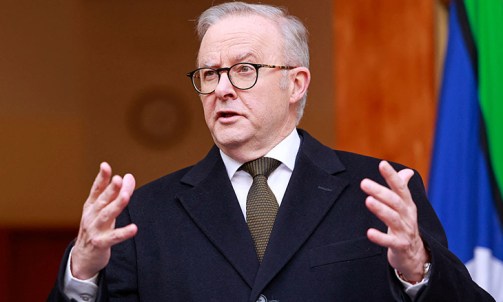
Antisemitism doesn’t spread only because of extremists. It spreads because politicians and institutions decide it is safer to equivocate than to confront. Too many leaders have learned that antisemitism is politically awkward. It is better to mumble about ‘social cohesion’, to condemn ‘all forms of hate’, to treat intimidation as ‘passionate activism’. It is dispiriting to think that we have reached the point where the machine that calibrates every word uttered by the Prime Minister is unable to make provision for a reprehensible moral breach.
A society that claims to celebrate difference cannot carve out a special permission slip for antisemitism and still pretend it stands for inclusion. If Bondi is to mean anything beyond grief, it should be Australia deciding that antisemitism is not a problem Jews must manage, but a betrayal the nation must end. Proving it in the small, daily choices that make a society safe: in classrooms, in workplaces, in public life, and from the mouths of leaders who name the truth without qualification.