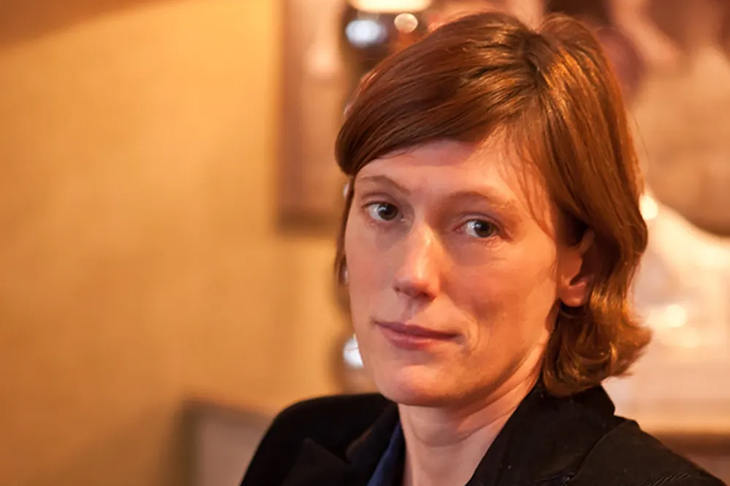
Joanna Kavenna is very serious about games. Her novels have a certain playful quality, even her debut Inglorious, where the humour and allusions are Mittel-european. More markedly ludic are her Lewis Carroll-esque fantasy about quantum physics, A Field Guide to Getting Lost and the Philip K. Dickish tech-dystopia of Zed. In Seven, however, it’s not just the style but the subject. As if to make clear that games are neither childish nor mere distractions, there is a pointed reference to Johan Huizinga’s study Homo Ludens¸ published on the eve of the second world war.
The narrator here is working for a formidable philosopher in Oslo, whose current project is entitled ‘Thinking outside the Box about Thinking outside the Box’. (‘I’m serious,’ the narrator archly notes.) Although there is a fair amount of academic satire, Kavenna sketches the actual importance. Archimedes may have said ‘Give me a lever long enough and a place to stand and I shall move the world’, but these Norwegian thinkers are vexed about there not being a place to stand; that one cannot think objectively about thoughts using the very mind that is doing said thinking. The opening chapter has a deliciously grotesque dinner party, fuelled by a drink aptly and worryingly called Black Death, which culminates in an incident where ‘they all looked as if they were doing impressions of “The Scream” in a game of charades, art-classics version’.
One box that especially interests the so-called Box Philosophers is that which contains a game called Seven, of which the narrator happens to be an above average player. ‘Thinking Outside the Box about Thinking Outside the Box’ work necessitates their going to Greece to meet up with a ‘great poet, mediocre dentist and terrible driver’ called Theodorus Apostolakis.
He is the creator and curator of the Society of Lost Things, and a Seven set was one of the motivations. The game seems a cross between Gō, Snakes and Ladders and backgammon; crucially no one seems to know the original rules or whether it is even a game. This cerebral picaresque takes in two Seven rivals, an AI trained to play it, gilded celebrities who will pay to find themselves by getting lost and art vandalism. Although it is witty, ingenious and says some sharp things, there is an undertow of melancholy.
Games are oases of meaning in an indifferent world – I vividly remember playing Solitaire repeatedly when my dad was in hospital for heart surgery, as if it made a difference or I could bet against the future. Kavenna captures this exquisitely. She is a writer of genuine elegance, intelligence and understated emotions. It is encouraging that there are those who still follow the pellucid postmodernism of Italo Calvino rather than the more rambunctious Angela Carter.
Got something to add? Join the discussion and comment below.
You might disagree with half of it, but you’ll enjoy reading all of it. Try your first month for free, then just $2 a week for the remainder of your first year.