As the poem goes:
Water, water, everywhere,
Nor any drop to drink
– which might well describe how residents of the Owens Valley felt after Los Angeles stole their lake.
Immortalised in Robert Towne’s screenplay for Chinatown, this early 20th-century water diversion via the 233-mile Los Angeles Aqueduct quickly led to an endless property boom for the Southland, and a near-biblical ecological disaster for Inyo County, California. Towne later described the main perpetrators of this crime as ‘an old boys Wasp network’ that included the LA Times publishers, Harrison Gray Otis and Harry Chandler, and the self-taught civil engineer William Mulholland. In other words, there has always been enough drinking water in southern California – just so long as you keep on the right side of the bankers.
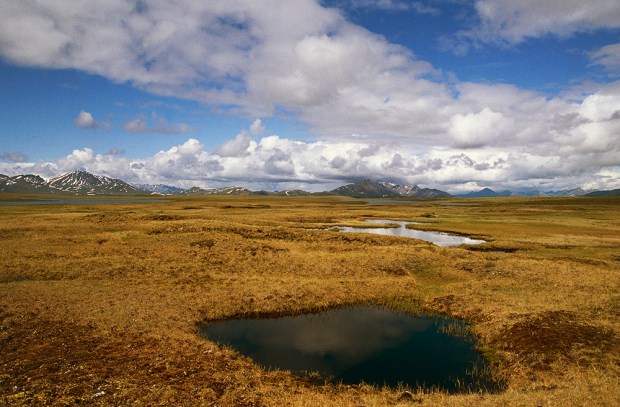
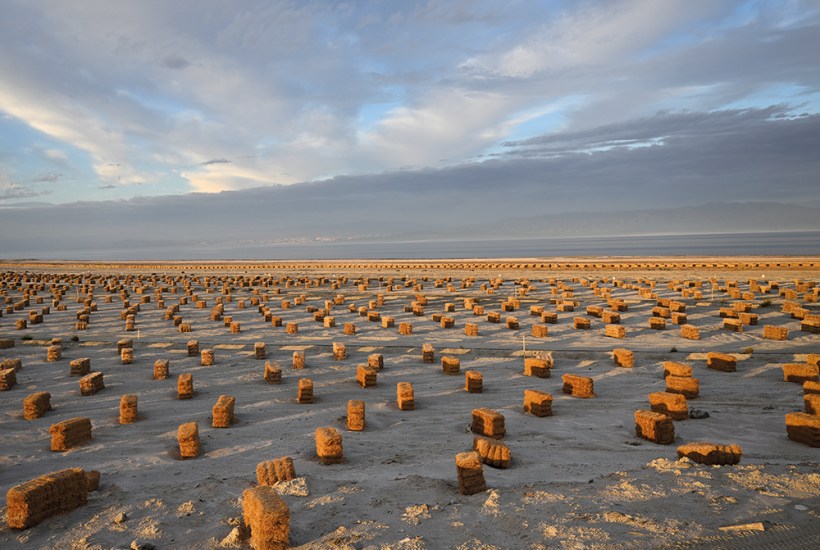
In her absorbing, reflective road trip through the geographical traumas of America’s most populated and (some of us believe) most beautiful state, the Italian novelist and film writer (and longtime California resident) Chiara Barzini finds it difficult to disentangle the horrific from the sublime, such as when she arrives at Owens Lake to find a ‘mirage’ drained down to ‘alkaline dust…causing bloody noses, watery eyes and irritated lungs’. Amid the ecological damage, local residents have been ‘living a slow death’, many sleeping with oxygen bottles beside their beds. In a small effort at restitution in the early 2000s, Los Angeles agreed to return a small percentage of water each year,
just so the dust won’t get blown away. It has been poured in merely to keep the soil moist, heavy enough not to fly into people’s homes and lungs. That’s the tinge of blue we are seeing. It’s just a murky lake bottom that reflects the colour of the sky. There’s no lake in reality, just its ghost, a faded copy of what it used to be.
It’s a California landscape filled with ghosts. Ghosts such as those who once inhabited Manzanar (also located in the Owens Valley), where the natives were displaced by the farmers who were displaced by the water engineers who were displaced by a Japanese internment camp, which the government designated with an Orwellian euphemism as a ‘War Relocation Centre’. This meant that when residents objected to being ‘relocated’, or to signing loyalty oaths, they were allowed to either protest and be gunned down, or escape to the hills where they could freeze to death. Then, of course, there was the intentionally least remembered tragedy of the period: the collapse in 1928 of the St Francis Dam, a Mulholland-supervised construction, which killed more than 400 people and would mark modern California’s third deadliest disaster – in a state notable for its disasters.
But perhaps the most haunting landscape Barzini explores is the Salton Sea, another dried out lake, located in Riverside and Imperial counties, which was at least partly the result of more water-engineering madness – the diversion of the Colorado River. Today the lake is a salty marsh that attracts those who find apocalypse appealing – such as a tribe of artists, alternative thinkers and outcasts that call themselves the Bombay Beach Institute of Particle Physics, Metaphysics and International Relations, led by a philosopher named Tao, who produces a podcast entitled Being in the World. Then there’s the ‘Family’ left behind by the polygamist and ‘health food pioneer’ Father Yod, who sound uneasily similar to another ‘Family’ from the 1960s who were not so easily forgotten.
While Barzini is prone to quoting Jean Baudrillard and the great LA historian Mike Davis, many of her California visions sound more like Britain’s prophet of doom-as-tedium, J.G. Ballard, such as when she encounters the lake of dead remains:
It looks like one of the volcanic Aeolian islands… The sand under our feet makes a crunching noise. It feels like I’m crushing a field of delicate pebbles. Except it’s not pebbles …It’s bones. During the die-offs, the fish and bird carcasses washed up on the shores, and after decades of rotting, they turned into piles of fish bones and sand – spines, otoliths, fin scraps, tiny teeth. We’re walking over a huge aquatic cemetery.
Reading Barzini’s exploration of these spaces, you can understand why so many writers have described the end of the world as something intimately Californian – from George R. Stewart’s magnificent, elegiac Earth Abides to Ward Moore/Ray Milland’s frenetic social breakdown melodrama, Panic in the Year Zero. And while Barzini’s book lacks the heft and/or comic hilarity of the best California travel and history narratives – from Richard Rayner’s Los Angeles Without a Map to Marc Reisner’s Cadillac Desert and (my personal favourite) Carey McWilliams’s Southern California: An Island on the Land – it does a pleasurable job of leading readers to the bookshop or library where all those great works can still be found.
Got something to add? Join the discussion and comment below.
You might disagree with half of it, but you’ll enjoy reading all of it. Try your first month for free, then just $2 a week for the remainder of your first year.