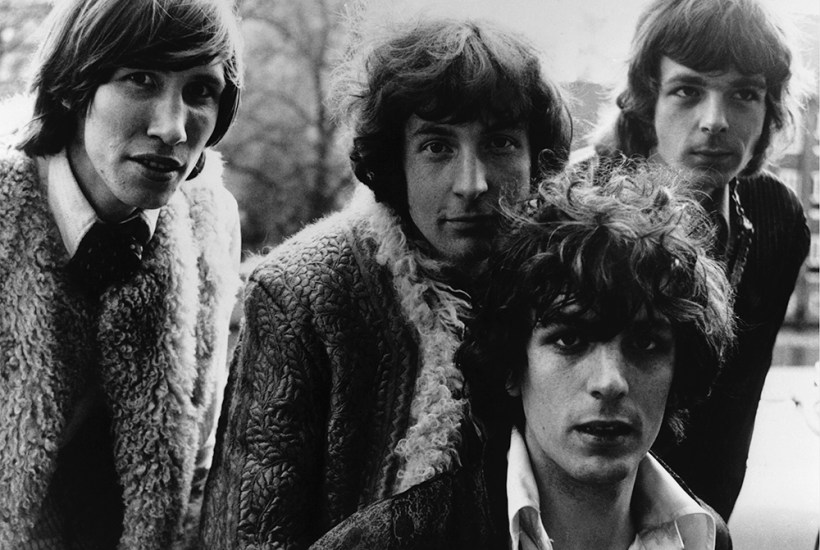
The English rock band Pink Floyd was founded 60 years ago in Cambridge. Reading two new books about them, it struck me how much time and place matter to their story. Now in their eighties, the surviving members remain a product of the milieu in which they were formed: middle class, semi-boho, comfortably numb. First they moved to London; then to the outer reaches of the cosmos. After that they circled the planet for decades, recollecting the emotions of their youth in both tranquillity and anger. You can take the multi-million-selling, emotionally repressed space cadets out of Cambridge…
Broadly speaking, five different businesses have traded under the name Pink Floyd. The start-up, known informally as ‘the Floyd’, was headed by the artist and songwriter Roger (‘Syd’) Barratt, until his abrupt departure in the late 1960s. The outfit’s second incarnation drafted in the guitar impresario David Gilmour and evolved into more of a collective enterprise: Ummagumma, Atom Heart Mother, all that.
By streamlining the group’s output from The Dark Side of the Moon and Wish You Were Here onwards, Pink Floyd 3 more than tripled operating profits. After a hostile takeover bid c. 1977, however, the bassist Roger Waters assumed command. Under his leadership, Pink Floyd 4 became the vehicle for a series of ambitious projects – Animals, The Wall – that, despite the CEO’s pessimistic outlook, continued to sell in the millions. The Floyd found themselves in a position to diversify into elaborate theatrical presentations and film, which included a movie adaptation of The Wall and an informal team up with The Wizard of Oz, details of which remain hazy.
But there were increasing tensions at board level. In the mid-1980s, Waters resigned his post, demanding the business be dissolved. The directors of Pink Floyd Inc. all started suing one another, ultimately resulting in Pink Floyd 5. Gilmour recruited a new team of anonymous backers and in 1987 successfully relaunched the brand. They reassured the markets with a slick multimedia presentation of albums such as A Momentary Lapse of Reason and The Division Bell, and a package of assets that included the original keyboard player Richard Wright, who had been dismissed during Waters’s tenure. It should be noted that Wright was retained initially as a salaried employee, not a full partner. Throughout the decades of their existence, as each Pink Floyd has given way to the next, the drummer Nick Mason has provided continuity, good humour and a consistent, not to say unvarying, 4/4 beat. In October 2024, the group reportedly sold their recorded music catalogue, name, image and likeness rights to Sony Music for $400 million.
Mike Cormack’s Everything Under the Sun affords an in-depth analysis of the group’s portfolio, taking stock of their musical output, concert appearances and bootleg recordings, and apportioning credit where it is due. Meanwhile, in Pink Floyd Shine On, Mark Blake attempts to balance the accounts, a significant feat of bookkeeping, as these elderly antagonists habitually contradict one another. Gilmour (79) and Waters (82) have been at loggerheads for at least 40 years; Mason (81) has of necessity to tread gingerly, lest he set off a fresh round of lawsuits, and Barratt and Wright are currently playing the great gig in the sky.
David Gilmour and Roger Waters have been at loggerheads for at least 40 years
Everything Under the Sun is a useful reminder that in all its guises, Pink Floyd have created music that speaks to people around the world. In the first part of the book, Cormack reviews the back catalogue in the manner of Ian MacDonald’s venerable Revolution in the Head, even providing a chronology that places the Floyd’s activities in the context of world events, just as MacDonald did with the Beatles. The reader may or may not agree with his verdicts on the merits of ‘See Emily Play’ (‘an utter joy more than 50 years later’) or the shortcomings of The Final Cut (‘Pink Floyd gave Waters a blank slate on which to fulminate’), but the author’s love and respect for all things Pink shine through. And fair play to him, he has heard a lot of bootlegs.
Blake is the author of the excellent Pigs Might Fly: The Inside Story of Pink Floyd (2008) and enjoys the confidence of both Gilmour and Mason, which could explain why Waters declined to talk to him for this latest book. Fortunately, Blake has interviewed him on several previous occasions. Waters’s inflammatory political views seem to have estranged him once and for all from Gilmour. Divested of the portfolio, and with Sony now at the helm, the senior partner is free of what he calls ‘the weight of the whole Pink Floyd thing’. As Blake notes at the end of 400 pages of seethingly polite and endlessly amusing bickering, however, ‘this stuff isn’t going away any time soon’; and death notwithstanding, it may well be that the whole Pink Floyd thing is only just beginning.
Got something to add? Join the discussion and comment below.
You might disagree with half of it, but you’ll enjoy reading all of it. Try your first month for free, then just $2 a week for the remainder of your first year.