Today, a muscular Richard the Lionheart still sits manfully astride his warhorse, sword held aloft, outside the Houses of Parliament, courtesy of Carlo Marochetti’s 1856 statue of the Plantagenet king. Richard would have approved. As Heather Blurton points out in her livelybook, he was never shy of portraying himself as a valiant monarch – one who actively created his own legend.
But first comes a potted history of the man. Incongruously, it is presented as an Introduction, though it accounts for about a fifth of this short book. It is no surprise that Richard achieved heroic status in his lifetime – much to his gratification. His life was packed with glamour, blood and brutality. But therein lies a problem: how to encapsulate this in a mere 30 pages? It’s a struggle. I would have liked to have seen Blurton expand more on the many dramatic events in Richard’s life; but her intention is not to tell Richard’s story so much as to trace his legend as it developed.
Even before he ascended the throne in 1189, Richard had made a name for himself as a relentless, unforgiving warrior. He was not originally meant to be king (and going to war against his father Henry II did not help); but the unexpected death of his older brother Henry, known as the Young King (and already crowned as such), left Richard to inherit. His first action was to set out on crusade – and so the legends started to accrue.
Before reaching the Holy Land, Richard had married en route, conquered Cyprus and destroyed a massive relief ship carrying supplies to the besieged Muslim garrison at Acre, which crusaders had been struggling to capture. No wonder he was cheered to the skies when his fleet reached port. Although this, the Third Crusade, was led jointly by the King of France, the stolid, uninspiring Philip II was left in Richard’s shadow, just as Richard’s younger brother John would be when he followed him as king of England.
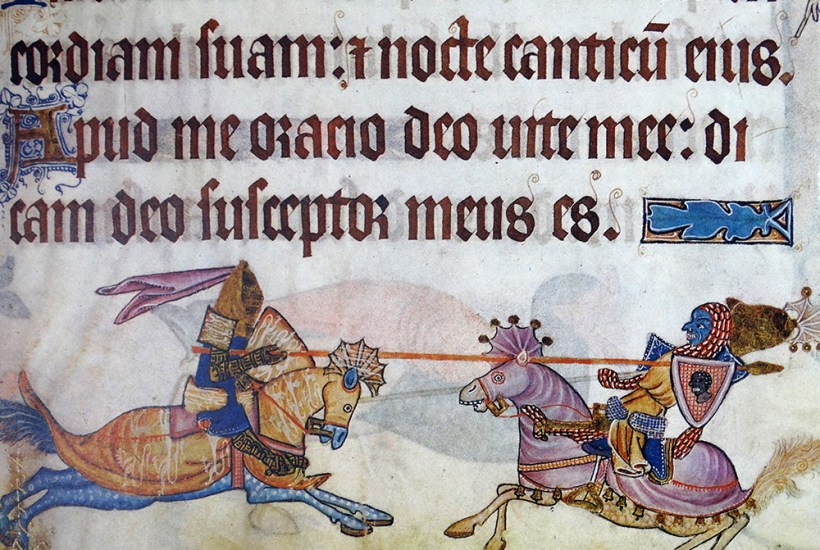
The true drama of the crusade was startling enough: serious illness, the massacre of some 2,500 Muslim prisoners and spectacular victories on the battlefield. But the urge to embellish even further was too strong for subsequent writers. So we have the courteous relationship between Richard and Saladin – the latter even nursing the former back to health, with one-to-one combat following later.
Although Acre soon fell, Jerusalem did not. This was an obvious disappointment for Richard, although he had achieved enough to help the crusader states survive for another 100 years. As Blurton points out, retellings of Richard’s feats as a crusader gloss over this failure to accentuate the best efforts of a thwarted hero. ‘What happened next was stranger than fiction,’ Blurton writes. On his journey home to England in 1192, Richard was shipwrecked; and, despite disguises, he was captured by the enemies he had so gleefully insulted on crusade.
Richard’s first action as king was to set out on crusade – and so the legends started to accrue
Further legends developed at this time, but two have remained foremost in the public imagination. One concerns the minstrel Blondel singing his way around central Europe until a timely call-and-response duet with the dulcet tenor of Richard helps him locate the king. The other is of the starving lion sent into Richard’s cell to kill him, only for the ever-aggressive warrior to thrust his arm down the animal’s throat and rip out its heart, then bring it to his captor’s court and eat it publicly, having first seasoned it with salt. (This story came long after Richard’s death. His leonine sobriquet had been acquired when he was still alive.)
Finally ransomed at huge cost (by whom?), Richard returned to England in February 1194, when the legends evaporate amid the subsequent grinding wars in France with Philip. Although there is still plenty of historical excitement to be had, there is less to contribute to the romance. Blurton passes over these five years of Richard’s life in a single sentence.
His demise provided one last factual basis for future storytelling. At the siege of Châlus-Chabrol in 1199, while inspecting the castle’s defences, Richard was struck by a crossbow bolt and fatally wounded. At the time, rumours spread that he had been trying to grab some treasure, but his presence was likely to have been to suppress a revolt. When the castle fell, Richard congratulated his assailant on his excellent shot and sent him away with money. But according to the well-informed chronicler Roger of Howden, his troops, distraught at the death of their master, flayed the poor man alive.
Throughout, the book adheres to its focus on the legend in literature and culture. The reality and context of Richard’s life are explored only in as much as they illuminate the stories. Blurton moves from the chroniclers of the time to the troubadours, among whose ranks was the cheerful psychopath Bertran de Born, who adored Richard as a ruthless man of action. The longest chapter is devoted to the Middle English Richard Coeur de Lion, a 14th-century rendering of a 13th-century romance, which Blurton convincingly argues was pivotal in cementing the various tales of Richard. Although she is incorrect in claiming that it was unusual for relatively contemporary figures to receive such treatment (the stories of Hereward and Fulk FitzWarin demonstrate otherwise), she is persuasive in making the case that the work cast Richard as ‘a distinctly English hero’ at the time of the Hundred Years’ War.
Blurton finishes this entertaining and beautifully produced book by examining Richard’s much later legends, propelled by Sir Walter Scott and Hollywood, the myths continuing to proliferate along the way, ensuring that they endure. Whether the same can be said for Richard’s statue in this iconoclastic age is another matter.
Got something to add? Join the discussion and comment below.
You might disagree with half of it, but you’ll enjoy reading all of it. Try your first month for free, then just $2 a week for the remainder of your first year.