Aristotle warned that one of the most effective tools of deception is the comparison of things that are not alike. False analogy, he argued, persuades not by clarifying reality but by erasing the distinctions on which reason depends. When unlike things are treated as equivalent, judgment collapses and rhetoric replaces truth. That error is now everywhere around us.
In contemporary political discourse, Holocaust imagery is routinely deployed through precisely this fallacy.
Law enforcement is likened to the Gestapo; immigration enforcement is framed as the persecution of Jews; Jewish self-defence is recast as Nazism.
These comparisons do not illuminate injustice, they manufacture it – by forcing history into a shape it does not possess. This is not dilution, it’s inversion.
The Mechanics of Inversion
Inversion is a specific rhetorical maneuver in which the moral architecture of history is turned upside down. Nazis are abstracted into a metaphor for ‘power’. Jews are reassigned the role of historical villains. The Holocaust is stripped of its singularity and reimagined as a generic symbol of oppression. Jewish self-defence, in turn, is reframed as genocidal aggression. This is not ignorance; it’s narrative warfare.
The move is precise and repeatable. By collapsing Nazism into a floating symbol of authority, its actual crimes disappear. By attaching that symbol to Jews – whether in the form of Israel, Jewish institutions, or individual Jews – the moral burden of history is reassigned. The victims become the perpetrators; the perpetrators dissolve into metaphor.
What results is not historical critique but moral reversal. The Holocaust ceases to be an event rooted in facts, intentions, and outcomes, and becomes a reusable accusation – detached from evidence, indifferent to scale, and immune to correction.
This same inversion now operates openly in American political life. The language once reserved for totalitarian regimes is casually applied to ordinary governance. Political opponents are branded ‘fascist’ not for abolishing elections or imprisoning dissidents, but for enforcing laws that already exist. When President Joe Biden referred to his critics as ‘semi-fascist’, the phrase itself revealed the hollowness of the charge. Fascism ceased to mean a historical system of mass mobilisation, censorship, and state terror; it became a moral insult untethered from fact.
Donald Trump, meanwhile, is routinely labelled ‘authoritarian’ for executing statutory powers granted by Congress and affirmed by the Constitution – particularly in matters of immigration and border control. Here again, lawful authority is reframed as tyranny. Enforcement becomes persecution. The state’s obligation to uphold its own laws is recast as a moral crime. This is not analysis; it is rhetorical sabotage.
The pattern is identical to Holocaust inversion. Terms of immense historical weight are stripped of specificity and redeployed as weapons. ‘Fascist’ no longer describes an ideology; it functions as a veto. Once applied, debate ends. One does not argue with fascists – one resists them. This linguistic inflation erodes the very concepts needed to recognise real tyranny when it appears. When everything is fascism, nothing is.
The False Equivalence at the Center
Nowhere is this inversion more grotesque than in the claim that modern immigration enforcement resembles the persecution of Jews under Nazism. Activists routinely portray illegal aliens as Jews ‘being hunted’, and agencies such as US Immigration and Customs Enforcement as the Gestapo. The analogy collapses under even minimal historical scrutiny.
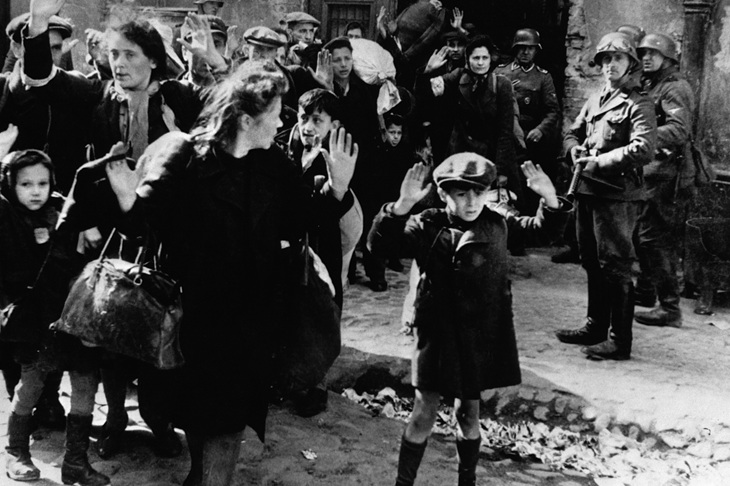
European Jews were legal citizens of their respective countries. They were native-born, tax-paying, culturally embedded members of society. They owned homes, businesses, and property. They served in national armies, participated in civic life, and had every reasonable expectation of legal protection. None of this mattered. They were stripped of citizenship, dispossessed, deported, and murdered for no reason other than being Jewish.
Illegal aliens, by contrast, are defined by a legal fact: they are present in a country in violation of federal statutes. Immigration enforcement is not racial policy, ethnic cleansing, or ideological extermination. It is the execution of codified law by a constitutional state – subject to courts, warrants, appeals, journalists, and public oversight. No one is being targeted for who they are; enforcement actions are taken because of what statutes are being violated.
To equate these realities is not merely inaccurate – it is historically obscene. It transforms genocide into metaphor and law enforcement into persecution. The analogy depends on erasing every relevant distinction: citizenship versus non-citizenship, extermination versus deportation, racial annihilation versus legal process.
If immigration enforcement truly resembled Nazi practice, there would be no warrants, no hearings, no protests, and no activists confronting officers openly in the street. Jews under Nazism did not enjoy the luxury of comparison; they vanished.
The Moral Theft
The French philosopher Alain Finkielkraut has described this phenomenon with devastating clarity. He calls it ‘the theft of Jewish suffering for the purpose of condemning Jews’. That phrase names the crime precisely.
Holocaust imagery carries unparalleled moral force in Western consciousness. To invoke Nazis or the Gestapo is to bypass argument and arrive instantly at judgment. It is a rhetorical shortcut that confers absolute moral authority without the burden of evidence. Once deployed, it relieves the speaker of the obligation to prove intent, scale, or consequence. The verdict precedes the facts.
This is why the analogy persists even after its falsity is exposed. It is not meant to illuminate reality; it is meant to end discussion.
Why It Works
The persistence of these comparisons raises an unavoidable question: Why do they endure even after they collapse under scrutiny? The answer is not confusion. It is incentive.
First, there is moral shortcutting. Holocaust language is the highest-voltage moral currency in Western culture. Deploying it delivers instant condemnation without the work of argument.
Second, there is delegitimisation. Calling law enforcement ‘Gestapo’, or Jewish self-defence ‘Nazi’, does not argue that a policy is wrong; it asserts that the actor is beyond moral consideration. Once someone is morally disqualified, anything done to them becomes justified.
Third, there is memory laundering. As living survivors disappear and memory becomes second-hand, the Holocaust increasingly exists as symbol rather than event. Symbols are easier to manipulate than facts. Once detached from testimony, dates, and outcomes, the past can be moulded to serve present agendas.
This does not require conspiracy to begin. But once it works, it rewards bad faith. The analogy spreads through emotional contagion, repetition, and social reinforcement. People repeat it not because it is accurate, but because it signals outrage, belonging, and virtue. Over time, the false equivalence hardens into ‘common sense’.
Why Jews Are the Target
This inversion disproportionately targets Jews for a reason many analysts avoid saying plainly. The Holocaust gives Jews a unique moral standing as victims of the most documented, systematic crime in modern history. Inversion seeks to neutralise that standing by turning it against them.
If Jews can be made into Nazis, their historical claims lose force. Their appeals to memory lose legitimacy. Their self-defence becomes suspect by definition. This is strategically advantageous to those who wish to remove Jewish moral standing from public discourse.
The effect is corrosive. The Holocaust is trivialised at the very moment its imagery is weaponised. History is not misunderstood; it is repurposed.
The Cost of Collapsing Distinctions
False equivalence does not merely offend historical sensibility; it damages moral judgment itself. When genocide becomes a metaphor, tyranny becomes indistinguishable from law. When Nazis are reduced to a symbol of ‘power’, power itself becomes inherently criminal. When every enforcement action is ‘Gestapo’, the word loses meaning – and with it, our ability to recognise real evil.
Aristotle understood this danger. Once distinctions collapse, reason cannot operate. And when reason fails, the loudest analogy wins.
Holocaust memory is not a prop. It is a discipline – one that demands specificity, proportion, and fidelity to fact. To abandon those requirements is not to honour the past but to betray it. And when history is turned into a weapon, the first casualty is truth.
Aaron J. Shuster is an award-winning cinematist, writer, and essayist who examines history, strategic culture, and the civilizational pressures shaping Western Civilisation.