Just before Christmas, NSW Premier Minns oversaw the passage of legislation constraining the right to protest in NSW, allowing the State government to outlaw a protest during a ‘terror designation’. The law does not go far enough yet may be struck down by the High Court for unduly burdening the implied right to political communication, found in the Constitution by the Court in 1992. This right has been interpreted broadly by subsequent Courts. Professional protester and Palestine Action Group organiser Josh Lees has flagged a challenge, presumably in the NSW Supreme Court.
Where a law requires interpretation in light of a case, we have a right to expect the Court to err on the side of common sense. I urge the judges to keep this in mind.
Political communication is defined as broadly as it possible – signs, pictures, slogans, protests, gestures, or silent action – related to local, state, federal or international issues. So, Lees has fertile ground.
The Court applies three tests. Does the law interfere with the implied right? Does it have a legitimate purpose since a balance needs to be struck between political communication and protecting other rights and interests? Could it be achieved by means that are less burdensome on the implied right?
The constitutional basis for the right to political communication is that in elections and referenda people have a right to hear all sides of a debate.
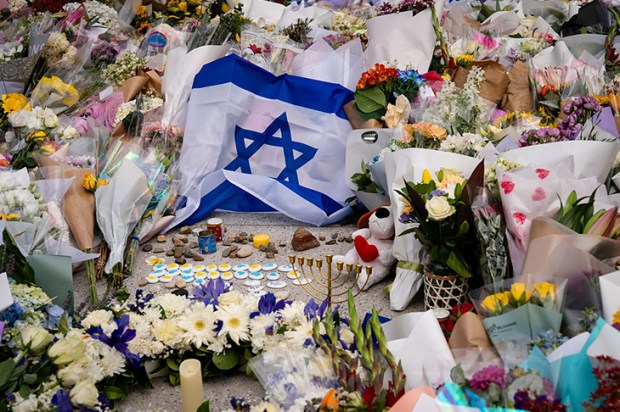
We now have an intolerable situation after two years of weekly, costly, disruptive and divisive protests in our two major cities that almost certainly led directly to the Bondi massacre. That is where common sense should come in, with a recognition that we no longer live in 1992, when legal reasoning could overcome any problem.
Arguments common-sense justices should consider are that Gaza is only marginally relevant to Australia’s national interest. You might argue Australia has a moral duty to do whatever it can (within reason) to inhibit a rogue state, but that’s not what these protests are about. They target Israel as a Jewish state. The demonstration at the Opera House on 9 October 2023 was purely antisemitic, since it would be three weeks before Israel responded militarily. The mob chanted either the genocidal ‘Gas the Jews’, as witnesses claimed, or, as senior police later claimed, ‘Where’s the Jews?’ – not ‘Where’s Israelis?’ (or ‘Zionists’). At a march in Sydney on 22 October 2023, a week before Israel went into Gaza, chants of ‘intifada’ were prominent. These protestors were selective and racist in their outrage.
I am not saying these protestors should be prosecuted, individually, for what they said but that they should not be accommodated to an extent that has cost taxpayers a fortune, inconvenienced citizens and businesses, and fostered hatred of Australian Jews.
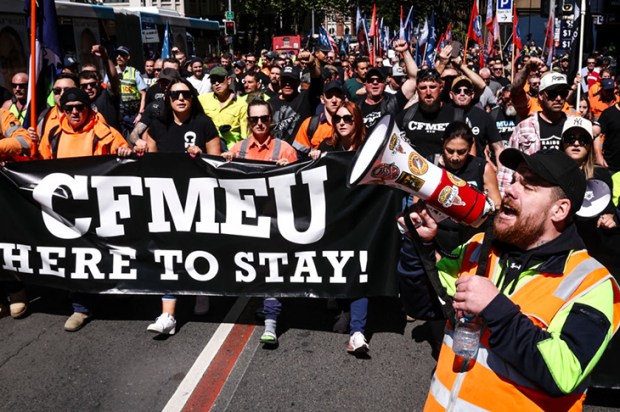
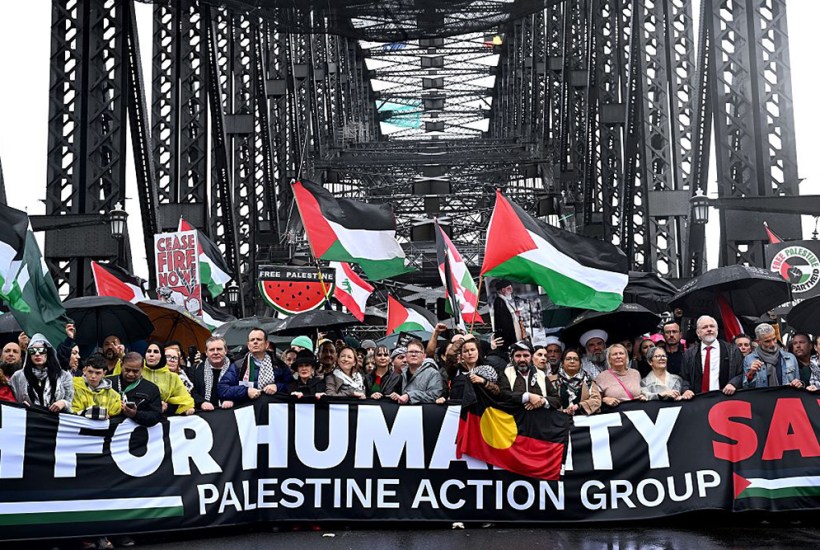
It might be open to Their Honours to infer that, as far as ‘political communication’ is concerned it is mission accomplished for the Pro-Palestinian mob. Is there a single voter who is unaware that a vocal, well-funded minority thinks Israel is a colonial power committing genocide in Gaza? Protests on this scale on major thoroughfares and the Sydney Harbour Bridge are not political communication but political intimidation intended to cause maximum inconvenience. On the first anniversary of 7 October 2023, serial pest Lees declared, ‘We remind you that after 7 October [2023], NSW Premier Chris Minns declared that we will never march in the streets. We defied this and shut down the streets for 52 consecutive weeks.’
If Australia were oppressed by a dictatorial regime, protests of this intensity might be acceptable, but would not be tolerated. Protests about international issues should be proportional to (a) the relevance of the issue for Australians, and (b) the extent to which the Australian government can influence foreign actors. This Labor government has done all it could (indeed more than it should have) to assuage the protestors, short of terminating all diplomatic and commercial relations with Israel, and maybe declaring war.
The courts should also only protect communication that is unambiguous, as ambiguous communication defeats the aim of informing the electorate. Slogans such as ‘from the river to the sea’ and ‘globalise the intifada’ are ambiguous but the first advocates the elimination of Israel and the second urges activists to kill Jews wherever they find them. There is a common-sense case that these slogans, and any including the phrase ‘death to’, should be proscribed.
A cohort of common-sense judges would not include former justice Michael McHugh, who argued that freedom of political communication also protects false, unreasoned and emotional political communications. God help us with this. If something is demonstrably false or unreasoned, how can it contribute to the public making an informed choice at an election?)
Humans are all too capable of genuinely believing something which is demonstrably false. Absent incitement to violence, no one should be prosecuted for, nor proscribed from, propagating a political falsehood but neither should they be given a megaphone to propagate it in our city centres. The same applies to allegations of genocide, routinely levelled at Israel in these protests. It is demonstrably false. ‘Genocide’ refers to acts committed with the intent to destroy, in whole or in part, a national, ethnic, racial, or religious group. It does not mean killing many people in war, which may be a war crime. Israel handed Gaza to the Palestinians in 2005 and is conducting a war of self-defence in response to genocidal attacks on its territory on 7 October 2023. That should be clear even to McHugh J.
Not every protest is political communication. There is a need, even a right, to pressure a government to act immediately, for example, to remove a repressive measure against citizens, such as Covid lockdowns. The pro-Palestinian protests are not of this nature.
The logic underlying the three-part test seems to be that the right to political communication is paramount, but no right is absolute; it must always be balanced against conflicting rights, in this case, the right of citizens to go about their business, which is being unduly burdened by the protests whose malign effects far outweigh their putative benefits.
There is no justification for the continuation of these pro-Palestinian protests. The logic underlying the new law appears to be that protesting in close temporal proximity to the Bondi massacre may encourage further terrorist acts and will offend Jews. Why doesn’t that logic apply at all times?
Any government should have the prerogative to declare that enough is enough, that these protests are vexatious. I concede this is complex, but consideration of this conundrum alone justifies the royal commission our Prime Minister is so loath to instigate. It could determine the extent, if any, to which the protests contributed to the rise of Australian antisemitism and the Bondi massacre, and how the tension between the right to protest and the relentless vilification of Jews can be resolved. A specifically drafted Commonwealth law buttressed by the findings of a royal commission would stand a good chance of endorsement by the High Court.
At least one High Court judge, Justice Simon Steward, has said the implied freedom of political communication was ‘too broad, ungainly and uncontrollable’, so, there is hope. Finding for the NSW government would be a step in the right direction, but it needs to go further.
Got something to add? Join the discussion and comment below.
You might disagree with half of it, but you’ll enjoy reading all of it. Try your first month for free, then just $2 a week for the remainder of your first year.