In the debate about withdrawing from the European Convention on Human Rights (ECHR) enthusiasts for European human rights law often seem to think they have a trump card. Leaving the ECHR, they say, would put the UK in the company of Belarus and Russia, two other European states that are not member states of the ECHR. Strictly speaking, they are not the only two. Kosovo is not (yet) a member; neither is Kazakhstan, which, incredibly, is eligible to join because 4 per cent of its territory is west of the Ural River. Still, it is the spectre of association with Belarus and Russia that looms large in parliamentary and public deliberation about ECHR membership.
We were ‘in a club’ with Russia up until its expulsion from the Council of Europe in 2022 and we remain ‘in a club’ with Azerbaijan and Turkey, two other states which routinely violate human rights
Many parliamentarians have deployed the Belarus/Russia comparison, including the Prime Minister and the Home Secretary. The Attorney General, Lord Hermer KC, mentioned it three times in his evidence to the Constitution Committee in September last year, warning that leaving the ECHR would place the UK, like Belarus and Russia, in ‘splendid isolation on this planet’. Sir John Major, Dominic Grieve KC, and Sir Bob Neill have all made similar comments, as have various pressure groups.
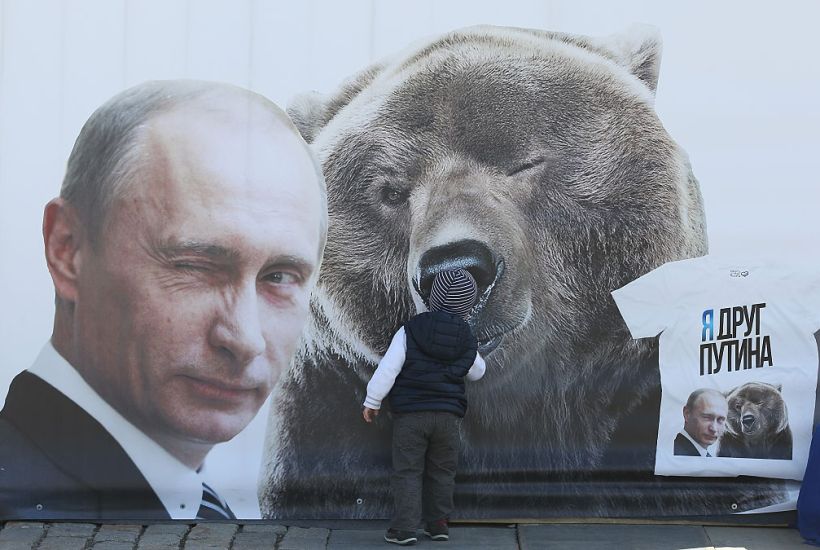
One can see the rhetorical appeal. The claim that leaving the ECHR would place the UK alongside Belarus and Russia is an emotionally loaded charge. No sane person in public life would welcome comparison with Putin’s Russia or Lukashenko’s Belarus. But as Conor Casey, Sir Stephen Laws KC and I argue in a new Policy Exchange paper, the claim is groundless and the comparison is absurd. Anyone who compares the UK outside the ECHR to Belarus or Russia should be firmly challenged to explain the nature of the comparison – and to explain why anyone else should take them seriously in future.
Lord Hermer repeated his warning about ‘splendid isolation’ in an interview published by the Guardian earlier this month, asserting that leaving the ECHR would make it impossible to cooperate with other states in tackling the problem of illegal immigration. In a foreword to Policy Exchange’s new paper, Alexander Downer, former foreign minister of Australia, is suitably withering, saying: ‘This is parochial nonsense. Europe is not the world, membership of the ECHR is not a condition of civilised status, and the UK outside the ECHR would not be cast into diplomatic darkness.’
Sir Ed Davey, leader of the Liberal Democrats, has deployed the comparison with Belarus/Russia in especially strong terms. Speaking in parliament in September last year, he asserted that his political opponents ‘want to join Russia and Vladimir Putin by withdrawing from the convention’. He doubled down in a debate in October, saying that ‘Russia under Vladimir Putin is the only country to have withdrawn from the European Convention on Human Rights’, speculating that admiration for Putin may be why Nigel Farage supports ECHR withdrawal, and noting that Russia is a state in which opponents of the regime are murdered and lawyers jailed.
What Sir Ed seems to have failed to realise is that Russia did not withdraw from the ECHR. It was expelled from the Council of Europe in the wake of its invasion of another member state, Ukraine. Having ceased to be a member of the Council of Europe it automatically ceased to be a party to the ECHR. Russia did not exercise its right under Article 58(1) to withdraw from the jurisdiction of the European Court of Human Rights. As for Belarus, its application to join the Council of Europe was rejected and thus it has never been, or been eligible to be, an ECHR member state.
If Russia had not invaded Ukraine, it almost certainly would not have been expelled from the Council of Europe and would remain an ECHR member state today, despite its long-standing and widespread abuse of human rights. We were ‘in a club’ with Russia up until its expulsion from 2022 and we remain in a club with Azerbaijan and Turkey, two other states which routinely violate human rights and have violated the sovereignty of other member states. One might say that this is shameful company to keep or you might reason that joint ECHR membership provides some modest levers with which to address their wrongdoing and to encourage better behaviour. The point is a finely balanced one and repays further attention, which it will receive in a future Policy Exchange paper.
What is absurd is to argue is that if the UK freely chose to leave the ECHR it would thereby place itself ‘in company’ with Belarus and Russia or, worse, somehow form ‘a club’ with them. If or when the UK chooses to leave the ECHR it will almost certainly be because of reasoned dissatisfaction with the Strasbourg Court’s abuse of its jurisdiction and to restore parliamentary democracy and vindicate the rule of law. This would be utterly unlike Belarus and Russia. Indeed, the UK might well leave the ECHR and remain a member of the Council of Europe. In the alternative, the UK would certainly be awarded observer status, participating in the Council’s activities with Canada, the Holy See, Japan, Mexico and the United States. Again, nothing like Belarus or Russia.
There is one country that has voluntarily left the Council of Europe and the ECHR, which is Greece under the Colonels in 1969. The Greek military dictatorship left the Council before it was expelled, in the wake of a finding that it had been engaged in mass human rights violations. If the UK chooses to leave the ECHR in the future, it will not be doing so to escape accountability but as a reasonable response to the unprincipled expansion of European human rights law over the decades and the consequent damage to parliamentary democracy and the rule of law.
The UK would be leaving the ECHR, moreover, in a context where 27 member states have expressed serious concerns about the Strasbourg Court’s immigration and asylum case law and are attempting to reform the ECHR system. If those reform attempts fail and the UK or any other member state decides to leave the Convention to restore effective border control, how is this remotely comparable to being expelled for human rights abuses or leaving before one is expelled?
Outside the ECHR, the UK would not be ‘keeping company’ with Belarus or Russia. It would not be ‘aligned’ with either state. On the contrary the UK would remain committed to European security and robustly opposed to Russian aggression. The obvious comparison to be drawn is not with two post-Communist dictatorships which lack free and fair elections or independent courts. Instead, the relevant comparison is with Australia, Canada and New Zealand, three countries that are closely related to Britain in terms of culture and history – and in which human rights are robustly protected without being subjected to the Strasbourg Court.