When something is partly good and partly bad, we used to say it was ‘a curate’s egg’. Odd expression. Why would we say that? It comes from an early-20th century cartoon in Punch in which a curate is having breakfast with his bishop, who asks, ‘How is your egg?’ The curate is stuck with an egg that has gone off, but doesn’t want to offend his bishop, so he replies, ‘It’s good in parts, my lord.’ Of course, a rotten egg is rotten all the way through – that’s the (very modest) joke of the cartoon. So, the phrase ‘the curate’s egg’ really should be used to mean ‘bad all the way through’ (not ‘alright in bits’).
There are times when we want to shout at the government – ‘Just get on with. Grit your teeth, take the political pain it causes, and just do what needs to be done. Bite the bullet!’ But how does sinking your dentures into ammunition come into this? It started with battlefield surgery before the invention of anaesthetics. In those dark days, the one skill a surgeon needed was to be very fast – for instance, to amputate a damaged leg before the patient died from shock. Unanaesthetised patients were given spirits to drink and told to bite on something hard – such as a bullet. Hence, ‘bite the bullet’ is a call to be stoical, to put up with the pain and get it over and done with.
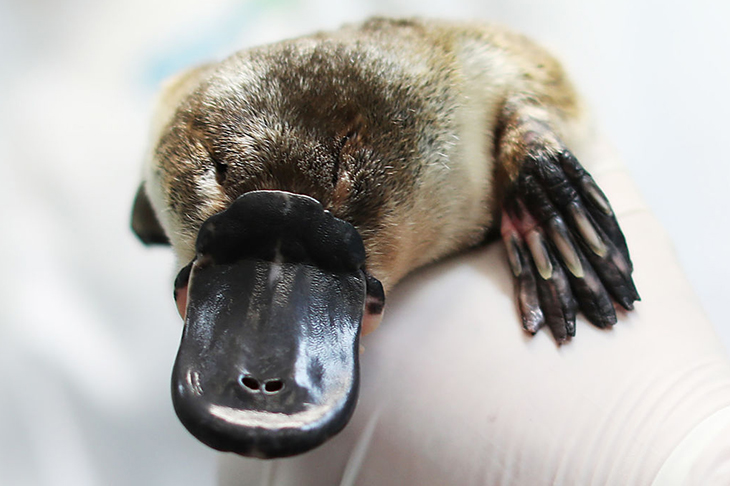
What are the correct plurals of ‘octopus’ and ‘platypus’? The answer is not obvious – and I think a lot of people get this wrong, so let me try to untangle it. Let’s start with the origins of the words. ‘Octopus’ is recorded in English from 1759. When the word was put together to name the eight-armed sea creature, it was in something called ‘scientific Latin’. But this is complicated by the fact that, behind the scientific Latin, lies a linguistic component from ancient Greek. The ‘octo-’ part (meaning ‘eight’), the Oxford explains, is ‘Of multiple origins. Partly a borrowing from Latin. Partly a borrowing from Greek.’ So, you see, it’s not simple. If we treat ‘octopus’ as a Latin word, the plural would be ‘octopi’– and this has been a common plural form over the years. (I’m sure this is the one I heard when I was a schoolboy). But the correctness of this has been challenged. The claim is that the most ancient (and therefore the original) source of ‘octo-’ is in Greek, so ‘octopus’ should be turned into a plural using Greek grammar, not Latin. This would make the plural ‘octopodes’. Which, if we are being punctilious, would have to be pronounced as three syllables, not two. The Greek pronunciation would be oct-oh-POD-ees (with the ‘o’ in POD as a long ‘o’ sound). And although some pedants will insist on this, it is clearly not comfortable in English (and it’s not even clear that it’s a plural!). So, what should we do? One possibility is to pluralise ‘octopus’ in the way that English normally pluralises words – by adding an ‘s’. That would make it ‘octopuses’ – and there are some who insist this is correct. But, again, having such a sibilant, hissing end is not comfortable in English. I have a better suggestion. Yes, treat it as an English word (and stop trying to treat it like Latin or Greek – English rules should apply). But to make it euphonious and comfortable, we should treat ‘octopus’ in the same way we treat ‘sheep’ – that is, that the singular and plural are identical. We talk about one sheep or three sheep, and the word doesn’t change. (Jeremy Clarkson plays on this by saying ‘three sheeps’ as a joke.) The same thing, I propose, will work for ‘octopus’ – if you say, ‘I saw three octopus at the aquarium’, I think you are grammatically correct, and it sounds just fine. ‘Platypus’ is a similar story. It came into English (from Greek via Latin) in 1799. The mistaken (Latinised) plural is ‘platypi’ (don’t use that, it just displays your ignorance). If you want a grammatically correct Greek plural, you could say ‘platypodids’– which would sound odd and be unhelpful. Instead, apply my sensible rule and make the plural and singular identical: you can see one platypus or three platypus, and the word doesn’t change. Or is this just too sensible for the pedants to agree to?
Got something to add? Join the discussion and comment below.
Contact Kel at ozwords.com.au
You might disagree with half of it, but you’ll enjoy reading all of it. Try your first month for free, then just $2 a week for the remainder of your first year.