Bernie Sanders has been rolling out political hot takes for more than half a century, and in recent years his familiar socialist prescriptions have found a new focus: artificial intelligence. In 2023 he argued that workers who use it should be entitled to a four-day week. In October of last year he called on corporations who employ AI to be hit with a “robot tax”. And, just last month, he made his punchiest proposal yet: a complete moratorium on all AI data centers.
In a characteristically plaintive video address, the Vermont Senator argued that halting data center construction would “give democracy a chance to catch up,” preventing the benefits of AI from being monopolized by “the wealthiest people on Earth.” Here, as often, Sanders is tapping into a real and growing sense of unease.
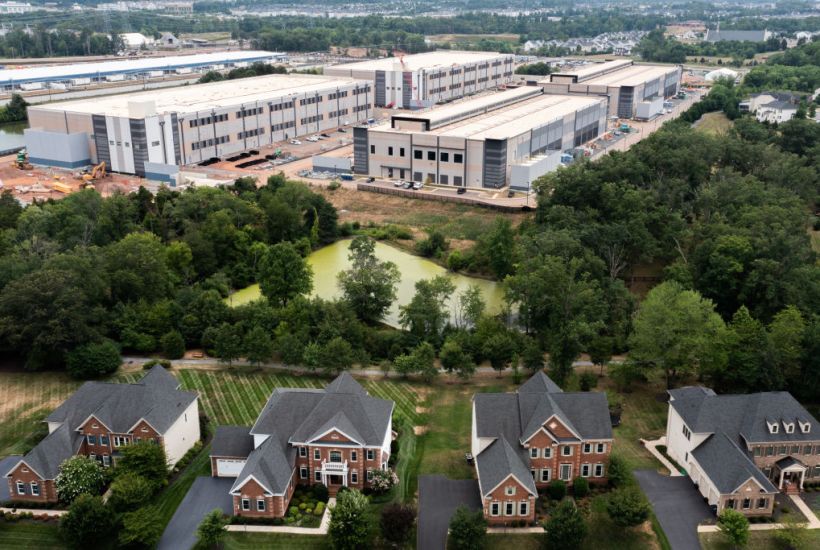
Polling from Pew Research last year found more Americans concerned by AI than excited by it. Job loss dominates these fears: an Ipsos survey finds 71 percent of Americans worry AI will lead to permanent unemployment. And data centers – the vast hangars filled with servers which power AI – introduce another source of anxiety: their insatiable appetite for electricity.
Data centers currently account for more than 4 percent of total US power consumption. By 2030, that figure is expected to surge past 12 percent to over 1,000 terawatt-hours: more power than the entirety of Japan uses. By 2033, OpenAI alone reportedly plans to consume energy on a scale comparable to India.
As well as environmental concerns, this level of power use is already having a real effect on US consumers and grid networks. In areas nearby data centers, wholesale electricity prices have risen by as much as 267 percent over the past five years. Grid strain has caused an uptick in small-scale blackouts, with far worse predicted as demand accelerates.
Yet despite these troubling figures, Sanders’s call for a blanket moratorium is deeply unrealistic. AI development is unlikely to be halted by legislative fiat, particularly when geopolitical competition with China looms in the background.
This is a technology which, since its inception, has been touted to one day cure cancer, solve cold fusion, and even turn mankind into a multi-planetary species (no matter that these claims often come from individuals running the biggest firms in the space).
President Trump, for his part, has embraced the AI hype with characteristic aplomb. “America is the country that started the AI race… and America is going to win it,” he declared in July.
There are, needless to say, economic factors also at play in Trump’s approbation. By all accounts, AI is the only thing propping up the US economy. Since 2022, 75 percent of gains in the S&P 500 have come from AI-related stocks. Without investment in data centers and computing capacity, the economy would barely have grown in the first half of 2025.
Unsurprisingly then, Trump has aligned himself closely with Silicon Valley, many of whom view regulation as an existential threat. An early draft of his “One Big Beautiful Bill” included a provision that would have blocked states from regulating AI for a decade; a proposal so sweeping it was defeated 99-1 in the Senate. Undeterred, Trump has since signed an executive order instructing federal agencies to identify and undermine state-level AI regulations with threats of withheld federal funding.
Politically, these moves to grant AI giants untrammeled license are not without risk. With so many Americans worried about job losses, the issue is increasingly salient at the ballot box. In battleground Pennsylvania, only 34 percent of voters support new data centers, while 42 percent oppose them. In Virginia, opposition to data centers has already flipped a state legislative seat to the Democrats.
So far though, fears of a jobs apocalypse have not materialized. Yale’s Budget Lab found that in 2024 AI’s impact on employment remains “minimal”, concentrated in a narrow set of tasks and industries. Instead, what has begun to crack is confidence in the AI business model itself – a development which may prove even more consequential for voters.
AI is starting to look very much like a classic bubble market. OpenAI alone has reportedly burned through $140 billion without turning a profit. Doubts are growing over whether “artificial general intelligence” – AI as capable as humans – is even achievable at all. And the industry’s own leaders are tempering their optimism: in August, OpenAI’s Sam Altman questioned whether investors were “overexcited”, while his chairman Bret Taylor, along with Bill Gates, have both compared the current moment to the dot-com bubble.
Ironically though, an AI collapse would make the problems Sanders worries about worse, not better. Vast sums have been sunk into expanding energy generation and grid capacity to support data centers. If AI demand falters, utility companies could be left with “stranded assets”: infrastructure built for customers who don’t end up needing it, and who don’t fulfill their obligations to buy large amounts of energy.
In electricity markets, the costs of stranded assets are typically passed on to consumers through higher rates. In other words, the public may already be underwriting one of the riskiest technological gambles in history.
Lawmakers have started to take note. Texas, which hosts a disproportionate number of data centers due to its cheap energy, is currently considering legislation requiring large power users to demonstrate long-term financial commitment to their projects. The aim is to prevent utility companies, and ultimately consumers, being stuck with the bill if AI firms fail.
This approach of requiring AI firms to guarantee payment for their infrastructure offers a template for other states. At the federal level, Senator Elizabeth Warren and colleagues are investigating whether energy buildout costs are being unfairly shifted onto households, and have pledged to hold the sector to greater levels of transparency and accountability.
Such targeted measures offer a more sensible framework than Sanders’s proposed moratorium. Because ultimately, progress in AI cannot be stopped even if politicians want it to: it is already embedded in the economy. Attempting to halt development would simply drive it overseas, leaving American consumers exposed to the same costs – or worse – without any of the benefits.
The signs of a bubble, however, are difficult to ignore. When it bursts, or even deflates, whatever firms are left standing will cash in. The losers will lick their wounds and move onto the next bet. And it will be ordinary consumers and taxpayers who are left to clean up the mess.
Should this nascent technology not live up to its hype, the tools to contain the fallout already exist. What remains uncertain is whether legislators will use them, and whether they will act in time.