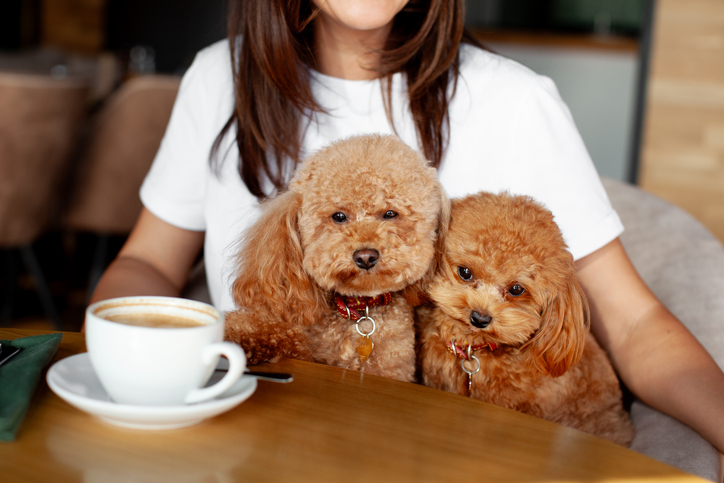
‘Puppiccino or hot dogolate, Bertie? Or will you try our special Christmas blend?’ The barista leaned across the counter, eyes fixed not on the man holding the lead but on the immaculately groomed corgi at his feet. For a moment, I wondered if this was a case of exceptionally poor diction and misplaced attention. Surely Bertie was the human member of the pair – the one capable of vocalising a preference? But no. Bertie’s tail wagged decisively. His companion – in another era known as the owner – translated boldly: ‘Bertie would like the Christmas blend, please.’
British coffee shops have long catered to a diverse clientele: caffeine addicts, closet sugar junkies (‘frappuccino with extra syrup and cream – no espresso’), ethical purists (‘five pounds for a cup of tea? Oh – organic leaves and sustainably sourced?! I’ll take a whole pot!’), and aficionados of alternative milks. Extending hospitality to dogs may have been the logical next step, but while it once felt like a novelty, it is now inescapable. Bertie is not unusual. He is a member of one of Britain’s fastest-growing demographic groups: canes in loco filiorum – dogs as substitutes for children.
In Britain’s case, dogs commandeer attention once devoted to raising the next generation
The numbers are striking. The UK now has over 11 million dogs, up three million in 15 years, with nearly a third of adults owning one, according to the 2025 PDSA PAW Report. Fertility rates, by contrast, have sunk to historic lows: around 1.4 children per woman in England and Wales, 1.25 in Scotland – well below population replacement level. Put plainly: fewer babies, more cockapoos. Some estimates suggest that roughly 7.5 million children under the age of ten live in the UK – over three million fewer than the country’s dogs. A stroll past the children’s play area in my local park makes the shift instantly visible. The swings are still. The dogs are not. Toddlers are routinely outnumbered three to one.
Amid this canine ascendance, Britain has built an evaluative culture around their inclusion. The annual DogFriendly Awards ranks pubs, cafes, attractions, and even entire towns by how welcoming they are to dogs. Cockermouth claimed the 2025 title, displacing last year’s winner, Bury St Edmunds. One wonders whether the town’s name gave this year’s champion a leg up. Dog festivals proliferate: Woofstock, DogFest, Dogstival – celebrations of canine culture complete with music, family entertainment and, in the words of one host, a ‘bustling marketplace featuring artisan food, crafts, and unique shopping stalls’. These festivals are not Crufts, where skills, intelligence, beauty or utility are judged. What is celebrated here is the dog’s full admission to the family table.
This reflects a population increasingly confused about how to order its loves and affections. Britain has long been fond of dogs (Queen Victoria owned no fewer than 88 collies!) and there is nothing wrong with this. They can be both delightful and useful. But the 21st century twist is that they have been hauled from the kennels into the kitchen by owners who style themselves as ‘mummy’ or ‘daddy’ to their furry pup. Dogs now have birthdays, personalised diets, and workplace wellbeing schemes built around their emotional support credentials. A friend was once instructed by a ‘dog behaviourist’ to feed her client – yes, the dog – chicken curry and rice. And, as Bertie demonstrates, dogs are now invited to exercise consumer choice. We are no longer merely fond of dogs; we have reorganised life around them.
C. S. Lewis warned that civilisation falters when secondary goods are promoted beyond their proper place – when what should decorate life is mistaken for what should direct it. When ‘second things’ are put first, he argued, we lose both the higher purposes of life and the lesser pleasures. ‘The woman who makes a dog the centre of her life’, he wrote with uncanny foresight, ‘loses, in the end, not only her human usefulness and dignity but even the proper pleasure of dog keeping’. His solution was simple: put first things first, and second things will follow.
Modern canine culture shows just how easily this inversion occurs. Dogs increasingly function as substitutes not only for children, but for life’s meaning and purpose – the very ‘first things’ that Lewis insisted must not be displaced. In Christian terms, those first things are not vague ideals but a clear ordering of life: ‘Seek ye first the kingdom of God, and his righteousness; and all these things shall be added unto you’ (Matthew 6:33). God before goods, purpose before comfort.
When that order weakens and first things recede, a vacuum opens, into which the second things advance. Passion and attention do not disappear; they are redirected. In Britain’s case, dogs commandeer attention once devoted to raising the next generation, sustaining communities, and orientating life beyond the self – towards God, moral formation, enduring responsibility, and the cultivation of the soul.
It is fitting that it should be a parish in Lewis’ spiritual home – the Church of England – that offered so precise an illustration of the age this Christmas. St John the Baptist Church in Holland Park marked the Nativity with dog-friendly carol services, in which five priests blessed hundreds of dogs and presented their owners with a certificate. A service celebrating the birth of a child – not merely any child, but the one Christians proclaim as God incarnate – was thus proclaimed to pews full of pets. Well-meaning, warmly received, heavily-attended; a quiet surrendering to the idea that the modern path to transcendence may run not through repentance or reverence, but through paws and wagging tails.
The stable at Bethlehem did indeed house animals, but their presence framed the scene; they played no part in it. It was the shepherds who came to worship the child Jesus – not their sheep. Yes, St. Francis preached to the birds and spoke tenderly to animals; but he did so in a world bursting with children, families and vocations, and from a life ordered uncompromisingly around God. We, by contrast, usher our dogs onto centre stage in a country where those first things have thinned out. The difference is not affection but order.
Other churches will doubtless follow suit. Just like the coffee shops and much of the public square, they will be keen to remain welcoming, relevant and inclusive. Perhaps, in time, Bertie will be offered not only a Christmas blend but also a liturgical role. Asked whether he renounces Satan and all his works, he will respond as he always does: with a hopeful wag, a wary growl, or indifferent silence. And somewhere between that silence and the stillness of the swings in the park, we may pause to reflect; and in that pause, decide to restore our attention to the enduring responsibilities that give life its meaning, especially those expressed through raising the next generation. Someone, after all, will need to interpret for Bertie’s offspring.