Last year, the 50th anniversary of the dismissal of the Whitlam government in November 1975 led to an avalanche of words on the dismissal itself and the performance of the Whitlam government.
Arguably, the dismissal was the best thing that happened to Whitlam. It allowed him to play the martyr – and let’s face it, performance was always his forte – and to effectively conceal the fundamental weaknesses of his terms in government.
The Whitlam years were ill-disciplined – nay, chaotic. Wild plans to improve the lot of citizens were badly implemented, and any attempt at fiscal prudence quickly set aside. Government spending went from 18.5 per cent of GDP when Whitlam was first elected to 24.3 per cent when Sir John Kerr pulled the pin.
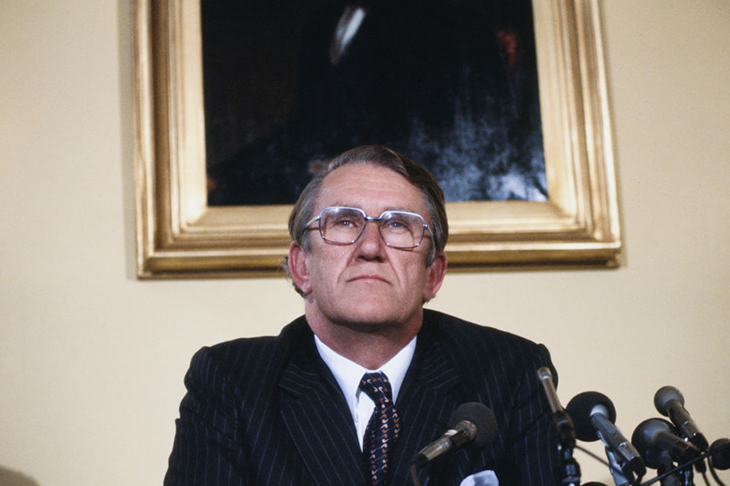
By contrast, very little was written about Malcolm Fraser, who managed to secure a thumping electoral victory over Whitlam in December 1975. Of course, there was the predictable smearing of Fraser’s character in relation to the blocking of supply in the Senate. But let’s be frank, this was one of his more commendable actions.
Late last year, a two-day symposium on the Fraser years was held at Trinity College, Melbourne. The conference focused on the question: Was Fraser a true liberal? Of course, this begged the definition of ‘liberal’.
Over the years, many lefties have reassessed Fraser because of his post-political attachment to progressive shibboleths, particularly on migrants and refugees. Essentially, he became one of them, rather than one of those nasty, heartless right-wingers who find a home in the Liberal party, or so the argument goes.
To tell you the truth, I have no time for Big Mal, not least because of his indulgent transformation later in his life. He was a dreadful economic manager, an agrarian socialist who didn’t believe in free markets and hated the banks. He was an advocate of industry protection and government regulation. He may have settled down the process of government and initiated a degree of fiscal consolidation, but he refused to acknowledge that the times were a-changin’.
After the two oil shocks of the 1970s, inflation soared in most advanced economies, and unemployment rose to levels unimaginable only a few years earlier. Fixed exchange rates quickly came unstuck.
The popularity of free-market economics grew as it became apparent that interventionist, expensive government spending programs dramatically failed to meet their objectives, including achieving macroeconomic stability.
Economics professor Milton Friedman was the man of the hour, even though he had been promulgating the free market/anti-Keynesian message since the early-1960s. He won the Nobel Prize in Economics in 1976.
It was at this time that Maurice Newman, a regular Spectator contributor, privately funded two separate trips by Friedman and his wife, Rose, to meet key Australian politicians to discuss the new economic paradigm. It must be said that one visit was a spectacular success, the other a dismal failure.
The first meeting was with Bill Hayden, who was the last treasurer in the Whitlam government and became shadow treasurer in opposition after Whitlam’s defeat. He listened carefully and respectfully.
Aware of the calamity that the Whitlam/Cairns economic approach had visited on the country, Hayden became a devotee of the new way of thinking. This influence persisted well into the 1980s when Bob Hawke became the next Labor prime minister, with newbie Paul Keating as treasurer.
The contrast with the other meeting was stark. Prime Minister Malcolm Fraser attended, along with Treasurer Phil Lynch (an arch protectionist), junior minister John Howard, and various staffers. Fraser was rude to Friedman and his wife from the start, cutting Milton off before he could finish his presentation. Floating exchange rates and reduced industry protection were anathema to Fraser.
The irony was that the economy was not going well. Other countries were floating their currencies, but Fraser had a commitment to farmers to keep the value of the dollar as low as possible. In the event of floating our dollar, currency manipulation would be largely impossible, and the government’s control over monetary policy weakened.
Fraser also had a complete blind spot when it came to industrial relations. He was an old-fashioned ‘clubber’ – a believer in the central role of trade unions and employer associations as well as compulsory arbitration. He thought he could control outcomes from the top down.
Inflation remained too high, and wage inflation contributed to this outcome. But the still industrially powerful trade unions never trusted Fraser and refused to play by the rules he sought to impose. At one stage, Fraser imposed a wage freeze, with wages accelerating when the pause was lifted. There was also plenty of strike action during his terms in government.
Notwithstanding his reputation for budgetary austerity, it was slow going repairing the budget after the profligate Whitlam years. In no year did real spending decline during the Fraser years. When he first took office, government payments as a percentage of GDP were 24.3 per cent. When he lost office, the figure was 23.4 per cent. Budget deficits were routine.
Paul Kelly, writing in the Australian, commented as follows on those years. ‘Fraser, as prime minister, was repudiated over time. Australia was not destined to return to the old order, a point Fraser only half grasped. [He] was the last prime minister to govern a socially conservative Australia and the last prime minister of the regulated, protectionist economy before the age of globalisation, free trade and deregulation.’
My assessment is that Fraser’s terms in government were largely wasted, unnecessarily delaying the inevitable transformation of the economy. But those on the left of the political spectrum don’t care about economics and are entranced by Fraser’s attitude to immigration and multiculturalism.
Let’s not forget it was Fraser who allowed in Muslims from war-torn Lebanon against specific departmental advice. It was Fraser who took up multiculturalism at the behest of his staffer, Petro Georgiou, later the Liberal member for Kooyong.
The long-run damage of these decisions should not be underestimated. Once migrants are admitted, they are essentially entitled to stay. And the pervasiveness of multiculturalism, both in terms of government policy as well as dominating attitudes within key institutions, has led to an obvious decline in the extent of shared values and social cohesion. Fraser might have been a disappointment when it comes to economics, but he was a disaster in other areas.
Got something to add? Join the discussion and comment below.
You might disagree with half of it, but you’ll enjoy reading all of it. Try your first month for free, then just $2 a week for the remainder of your first year.