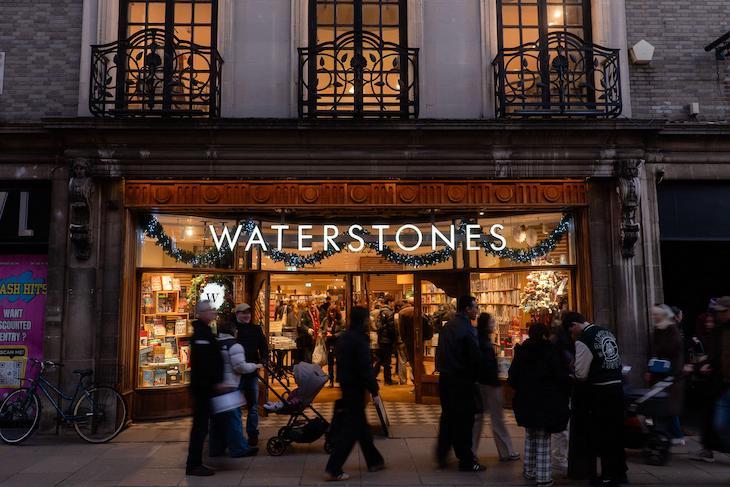
Every Christmas, I throw off my doctoral gown, slap the monographs, the Collected Works and the many-volume Letters back onto their library shelves and uncloister my bibliomania for a seasonal stint at the local bookshop. What pulls people like me into bookselling – even if only for a month during the holiday seasons – is not the famously slim pay, but the chance to put their love of books in the service of others. The pleasure of selling a book whose power has been felt in one’s own life – the delight, in other words, of making a present of something good and consequential – more than makes up for the low wage.
Too many bookshop visitors never venture past the elegant pyramids of new and perennial titles erected on the tables up front
In this respect, Christmas should be a golden time for booksellers: customers shopping for books to gift their dear ones often tread in the dark as to what might suit a fidgety pre-teen niece or an easily shocked godparent. Booksellers are there to lend a guiding hand amid the wilderness of choice. The rub is they must compete, not just with the likes of BookTok and Dua Lipa – each fishing from the same lustreless, shallow, narrow pool, reflective of popular appetites and without a drop of daring in it – but also, less notably, with front-of-shop displays.
Too many customers never venture past the elegant pyramids of new and perennial titles erected on the tables up front to browse the bookcases and let themselves be coaxed by an audacious title, or a fresh first paragraph into sampling off-the-radar books at leisure. Even fewer turn to booksellers to steer them along.
But if deferring to front-of-shop displays does away with the awkward elements of human interaction – the discomfort of declining a recommendation, say, or of being stuck with chatty staff when short on time – it also does away with the potential for serendipity. Promoted books (often formulaic and risk-averse) sell because they’re visible, their sales justify more promotion, and other potentially greater books fall through the cracks.
Many customers of Cambridge’s historic Heffers are disappointed to learn it now belongs to Waterstones, which under several names (including Foyles, Hatchards and Blackwell’s) today owns a huge number of bookshops in the UK and Ireland. But the showcase of largely identical titles in Heffers and Cambridge’s Waterstones, located a stone’s throw from each other, gives it away.
When Daunt Books’ founder James Daunt became managing director of Waterstones in 2011, he vowed to return responsibility for stock selection to local booksellers, banning the practice of charging publishers for prominent placement. Despite Daunt’s magnanimous claim, the reality has not been good for booksellers. If senior booksellers once presided over individual sections in keeping with their subject expertise, they have been effectively demoted to the lower order of generic retailers. Booksellers specialise in everything and nothing, and are mainly tasked with processing payments and replenishing shelves. A bookseller’s work could equally be done at Tesco. As Arthur Kay points out in this week’s Spectator, ‘experienced staff (have been) quietly priced out as overheads are trimmed’.
The autonomy of local booksellers is largely limited: core stock and minimum stock levels are decided by Waterstones’ Piccadilly head office, which is also tasked with orchestrating nationwide promotions. Even if Waterstones’ recommendation strategy doesn’t use data in the way an algorithm would, it appears to be structured like one all the same – with feedback loops between visibility and sales.
The truth is that too many of Britain’s bookshops showcase a bewildering abundance of choice while funnelling shoppers towards a narrow set of commercially optimal outcomes. The aesthetic experience of bookshops remains, but their intellectual function (discovery, the encounter with the unexpected and the unquantifiable) is lost. The overall effect is that bookshop fronts are the same from Ipswich to Inverness, liable to produce a same-ification of culture on a national scale.
For Waterstones to employ corporate machinations designed to maximise profit in a survival race against tech giants like Amazon is no scandal. But if bookshops do end up relying on algorithmic curation to keep going, we’re free to resist this commercial imperative dictating our reading lives.
A bookseller’s work could equally be done at Tesco
Unlike engineered displays, booksellers have the ability to discern the subtleties and fine distinctions within a range of deep appreciation, something known as taste. Sales-driven influencing invites shoppers to treat books as goods to be acquired, consumed and quickly replaced – a tasteful human intelligence, on the other hand, influences shoppers to engage with a book for what it is: irreplaceable and irreplicable, one soul reaching to another.
Booksellers are only justified in their role – only worth the investment – if bookshop-goers value their expertise. Only when shoppers recognise this value does Waterstones have any incentive to follow suit.
So, here’s a new year’s resolution: next time you visit a bookshop, walk past the front tables, venture into the various sections and – most radically – ask a bookseller for help.