Less than two months after its imposition, the world’s first children’s social media ban is already exceeding targets, with a post-Christmas online survey showing that six out of seven Australian schoolgirls no longer care what they look like and that nine out of ten Australian schoolboys have turned to terrestrial mail to bully classmates. Initial doubts about the reliability of the survey results were allayed when it was pointed out that respondents’ answers took the form of pinkie promises. Meanwhile, churches and schools have noticed a surge in applications for choirmaster and netball coaching positions from convicted paedophiles, and parents have reported a 65 per cent increase in the participation of children in mealtime conversations. Encouraged by these results, other lobby groups are now pressuring state and federal governments to green-light programs previously considered prohibitively counterintuitive. These include offering tours of lung cancer wards to bikie gang members suspected of distributing illegal tobacco and vaping products, and the floating of signs saying NO SHARKS BEYOND THIS POINT a hundred metres off our most popular beaches.
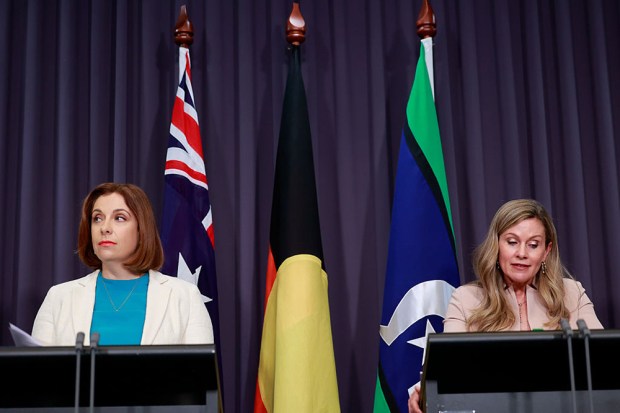
The social media ban is not the only instance of the Albanese government framing what some might characterise as Pollyanna policy, but I am sure that most Speccie readers share my hope that dusting off John Howard’s 1996 gun amnesty will make the more fanatical elements within Australia’s Islamic communities rethink their position on Jews (and Christians, Hindus, homosexuals, atheists, dogs, etc). Or at least revert to the less industrially effective but more scripturally endorsed use of knives and swords – which is, after all, still the preferred MO of their better-funded and organised European counterparts. Meanwhile, we must heed the requests of our Prime Minister, Foreign Minister and Immigration Minister not to rush to judgment or look for scapegoats. Specifically, not to let the terrible events of December 14 distract us from what, apart from Net Zero, a Labor government has made Australia’s single biggest national project: to lead the Western World in its, ahem, crusade towards the sunlit uplands of multiculturalism – clouds and cuckoos notwithstanding. Those who sought to weaponise the absence of tears from Ms Wong’s public response to the tragedy would do well to remember that both Winston Churchill’s lips remained impressively stiff when he made the speech that rallied the spirit of Britain against the scourge of Nazism. It would not surprise this columnist to learn that Ms Wong suffers from a variation of the same exocrine gland dysfunction that prevents the man we must all get used to calling Andrew Mountbatten from perspiring.
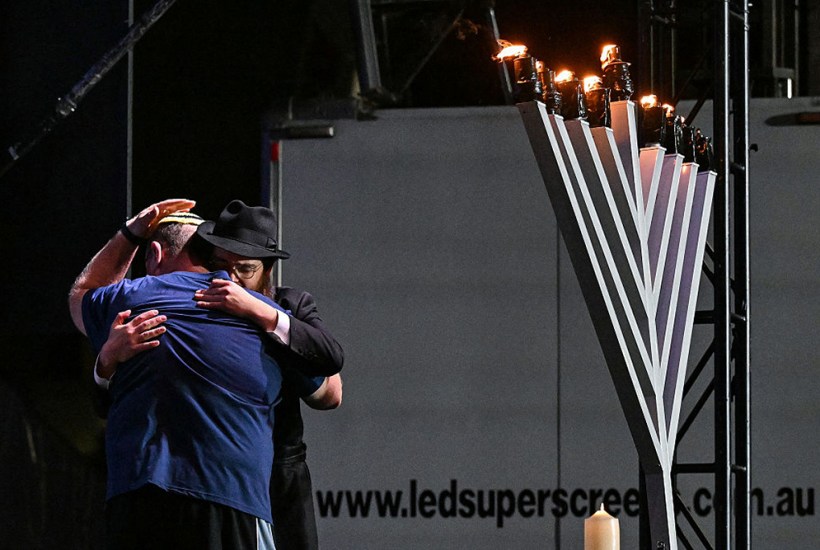
I learnt about the Bondi massacre in a transit lounge in Hong Kong, waiting for a connecting flight to London. The TV in the lounge had the sound turned off, and I might not have looked twice at the screen if it had not filled, momentarily, with the face of a friend. It wasn’t until I had accessed the complimentary wi-fi that I learnt that Rabbi Dovid Slavin, the founder of Bondi charity Our Big Kitchen – whose advertising I create – was being interviewed as a survivor, not a victim. Like the less fortunate Rabbis Eli Schlanger and Yaakov Levitan, Rabbi Dovid is a leader of Bondi’s orthodox community, and when it comes to the distribution of the hundreds of meals his teams of volunteers prepare every day, he applies a policy which is nothing less than discriminatory: only poor and homeless people get to eat them.
Not surprisingly, the shockwave from Bondi reached England before I did. The friends waiting for me in the arrivals hall weren’t smiling, and for the next two weeks, every conversation I had – even with people I hadn’t seen for years – began not with a joke about the Ashes or the thinning of my hair, but with an enquiry about whether anyone I knew had been directly affected by the shootings. At first, I said no, that while I have made many Jewish friends in Sydney, none of them, as far as I knew, had lost a friend or family member. But the more I read about and watched what had happened in the city, which has been my home for most of my adult life, the more visceral the connection I felt with the bereaved, and the more I wished I were there.
Got something to add? Join the discussion and comment below.
You might disagree with half of it, but you’ll enjoy reading all of it. Try your first month for free, then just $2 a week for the remainder of your first year.