
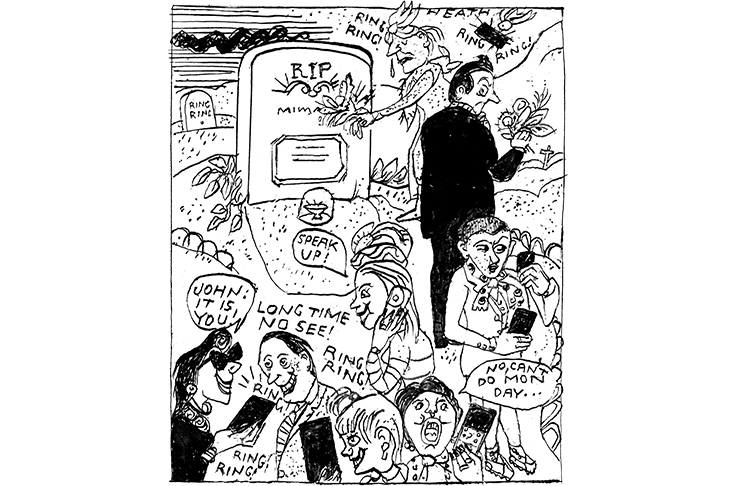
Two years ago my quality of life began to go downhill. It happened when BT Openreach gave our old copper landline a compulsory upgrade to ‘Digital Voice’, meaning all calls would be made over wifi. A succession of visiting engineers failed to resolve the crackling and the cutting out on the new digital line or the uninstructed diversion of incoming calls to voicemail.
Worse, the new digital service wouldn’t extend to the bedroom: ‘It’s an old cottage, you see, with thick walls.’ Never mind that for decades I had spent many happy hours per day lying in bed (like Mrs Stitch, my role model) organising jobs and romantic partners for friends, jigsawing together the data – unearthed by longform chatting over the copper landline – to make the matches. All this with then-unappreciated audible clarity.
Landlines of the sort which could be relied upon during national crises of the past will cease to exist
Finally, without instruction or consent, BT simply removed our landline service altogether. The substitute – iPhone conversations – just don’t cut the mustard. You have to wear earphones or the head gets hot, and the interruptions are constant as the line keeps dropping, and there are blizzards of alerts coming in while you chat.
So, without a copper landline, my QoL has gone downhill. Not only can I no longer matchmake but I also can’t resolve things so easily. I like being able to think things through by talking them through. Truths emerge from extended conversations, especially when, as in the psychiatrist’s chair, there is no eye contact.
By the start of next year the telecommunications industry will have switched every single British landline from the copper-based analogue system to the unsatisfactory digital. The old system wasn’t broke, so why did we have to fix it? The industry consensus is that the copper landline system is costly and energy-inefficient and suppliers are no longer manufacturing spare parts. Current repairs rely on recycling parts from already decommissioned sections of the network. The new digital system will supposedly allow for cheaper, better-quality calls and, with the help of AI, better protection for the customer against scammers. All this with no change to one’s number or handset and at no extra cost.
In switching, Britain is following the lead of Germany, Switzerland and the Netherlands, who are all near the end of the migration process. One is reminded of Hutber’s Law – ‘improvement means deterioration’.
How could our own leaders also be so shortsighted as to put all our eggs in the one basket? Don’t they remember Storm Arwen in 2021, which knocked out power in the north-east for 12 days? Mobiles could not be charged and therefore only those with landlines had any idea of what was going on in the outside world. Now, landlines of the sort which could be relied upon during national crises of the past will cease to exist.
Why not retain even a skeleton service of this robust system of communications in anticipation of, for example, Vladimir Putin or Xi Jinping turning off our wifi in the same way Donald Trump turned off the electricity in Caracas when he went for Maduro? In a digital blackout, where would we turn for info? Carrier pigeons? Only some of us have had the sense to retain our analogue radios.
BT officials admit that Digital Voice (the replacement for the vast majority of customers) will not work in a power cut and that BT ‘relies on the energy companies to maintain power service’. However, in the event of a power cut, BT offers two (inadequate) solutions – a battery back-up unit, which only lasts for a few hours, and a hybrid phone, ‘only available to those in receipt of a good mobile coverage’.
Our ability to chat in the aftermath of a storm will be the least of our worries when you consider the rise of ‘seabed warfare’, which makes the prospect of a hostile foreign power switching off our internet far from fanciful. Recent incidents relating to seabed warfare include one on Christmas Day 2024, when four fibre-optic cables connecting Finland to Estonia and Germany were severed in what was almost certainly an act of sabotage carried out by the Russians. In March last year, China unveiled its new deep-sea cable cutter, capable of slicing at 4,000 metres, well beyond the average depth of undersea cables.
As an island, the UK is reliant on subsea infrastructure. Professor Michael Clarke, Sky News’s security and defence analyst, says ‘Britain is replete with pipelines, and telecommunications and electricity cables’, including offshore power from wind farms and the European Grid. In the Digital Voice set-up, each landline has to remain powered and connected to the internet, so if there is disruption to our undersea cables which affects the National Grid or internet activity, the new system will fail.
My point is not that the old system was invulnerable. Rather, it is that our communications infrastructure should incorporate the strengths of both digital and analogue technology.
What could be behind the shortsightedness of BT Openreach spearheading the decommissioning of back-up copper land-lines? Is stupidity at play, or could it be something more sinister? By the 2030s, Open-reach expects to have recovered 200,000 tons of copper, the present market valuation of which lies at £1.5 billion. Who might want this copper? It is unclear, although Ed Miliband may be in need, as his net-zero projects tend to be rather copper-intensive.
More broadly, is there not a national security imperative for our telecoms industry to provide a non-digital communications network? Either by preserving a skeleton of the analogue system or by devising some alternative network system that isn’t so exposed? We wait to hear.
Got something to add? Join the discussion and comment below.
You might disagree with half of it, but you’ll enjoy reading all of it. Try your first month for free, then just $2 a week for the remainder of your first year.