All innovations seem unseemly to fogeys. When bitcoin, the first of the cryptocurrencies, was launched in 2009, we dismissed it as a deplorable and transient phenomenon. Its inventor, who called himself Satoshi Nakamoto, would not reveal his real name. Perhaps he did not exist and whoever hid behind the pseudonym was having a joke at our expense. When Satoshi created the first bitcoin on 9 January 2009, he embedded within its code a headline from a recent Times: ‘Chancellor on brink of second bailout for banks.’
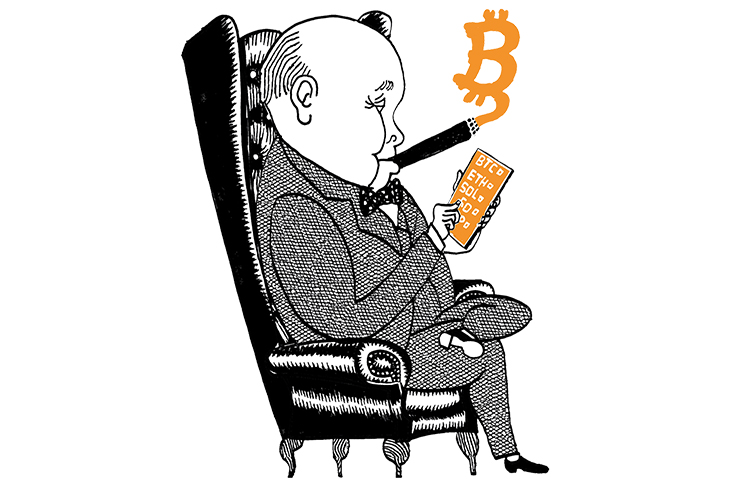
Crypto appeals to people who distrust banks, as well one may. ‘Never trust the bankers,’ Winston Churchill warned in old age. History suggests one can trust neither governments nor central banks to maintain the value of money. Since 1914, the pound has lost more than 99 per cent of its value, the dollar about 97 per cent, the Swiss franc more than 90 per cent. In the past 26 years, the euro has lost around 44 per cent of its value, a point not appreciated by German savers who were forced to swap their marks for it. Well over a million Iranian rials are needed to buy one American dollar. In my wallet I carry, as a sad reminder of how bad things can get, a note issued in 2008 by the Reserve Bank of Zimbabwe declaring: ‘I promise to pay the bearer on demand $5 billion.’
The gap in the market for a currency which maintains its worth became particularly clear after the global banking crisis of 2007-09. Loss of faith in traditional banking, which on examination turned out not to be very traditional, helps account for the vast amount of time, intelligence and energy devoted to crypto.
A student told me he got into crypto in 2021-22 while learning about cryptography as part of his computer science degree. He found the maths interesting, and Nvidia released a new line of graphic cards which were quite profitable: they could be used for mining, the process of validating a chain of crypto transactions. Once he had downloaded the software, his computer could work away at this while he was writing an essay, and he could make £5 or £10 a day. He and his friends were on a fixed-rate tariff for electricity, so bought more graphics cards and did more mining, the concept formed by analogy with gold mining.
Here, it seemed, was a way of attaining financial independence from one’s parents without getting a job. One tended, of course, to hear about the people who prospered, and not about those who lost everything. There was someone in his year who made a retirement level of money, several million pounds, by launching a new currency with an attention-grabbing name. When the price soared, he sold the huge number of coins he had kept for himself and tipped off a few of his friends, each of whom made about £10,000. A few hours later the price crashed, never to recover.
Financial regulators could not keep up with what was plainly fraud. When I asked my student friend if he considers crypto to be a good thing, he replied: ‘No is the short answer, but I think that it could be. The tech is really clever, but the people involved are charlatans, snake-oil salesmen and grifters.’
While this is true, it is not the whole truth. Seventeen years after it was launched, bitcoin still exists and has become by far the most valuable of the cryptocurrencies. It commands confidence in part because it has kept its original promise only ever to create 21 million coins. At the time of writing, a single bitcoin is worth just over £71,000. It has been through violent fluctuations, but has not been wiped out, and is commended by its supporters not only as a store of value, but as a way of carrying out cross-border transactions much more cheaply and quickly than by using the banks.
‘The tech is really clever, but the people involved are charlatans, snake-oil salesmen and grifters’
Bitcoin and some other cryptocurrencies have thrived despite being denounced in the most categorical terms by regulators and central banks as Ponzi schemes liable to collapse at any moment which use inordinate amounts of electricity. The Bank for International Settlements in Basel warned in a report in 2018: ‘Trust can evaporate at any time because of the fragility of the decentralised consensus through which transactions are recorded. A cryptocurrency can simply stop functioning, resulting in a complete loss of value.’
The Financial Conduct Authority warns: ‘If you decide to invest in crypto then you should be prepared to lose all the money you have invested.’ And a British financial adviser said: ‘I am not allowed to advise on crypto as it is an unregulated product, and I have never invested in it personally as I don’t understand what moves its price and I don’t want to invest in things I don’t understand.’ But at the same time, Blackrock, Fidelity and J.P. Morgan are now among firms offering crypto products to their customers.
In the City of London, there are very mixed views about crypto. Some remain deeply sceptical, while others are madly enthusiastic. As a matter of personal temperament, I am inclined to side with the sceptics, but a line from ‘The Hunting of the Snark’ by Lewis Carroll floated into my mind: ‘They threatened its life with a railway-share.’
This refers to the railway mania of the 1840s, in which one could easily lose a fortune. Innovation is risky. We sometimes talk about investment, and indeed life, as if everything ought to be safe. This is neither possible nor desirable. If no one in the City ever took a risk on new technology, the City would be dead. Some crypto is good and some is bad, and the job of the City is to work out which is which.<//>
Got something to add? Join the discussion and comment below.
You might disagree with half of it, but you’ll enjoy reading all of it. Try your first month for free, then just $2 a week for the remainder of your first year.